





What Is an End-to-End Digital Product Partner?
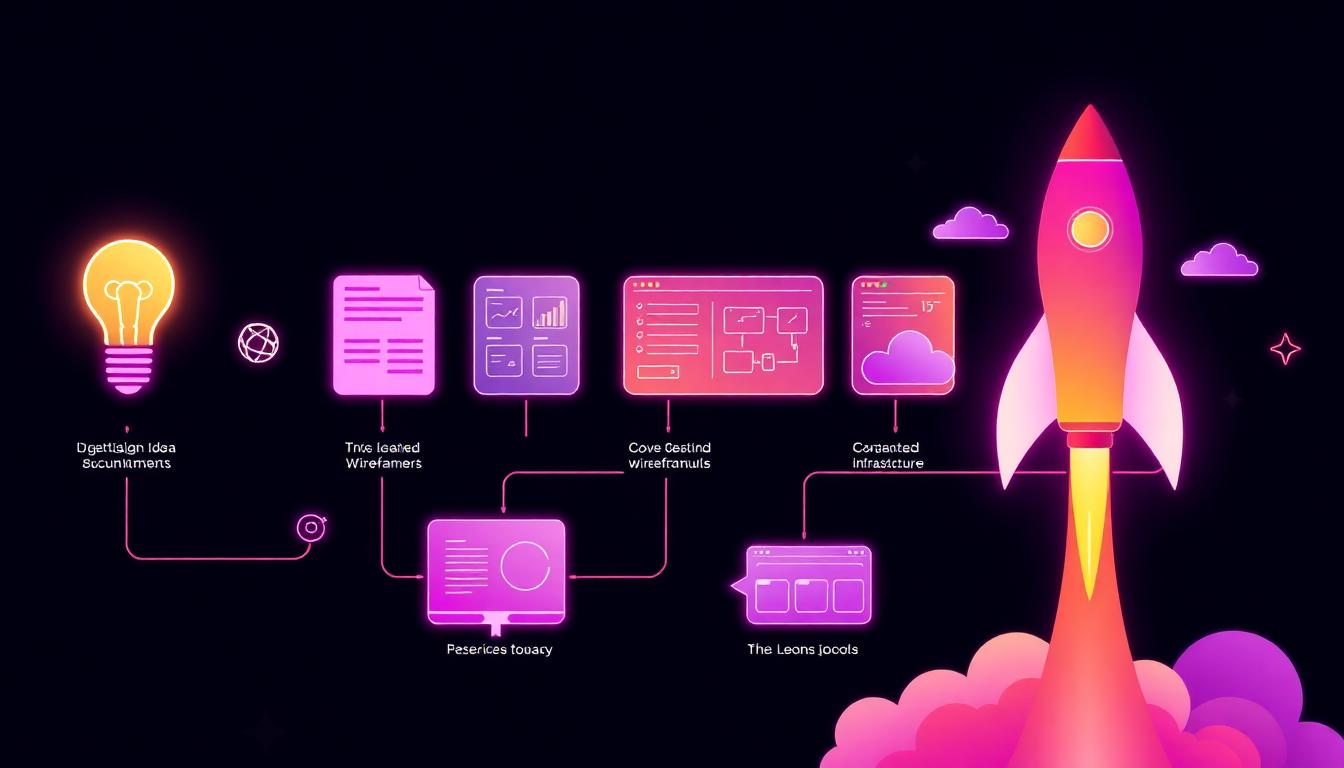
An end-to-end digital product partner is an agency or studio that owns the complete product lifecycle, not just a slice of it. From the moment an idea is conceived through market validation, user experience design, visual design, full-stack engineering, quality assurance, launch, and post-launch iteration, the partner maintains continuity, context, and accountability.
This is fundamentally different from the traditional vendor model where you hire a strategist, then a design agency, then a dev shop, then a QA firm, then a marketing consultant, each handing off to the next with lost context, conflicting assumptions, and integration friction at every seam.
- Strategy & validation: market research, competitive analysis, user interviews, assumption testing, and business model validation before a single line of code is written.
- UX research & design: user journey mapping, information architecture, wireframing, prototyping, usability testing, and interaction design as a continuous loop with engineering.
- Visual design & brand: design systems, component libraries, accessibility compliance, motion design, and brand consistency across all touchpoints.
- Full-stack engineering: iOS, Android, React Native, Next.js, backend services, APIs, databases, third-party integrations, and real-time features.
- DevOps & infrastructure: cloud architecture, CI/CD pipelines, automated testing, observability, security scanning, and compliance documentation.
- Launch & go-to-market: app store submission, ASO, beta programs, press kits, analytics instrumentation, and launch monitoring.
- Post-launch iteration: user behavior analysis, A/B testing, feature prioritization, performance optimization, and continuous deployment based on real metrics.
End-to-End Partner vs. Point-Solution Vendors: The Real Cost
Most organizations default to point vendors because they believe it gives them "best-of-breed" expertise and competitive pricing. The reality is more nuanced, and often more expensive.
| Dimension | Point Vendors (3-5) | End-to-End Partner | Impact |
|---|---|---|---|
| Project management overhead | 15-25% of total budget | 5-8% of total budget | 10-17% savings |
| Context loss at handoffs | High: each vendor re-learns | None: shared team memory | Faster iteration, fewer bugs |
| Design-engineering alignment | Fragmented: separate contracts | Integrated: same team | Coherent UX, no translation loss |
| Timeline coordination | Sequential dependencies, delays cascade | Parallel workstreams, unified schedule | 20-30% faster to launch |
| Accountability | Diffused: blame ping-pong | Single point of accountability | Problems get solved, not discussed |
| Scope flexibility | Change orders multiply across vendors | Unified re-baselining | Scope pivots without contract warfare |
| Post-launch support | Multiple support contracts | Single continuity plan | Faster incident resolution |
| Best for | Large enterprises with strong PMO | Startups, scale-ups, product-led orgs | Alignment with internal capability |
The exception: enterprises with mature product management offices (PMOs), established design systems, and strong technical architecture teams can sometimes achieve better outcomes with point vendors, but only if they have the internal integration capability to manage the seams. Most organizations overestimate this capability.
"The cost of integration between vendors is almost never in the contract. It lives in the meetings, the re-explaining, the version mismatches, and the finger-pointing when things break at the seams."Former CTO, Fortune 100 Retail
The Full Product Lifecycle: What End-to-End Actually Means
Every end-to-end partner should deliver across seven distinct phases. Each phase has specific deliverables, decision gates, and success metrics.
| Phase | Duration | Key Activities | Deliverables | Kill Criteria |
|---|---|---|---|---|
| Strategy & Validation | 4-6 weeks | Market research, user interviews, competitive teardown, assumption mapping, business model canvas | Validated concept document, user insight report, go/no-go recommendation | <30% of interviewed users rank problem as top-3 painful |
| UX Research & Design | 4-6 weeks | Journey mapping, information architecture, wireframing, prototyping, usability testing | Tested high-fidelity prototype, design system v1, component library | <70% of test users complete core flow without assistance |
| Visual Design & Brand | 3-4 weeks | Visual direction, brand system, UI polish, motion design, accessibility audit | Complete design system, brand guidelines, accessible component library | Brand does not differentiate in competitive blind test |
| Engineering & Build | 12-24 weeks | Architecture, sprint development, API integration, QA automation, performance optimization | Functional product with core features, API documentation, test coverage >80% | Core user flow cannot handle 10× expected launch traffic |
| DevOps & Security | Ongoing | Infrastructure setup, CI/CD, monitoring, security scanning, compliance documentation | IaC in client cloud, deployed pipelines, security audit report, SOC 2 alignment | Critical vulnerabilities unresolved at launch |
| Launch & Go-to-Market | 3-4 weeks | App store submission, ASO, beta program, press kit, analytics instrumentation | Live product, app store presence, launch monitoring dashboard | App store rejection or beta NPS <40 |
| Post-Launch Iteration | Ongoing (retainer) | User behavior analysis, A/B testing, feature roadmap, performance optimization, security updates | Monthly iteration sprints, analytics reports, roadmap recommendations | Month-1 retention <20% with no actionable fix plan |
Top 12 End-to-End Digital Product Partners 2026
These partners were selected based on: (1) verifiable end-to-end delivery across all seven lifecycle phases, (2) at least three client references with products in production 18+ months, (3) published design systems or technical methodologies, (4) in-house DevOps and security capabilities, (5) transparent pricing or published rate cards, and (6) geographic coverage in at least one major US or European timezone.
| Partner | HQ | Strengths | Typical Engagement | Notable Deliveries |
|---|---|---|---|---|
| Frenchy Digital | Los Angeles / Paris / Geneva | Full-cycle, AI-native products, cross-platform, growth engineering | $150K-$1.2M (6-14 months) | Pergola Cave, ScoreBiz360, SnapFit, 50+ apps launched |
| IDEO | Palo Alto / London / Munich | Design-led innovation, Fortune 500 transformation | $500K-$5M+ | Apple, Pepsi, Pfizer digital products |
| Fjord (Accenture) | London / New York / Stockholm | Enterprise scale, systems integration, global delivery | $1M-$10M+ | Fortune 100 digital transformation |
| R/GA | New York / London / São Paulo | Brand + product, marketing integration, innovation consulting | $400K-$3M | Nike, Samsung, Google campaigns |
| Huge | Brooklyn / London / Tokyo | Digital-first brands, DTC, consumer experience | $300K-$2M | Google, Hulu, Toyota |
| Work & Co | Brooklyn / Portland / Copenhagen | Product design + engineering, lean teams, fast delivery | $250K-$1.5M | Apple, Etsy, Marriott |
| Ustwo | London / New York / Malmö | Premium mobile, games, human-centered design | $200K-$1M | Monument Valley, Adidas, Ford |
| Netguru | Poznań, Poland | Fintech, proptech, startup-to-scaleup | $100K-$800K | Solaris, Keller Williams, Hive |
| MojoTech | Providence, RI | Enterprise SaaS, data platforms, React expertise | $200K-$1M | Fortune 100 internal platforms |
| Rapidrise | San Francisco | B2B SaaS, developer tools, startup speed | $120K-$600K | Multiple YC-backed products |
| MindSea | Halifax, Canada | Healthtech, wellness, regulated products | $90K-$500K | 30+ health apps in production |
| STX Next | Poznań, Poland | Python/Django, data-heavy, fintech | $80K-$600K | 150+ digital products delivered |
Pricing & Engagement Models for End-to-End Delivery
End-to-end pricing reflects the breadth of capabilities and the continuity of accountability. The models that align incentives best are phase-based with outcome-linked milestones.
| Phase | Model | Typical Range | What It Includes |
|---|---|---|---|
| Discovery & Validation | Fixed-price sprint | $15K-$40K | Research, interviews, prototypes, go/no-go recommendation |
| Design & Prototyping | Fixed-price | $25K-$80K | Full design system, tested prototypes, component library, accessibility audit |
| Engineering Build | Milestone-based monthly sprints | $40K-$150K/month | Full-stack development, QA automation, API integrations, weekly demos |
| DevOps & Security | Included in build or separate setup | $20K-$60K | Infrastructure-as-code, CI/CD, security scanning, compliance docs |
| Launch & Stabilization | Fixed-price | $20K-$50K | App stores, ASO, beta, monitoring, incident response plan |
| Post-Launch Iteration | Monthly retainer | $15K-$40K/month | Analytics review, A/B tests, feature sprints, security updates |
Total first-year investment for a typical multi-platform digital product: $300K-$700K for build + $60K-$150K for first-year iteration and maintenance. Enterprise platforms with global deployment, AI, or regulated workloads: $800K-$2.5M build + $200K-$500K annual.
30-Point Vetting Checklist for End-to-End Partners
Use this checklist during evaluation. Score each item 1-5. Any partner scoring below 4 on more than five items should be eliminated.
| Category | Criteria | Why It Matters |
|---|---|---|
| Strategy | Has a documented discovery framework | Prevents building the wrong thing |
| Strategy | Conducts user interviews, not just stakeholder meetings | Separates assumptions from evidence |
| Strategy | Provides go/no-go recommendations with kill criteria | Intellectual honesty saves budget |
| Design | Maintains an in-house design system | Ensures consistency and speed |
| Design | Prototypes are tested with real users before build | De-risks UX before engineering commits |
| Design | Accessibility is built in, not bolted on | Legal compliance + market reach |
| Engineering | Named tech lead with 8+ years experience | Senior judgment prevents architectural dead ends |
| Engineering | Uses modern, maintainable stack with documentation | Future hiring and scaling depend on this |
| Engineering | Code is reviewed, tested, and linted automatically | Quality at speed requires discipline |
| Engineering | APIs are documented and versioned from day one | Integration partners need this |
| DevOps | Infrastructure-as-code in your cloud account | You own the infrastructure, not the vendor |
| DevOps | CI/CD pipeline deploys on every merge | Velocity depends on deployment friction |
| DevOps | Automated security scanning in pipeline | Vulnerabilities caught before production |
| DevOps | Observability with real-time alerting configured | Know when things break before users do |
| Security | Security audit completed before launch | Trust and compliance requirement |
| Security | Compliance alignment documented (SOC 2, ISO 27001, GDPR) | B2B and regulated markets require this |
| Security | Data encryption at rest and in transit | Table stakes, but verify it |
| Launch | App store submission experience on both iOS and Android | Rejection cycles kill launch timelines |
| Launch | ASO and growth instrumentation built into v1.0 | Launching without growth tools is leaving money on the table |
| Launch | Beta program management with feedback loops | Early user feedback shapes iteration |
| Post-Launch | 90-day stabilization included in scope | Critical bugs and UX friction get fixed |
| Post-Launch | Analytics review and optimization sprints | Data-driven iteration beats opinion |
| Post-Launch | Clear retainer model for ongoing work | Products need continuous care, not just launch |
| Business | Three references with 18+ months in production | Past performance is the best predictor |
| Business | Full IP assignment in contract | You must own your product |
| Business | Transparent team composition (no hidden offshore) | Accountability requires visibility |
| Business | Fixed-price discovery before open-ended build | De-risk before committing large budget |
| Business | Weekly demos with stakeholder access | Visibility prevents surprises |
| Business | Written SLA for critical bug response | Clear expectations prevent disputes |
| Business | Offboarding plan with knowledge transfer | You should survive vendor departure |
Strategy & Validation: The Phase Most Partners Skip
The majority of product failures trace back to inadequate discovery. End-to-end partners that skip or compress this phase are not end-to-end: they are execution teams waiting for you to tell them what to build.
- Problem validation: Interview 10-20 target users. Do not describe your solution; ask about their problem. Rank problems by frequency and intensity. If your target problem is not in their top three, pivot or abandon.
- Competitive teardown: Analyze 5-10 direct and indirect competitors. Map their feature sets, pricing, user reviews, and apparent weaknesses. Identify the 'wedge': the specific intersection of user pain and competitor weakness where you can win.
- Assumption mapping: List every assumption underlying your business model. Classify each as desirability (do users want it?), feasibility (can we build it?), viability (can it be profitable?), and usability (can users actually use it?). Test the riskiest first.
- Business model canvas: Document value proposition, customer segments, revenue streams, cost structure, key partners, and channels. Pressure-test each block with real data, not optimism.
- Technical feasibility spike: For products with uncertain technical paths (novel AI, real-time sync, hardware integration), run a 1-2 week engineering spike before committing to full build. A $5K spike that prevents a $200K dead end is the best ROI in product development.
"No business plan survives first contact with the customer. The goal of discovery is to make that contact as cheap and early as possible."Steve Blank, The Four Steps to the Epiphany
Design & User Experience: Where Products Win or Lose
Design is not decoration. In end-to-end delivery, design is the bridge between user need and technical implementation. Poor design creates invisible friction that engineering cannot fix with better code.
- User journey mapping: Map every touchpoint from awareness to retention. Identify moments of confusion, drop-off, and delight. The best partners journey-map before wireframing.
- Information architecture: Structure content and functionality around user mental models, not organizational charts. Test IA with card sorting and tree testing before visual design begins.
- Interaction design: Define how users accomplish tasks: navigation patterns, form flows, error states, loading states, empty states, and edge cases. Every state is designed, not left to engineering discretion.
- Visual design system: Colors, typography, spacing, motion, and component behaviors defined as a reusable system. Not just screens: a language that scales across platforms and future features.
- Accessibility compliance: WCAG 2.1 AA minimum, with audit checkpoints at design and engineering phases. Accessibility is a market reach issue (15% of users) and a legal one.
- Usability testing: Moderated and unmoderated testing with 5-8 users per major flow. Issues identified here cost $1 to fix; in production, they cost $100.
Engineering & Architecture: Building for Today and Tomorrow
Engineering is where strategy and design become reality. End-to-end partners must balance speed to launch with architectural decisions that do not paint the product into a corner.
| Decision | Speed-First Choice | Scale-Ready Choice | When to Choose Scale |
|---|---|---|---|
| Mobile platform | React Native (shared codebase) | Native iOS + Android | >100K MAU or hardware-heavy features |
| Web framework | Next.js (App Router) | Next.js + edge caching | Global audience or SEO-critical |
| Backend | Node.js + NestJS | Node.js + Go microservices | >10K concurrent or complex domains |
| Database | PostgreSQL (Supabase) | PostgreSQL + read replicas + caching | >1M users or complex queries |
| Auth | Supabase Auth / Auth0 | Auth0 + custom SSO | Enterprise sales or regulated data |
| Payments | Stripe Checkout | Stripe + Tax + Billing | Global sales or B2B subscriptions |
| AI/ML | OpenAI API + embeddings | Fine-tuned models + vector DB | AI is core differentiator |
| Real-time | Server-Sent Events | WebSockets + Redis pub/sub | Chat, live data, multiplayer |
The 2026 standard: TypeScript across all layers, design tokens synchronized between Figma and code, automated testing at unit, integration, and E2E levels, and infrastructure-as-code from the first deployment. Partners deviating from these defaults should have documented justification.
DevOps, Security & Compliance: The Invisible Foundation
Products built without integrated DevOps and security routinely degrade within 90 days of launch. This is not an ops problem. It is a product quality problem.
- Infrastructure-as-code: Terraform or Pulumi defining every resource. Infrastructure is versioned, reviewed, and deployed like application code. No manual console clicks.
- CI/CD pipeline: Automated build, test, security scan, and deployment on every merge. Target: deploy to production in under 15 minutes with zero manual steps.
- Automated testing: Unit tests (>80% coverage), integration tests for API contracts, E2E tests for critical user flows, visual regression tests for UI stability.
- Security scanning: SAST (static analysis), DAST (dynamic scanning), dependency vulnerability checks, and container scanning in every build. No vulnerabilities in critical or high severity at launch.
- Observability: Application performance monitoring (APM), error tracking, distributed tracing, and structured logging. Alerting on SLIs, not just symptoms.
- Compliance documentation: SOC 2 Type II or ISO 27001 alignment documented. GDPR Article 28 processing agreements for EU users. HIPAA BAA for health data. PCI-DSS SAQ for payments.
Launch & Go-to-Market: More Than App Store Submission
Launch is not a single event. It is a coordinated sequence of technical, marketing, and support activities that determines whether a product gains traction or disappears.
- Technical launch: App store submission (iOS App Store, Google Play), web deployment, CDN configuration, SSL certificates, domain setup, and monitoring dashboards. Includes rejection remediation plan.
- App Store Optimization: Keyword-optimized titles and descriptions, A/B tested screenshots and preview videos, ratings solicitation flows, and featured-placement outreach.
- Beta program: Closed beta with 50-200 users, feedback collection, bug triage, and iteration before public launch. Beta users become advocates if treated well.
- Analytics instrumentation: Full-funnel event tracking configured before launch. Acquisition, activation, retention, revenue, and referral metrics visible from day one.
- Support readiness: Help center, FAQ, in-app guidance, and support ticket workflow. Nothing kills retention faster than users hitting a wall with no help.
- Press and marketing: Press kit, launch announcement, Product Hunt listing, social media assets, and founder outreach to relevant publications and communities.
The best partners treat launch as a phase, not a date. They monitor metrics hourly for the first 72 hours, triage issues in real time, and have a rollback plan if critical failures occur.
Post-Launch Iteration: Where Products Become Businesses
Launch day is day one of the real work. Products that succeed are those that iterate based on real user behavior, not founder intuition.
| Activity | Frequency | Goal | Tools |
|---|---|---|---|
| Analytics review | Weekly | Identify drop-off points and high-value flows | Amplitude, Mixpanel, PostHog |
| User interview cycle | Bi-weekly | Qualitative insight into quantitative patterns | UserTesting, Lookback, Zoom |
| A/B testing | Continuous | Optimize onboarding, pricing, and core flows | Optimizely, LaunchDarkly, Statsig |
| Performance monitoring | Real-time | Catch regressions before users complain | Datadog, New Relic, Sentry |
| Security updates | Monthly | Patch vulnerabilities, rotate credentials | Snyk, Dependabot, Trivy |
| Feature prioritization | Monthly | Roadmap based on impact/effort and user signals | Productboard, Canny, Notion |
| Quarterly planning | Quarterly | Strategic alignment on vision, metrics, and team | OKR frameworks, board updates |
10 Red Flags When Choosing an End-to-End Partner
The end-to-end partner market includes exceptional operators and dangerous generalists. These red flags are disqualifying.
- No discovery phase: Partners who go from first call to build quote in one meeting have not understood your problem. They are selling, not solving.
- Design and engineering are separate companies: If the partner subcontracts design or engineering, they are a coordinator, not an end-to-end partner. Demand transparency.
- No post-launch accountability: A partner whose contract ends at app store submission is not end-to-end. Real products need 90 days of stabilization minimum.
- IP retention or licensing restrictions: You must own your code, designs, and data. Any vendor who retains IP or demands ongoing licensing is a structural risk.
- Offshore teams without transparency: Global talent is fine; hidden teams are not. If you cannot meet the actual people building your product, you cannot hold them accountable.
- Template-heavy portfolios: If every product looks the same, they are white-labeling, not designing. Your product will not differentiate.
- No security or compliance discussion: A partner who does not bring up security, GDPR, or SOC 2 in the first two meetings does not build for the real world.
- Fixed bid on undefined scope: Fixed-price contracts without discovery incentivize corner-cutting. The partner will recover margin by reducing scope or quality invisibly.
- No named tech lead or designer: If the partner cannot tell you who will lead your project before you sign, they are staffing reactively with whoever is available.
- Vague about team composition: 'We have 200 engineers' is irrelevant if none are assigned to you. Demand named roles and time commitments.
Frenchy Digital: End-to-End Delivery, Founder to Fortune 500
Frenchy Digital is a full-cycle digital product partner with 100+ products launched across Los Angeles, New York, Paris, Geneva, London, and beyond. We deliver complete product lifecycles for startups, scale-ups, and enterprise innovation teams.
- Integrated discovery: 4-week validation sprints with real user interviews, competitive teardowns, and honest go/no-go recommendations.
- In-house design systems: Every product starts from a validated design system, not a blank canvas. Speed and consistency from week one.
- Senior-led engineering: Named tech leads with 10+ years experience, full-stack teams, and modern stacks (React Native, Next.js, Node.js, PostgreSQL, AWS/GCP).
- DevOps and security built in: Infrastructure-as-code in your cloud, CI/CD from day one, automated security scanning, and compliance documentation.
- Growth engineering: Analytics, onboarding optimization, referral mechanics, and ASO built into v1.0, not added later.
- Post-launch optimization: 90 days of stabilization, analytics review, and iteration sprints. Retainers for continuous improvement.
| Engagement Type | Scope | Timeline | Investment |
|---|---|---|---|
| Discovery Sprint | Validation, prototype, build proposal | 4 weeks | $15K-$30K |
| Focused Product | Single platform, core features, launch | 4-6 months | $100K-$250K |
| Multi-Platform Product | iOS + Android + Web, integrations, admin | 6-10 months | $250K-$700K |
| Enterprise Platform | AI, compliance, global deployment, complex integrations | 10-18 months | $700K-$1.5M |
| Post-Launch Retainer | Iteration, optimization, maintenance | Ongoing | $15K-$35K/month |
Every engagement includes named owners, full IP transfer from kickoff, weekly stakeholder demos, and infrastructure delivered in your cloud account. We do not outsource without transparency, we do not retain IP, and we do not skip discovery.
Building a digital product from scratch?
Book a free 30-minute discovery call with Frenchy Digital. We’ll map your full product lifecycle, benchmark your budget, and give you an honest assessment of scope, timeline, and team structure, whether or not you work with us.
1517 S Bentley Ave Suite 204, Los Angeles CA 90025
Frequently Asked Questions
Sources & References
- 1IDC: Worldwide Digital Transformation Forecast↗
- 2McKinsey: The Value of Integrated Product Development↗
- 3Clutch: Top Product Design & Development Companies↗
- 4Forrester: Total Economic Impact of End-to-End Partners↗
- 5Gartner: Enterprise Software Market Forecast 2026↗
- 6DORA: State of DevOps Report↗
- 7Standish Group: CHAOS Report↗
- 8ISO/IEC 27001: Information Security Management↗
- 9NIST Cybersecurity Framework↗
- 10AWS Well-Architected Framework↗