











Silicon Beach: LA's Tech Ecosystem
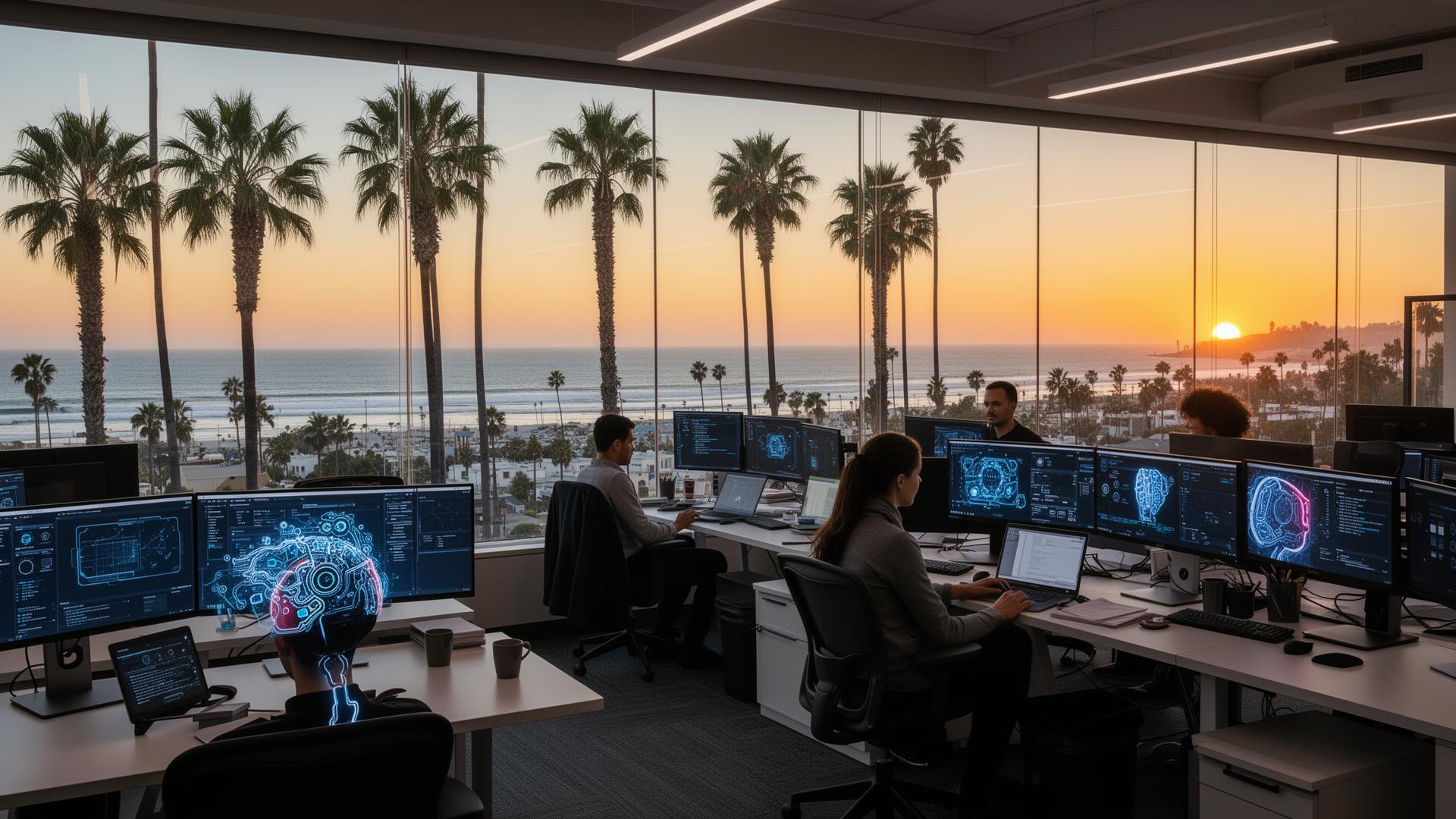
Silicon Beach, the stretch of coastal and near-coastal Los Angeles running through Santa Monica, Venice, Playa Vista, Culver City, and El Segundo, has evolved from a scrappy advertising-technology cluster into a diversified tech ecosystem that increasingly rivals San Francisco's South of Market district. By 2026, Los Angeles's AI market reached $31.8 billion, according to Bloomberg, powered by 18,400 AI/ML companies and 287,000 tech workers spread across entertainment, aerospace, healthcare, fashion, and logistics: a breadth no other tech hub in the country can match.
That breadth is the product of three overlapping growth phases. The AdTech Boom (2010-2015) produced Silicon Beach's first wave of exits (Myspace ($580M acquisition), Overture (Yahoo's $1.6B acquisition), and Demand Media's $1.5B IPO) and saw Snapchat found itself in 2011 on a $485K Lightspeed seed round, while Dollar Shave Club's viral 2012 launch video proved LA's creative-plus-technical fusion could build billion-dollar brands (it sold to Unilever for $1B). The Consumer Tech & Content phase (2015-2020) followed, anchored by Snap's 2017 IPO at a $24B valuation, Disney's massive Burbank/Glendale hiring push ahead of Disney+, and SpaceX's 2018 Falcon Heavy success. Since 2020, an AI & Entertainment Convergence phase has taken over: COVID-accelerated streaming and virtual production, the 2022-2026 generative AI explosion, and a new wave of LA-born AI unicorns: Runway ML ($1.5B valuation), Pika Labs, and Character.AI ($1B valuation) among them.
| Dimension | Los Angeles | Silicon Valley |
|---|---|---|
| Primary industries | Entertainment, aerospace, fashion, healthcare, logistics, consumer tech | Enterprise SaaS, semiconductors, cloud infrastructure, developer tools |
| AI focus | Consumer-facing AI, content creation, computer vision, recommender systems, autonomous systems | Enterprise AI, infrastructure, developer platforms, foundational models |
| AI engineer pay | $130K-$180K | $160K-$240K |
| Cost of living | Median rent ~$2,800 | Median rent ~$3,500+ |
| VC funding (2025) | $12.4B, up from $8.2B in 2021 | $42.3B, down from $68B peak in 2021 |
| Competitive advantage | Creative talent, consumer insight, entertainment IP, aerospace heritage | Dense network effects, deep technical talent, Stanford/Berkeley pipeline |
| Neighborhood | Major Companies | Strengths |
|---|---|---|
| Santa Monica & Venice | Snap (HQ), Google, Hulu, Activision Blizzard | Lifestyle appeal draws SF talent, central location, walkable |
| Playa Vista | YouTube Space, Google Cloud, Electronic Arts, The Honest Company, Belkin | Modern office space, LAX proximity, tech company density |
| Culver City | Apple TV+ production, Amazon Studios, Sony Pictures, HBO, TikTok (West Coast hub) | Studio infrastructure, production facilities, entertainment talent access |
| El Segundo & Hawthorne | SpaceX, Northrop Grumman, Boeing, Relativity Space, Rocket Lab USA | Aerospace heritage, manufacturing facilities, defense contracts |
Hollywood's AI Revolution: Entertainment Industry Transformation
Entertainment is LA's most distinctive AI application area. Every major city has enterprise software companies; only Los Angeles combines a $2.1 trillion global entertainment industry with frontier AI research, an intersection Variety's 2026 analysis calls unprecedented in scale.
Warner Bros. Discovery: AI Across the Production Pipeline
Warner Bros. Discovery ($41.3B revenue, home to HBO, CNN, and Discovery) faces existential pressure to produce more content, faster and cheaper, while competing against Netflix's $33B content budget, Disney, Amazon, and Apple. AI now touches every stage of its pipeline:
- Pre-production: AI script readers cut the reading backlog 85%; casting AI helped cast 40% of TV supporting roles in 2025; budget-forecasting AI lands within 8% of final costs versus 23% for traditional estimates.
- Production: 12 LED-volume virtual production stages in Burbank cut location-shoot costs 40-60% while letting directors see final shots in real time; computer vision tracks continuity and flags dailies issues automatically.
- Post-production: AI VFX (Runway ML's Gen-2, Pika Labs) powered effects on 30+ films in 2024-2025, saving an estimated $180M; automated rough-cut editing runs 30-40% faster; AI-assisted lip-sync dubbing released 'The Flash' in 47 languages.
- Distribution & marketing: Release-timing models forecast box office performance (correctly bracketing Barbie's eventual $1.4B run); AI-assembled, A/B-tested trailers see 35% higher engagement than human-edited cuts.
On the streaming side, Max (HBO Max + Discovery+) attributes an 18% retention improvement from 2023 to 2025 largely to better recommendations, while AI-tested thumbnail personalization lifted click-through rates 28%. Combined, these AI efficiency gains cut Warner Bros. Discovery's production costs by $850M annually and grew content output 35% on the same budget, while Max subscribers climbed to 82 million by Q4 2025, up from 73 million in 2024. The gains came with real friction: the 2023 WGA and SAG-AFTRA strikes centered squarely on AI, and the resulting contracts locked in guardrails: human writers must be credited, AI treated as a tool rather than a replacement, and actors retain control over their digital likenesses.
Netflix takes a similarly AI-first approach from its Los Gatos headquarters and large LA production footprint, with 260 million subscribers and $33.7B in revenue. The company estimates its recommendation system drives 80% of all viewing hours and is worth roughly $1B annually through reduced churn: not one algorithm but hundreds of specialized ML models blending collaborative filtering, content similarity, sequential viewing patterns, and even time-of-day signals. That same data shapes what gets made: the decision to greenlight House of Cards famously drew on viewing data showing David Fincher fans who liked the British original would watch, and granular drop-off analysis helped establish 8-10 episodes as the sweet spot for prestige dramas, versus broadcast TV's traditional 22.
Netflix estimates its recommendation system is worth roughly $1 billion a year through reduced churn. A single AI system now functions as one of the company's core competitive moats.
AI Startups Disrupting Entertainment
Alongside the studios, a cluster of LA-based AI startups is rewiring how content gets made, edited, and localized, with real venture capital behind them.
| Startup | Valuation / Funding | What It Does |
|---|---|---|
| Runway ML (Santa Monica) | $1.5B valuation, $237M raised (Google, Nvidia, Salesforce Ventures) | Gen-2 text/image-to-video generation used by Netflix and Warner Bros for VFX and pre-visualization |
| ElevenLabs | $1.1B valuation | Ultra-realistic AI voice synthesis and cloning in 29 languages, used for dubbing and audiobook narration |
| Captions (Los Angeles) | $500M valuation, 15M users at $30/month | AI video editing that turns raw footage into edited short-form content with captions and transitions |
| Flawless (Los Angeles) | $32M raised | TrueSync AI lip-sync for dubbing, licensed by major studios and used on Mission Impossible international releases |
Runway ML, founded by Chilean entrepreneur Cristóbal Valenzuela and based in Santa Monica, is democratizing visual effects that once required $100K+ studio budgets: a shift praised for accessibility and criticized for threatening jobs in an already precarious VFX industry increasingly outsourced overseas. ElevenLabs' voice cloning raises its own ethical questions around consent and impersonation, which the company addresses by requiring proof of consent before cloning, though enforcement remains difficult in practice. Flawless's TrueSync technology solves a problem dubbing has never fully cracked (lips that actually match translated audio) and earned direct approval from Tom Cruise for use on Mission Impossible's international releases.
Aerospace & Defense: LA's Hidden AI Powerhouse
Los Angeles has been America's aerospace capital since the Lockheed and Hughes Aircraft era, and its modern aerospace sector is now among the most AI-intensive industries in the city: autonomous flight systems, satellite imagery analysis, predictive maintenance, and manufacturing optimization all run on machine learning.
SpaceX: AI-Powered Space Exploration
From its Hawthorne headquarters (12,000+ employees, $180B valuation), SpaceX depends on AI for feats no human reflexes could execute:
- Autonomous rocket landing: A rocket traveling 5,000+ mph must slow, orient, and land on a 300-foot ocean barge with no human intervention possible. Computer vision and reinforcement learning, trained on thousands of simulations, now land rockets successfully 95%+ of the time, saving roughly $28M per reused booster.
- Starlink satellite network: 5,500+ satellites (as of February 2026) autonomously manage their own orbit maintenance, collision avoidance, and beam steering, delivering global internet (including oceans and remote regions) to 3 million subscribers.
- Manufacturing AI: Computer vision inspects welds and composite layups across 100+ annual Falcon 9 missions; predictive maintenance and AI-driven supply-chain management coordinate more than 5,000 suppliers.
The payoff is roughly a 10x reduction in launch costs through reusability (about $3,000/kg versus $30,000+ for competitors) and it's only getting more AI-dependent: Starship, SpaceX's fully reusable next-generation rocket, autonomously lands a 150-ton spacecraft on tower "chopsticks" (first successful catch: October 2024), a capability considered essential to Mars mission feasibility given 3-22 minute one-way communication delays. SpaceX isn't alone in El Segundo and Long Beach: Northrop Grumman's B-21 Raider stealth bomber (delivered 2023) leans heavily on AI for flight control and mission planning; Relativity Space 3D-prints entire rockets on its proprietary Stargate printer, with AI optimizing print parameters and structural analysis toward a stated goal of manufacturing rockets on Mars from local materials; and Palmer Luckey's Anduril Industries builds AI-powered autonomous drones and surveillance towers for defense and border security at a $3B valuation: a category that draws real controversy over AI weaponization even as the company argues autonomous systems reduce risk to soldiers.
Healthcare & Life Sciences: AI Clinical Applications
LA's healthcare sector (Cedars-Sinai, UCLA Health, USC Keck Medicine, City of Hope) is adopting AI across diagnostics, clinical operations, and precision medicine, a trend Forbes' healthcare analysis flags as some of the country's fastest clinical AI adoption.
At Cedars-Sinai in Beverly Hills, computer vision analyzes X-rays, MRIs, and CT scans to detect cancers, fractures, and internal bleeding with 96% accuracy, matching specialist radiologists and meaningfully reducing missed diagnoses across the emergency department, oncology, and cardiology. Machine learning models trained on patient vitals, lab results, and history now predict sepsis onset 6-12 hours before clinical symptoms appear; since sepsis kills roughly 270,000 Americans annually, that early warning window has cut sepsis mortality 18% at Cedars-Sinai. Ambient clinical documentation (AI that listens to doctor-patient conversations and drafts clinical notes automatically, built on a Nuance/Microsoft partnership) saves physicians roughly two hours a day, giving them back face time with patients instead of paperwork.
Implementation Roadmap: AI Integration for LA Companies
Across every LA industry we work with, successful AI integration follows a similar four-phase arc rather than a single big-bang deployment. Our guide to AI agent implementations across industries walks through this pattern in more operational depth.
- 1.Assessment & Strategy (1-2 months): Identify high-value use cases specific to the industry (entertainment: recommendations and production optimization; aerospace: autonomous systems and predictive maintenance; healthcare: diagnostics and clinical workflows), audit data infrastructure (most AI projects fail on data quality, not algorithms), and benchmark competitors.
- 2.Quick Wins & Pilot Projects (3-6 months): Run 1-2 low-complexity, high-value proofs of concept that validate feasibility and ROI, involving end users early and, where relevant, tapping LA's local talent pool (USC/UCLA graduates, entertainment tech professionals, aerospace engineers moving into commercial AI).
- 3.Scale & Production Deployment (6-18 months): Industrialize successful pilots with production-grade engineering and monitoring, integrate with existing systems (media asset management, flight control systems, EMRs), and establish AI governance, especially critical for healthcare and defense work.
- 4.AI-First Transformation (18-36 months): AI becomes a default consideration in product and operating decisions, proprietary models trained on unique data become a genuine competitive moat, and new business models emerge that depend on AI the way Netflix's subscription economics depend on its recommendation engine.
LA-Specific Challenges to AI Integration
Building AI in Los Angeles means navigating a set of frictions that don't show up the same way in Silicon Valley.
- Talent competition: Bay Area companies pay AI engineers $160K-$240K versus LA's $130K-$180K, but lower cost of living (median rent $2,800 vs $3,500), better weather, entertainment industry access, and family-friendly neighborhoods increasingly pull talent to LA even at a 10-15% salary discount.
- Funding disparity: SF Bay Area still draws 3.4x more VC funding than LA ($42.3B vs $12.4B in 2025), pushing many LA startups to pitch SF-based VCs or open satellite offices there, though a maturing local ecosystem (Upfront Ventures, Mucker Capital, Greycroft) and corporate venture arms (Disney Accelerator, Warner Bros. Discovery Ventures, Snap) are closing the gap.
- Industry-specific hurdles: Entertainment faces union resistance from the WGA, SAG-AFTRA, and IATSE to AI perceived as threatening jobs, requiring careful change management and contractual protections; aerospace faces ITAR citizenship restrictions on talent plus heavy FAA, FCC, and DOD regulatory burden and long sales cycles.
- Diversity and inclusion: LA's tech workforce is meaningfully more diverse than Silicon Valley's (48% Latino, 11% Black, 29% white, 12% Asian versus SF's 15% Latino, 5% Black, 40% white, 34% Asian), an asset for building AI that serves broader populations, though realizing it requires intentional recruiting beyond the traditional Stanford/Berkeley CS pipeline.
See our guide to calculating AI agent ROI for LA businesses for how to build the financial case in this funding environment.
The Future: LA's AI Trajectory (2026-2030)
Six forces will shape Los Angeles's AI trajectory through 2030, building on research strength that already ranks USC Viterbi #10 nationally for AI research, with UCLA and Caltech both in the top 20.
- Generative AI + entertainment: By 2028, independent creators could produce Hollywood-quality content on $100/month AI tools instead of $100M studio budgets: real democratization, alongside real quality-control and IP questions.
- Virtual production dominance: LED-volume stages, pioneered in LA, are becoming an industry standard well beyond it, prized for creative flexibility, real-time iteration, and a smaller carbon footprint than location shoots.
- Autonomous aerospace: SpaceX's Mars ambitions depend entirely on autonomous landing, resource extraction, and habitation systems given 3-22 minute communication delays, with terrestrial spillover into autonomous aircraft and urban air mobility.
- Healthcare AI at the point of care: As FDA approvals increase, AI analysis could become standard of care in radiology, pathology, and dermatology by 2028, with LA's hospital systems among the leaders, provided models are validated across genuinely diverse patient populations.
- LA-SF talent migration: The Bay Area's cost-of-living crisis and normalized remote work are pushing tech talent toward LA's lifestyle and affordability, a trend that could accelerate LA's rise as a tech hub.
- Ethical AI leadership: Entertainment's early, forced confrontation with deepfakes, synthetic media, and digital likenesses (crystallized in SAG-AFTRA's 2023 AI provisions) positions LA as a template for how other industries negotiate the AI workforce transition.
Why Frenchy Digital Is the Right AI Partner for LA Companies
Frenchy Digital builds AI-integrated mobile and web products for the industries that make Los Angeles unique: entertainment (recommendation systems, content analysis, computer vision for production, generative AI for creative workflows), aerospace (autonomous systems, predictive maintenance, manufacturing optimization), healthcare (clinical decision support, medical imaging, NLP for documentation), and consumer brands (personalization and computer vision for LA's fashion, beauty, and lifestyle companies).
Frenchy Digital is headquartered in Los Angeles, with international teams in Geneva, Switzerland and Paris, France, giving clients AI strategy and engineering coverage across US and European working hours. That LA base isn't incidental: it means direct familiarity with entertainment industry union dynamics, ITAR-aware aerospace engineering practices, and HIPAA-compliant healthcare workflows, rather than generic AI advice applied to LA companies from the outside. Whether your roadmap starts with a scoped MVP build or needs startup consulting to prioritize the right use cases first, the same LA-based team carries it through to production.
Frenchy Digital AI Integration Capabilities
- AI Strategy & Consulting: opportunity assessment, roadmap development, and business case analysis tailored to your industry.
- Custom AI Development: machine learning, computer vision, NLP, recommendation systems, and generative AI integrations.
- Production Deployment & MLOps: scaling, monitoring, and maintaining AI systems once they leave the pilot stage.
- Mobile & Web Apps: React Native, iOS, Android, and web platforms built around AI capabilities from day one.
- Data Engineering: pipelines, governance, and infrastructure that make AI projects possible in the first place.
Ready to bring AI into your LA business the right way? Schedule your free discovery call and get a clear, industry-specific view of where AI can move the needle for your company first.
Ready to Integrate AI Into Your LA Business?
Get a strategic AI roadmap tailored to your industry (entertainment, aerospace, healthcare, or consumer tech) from a team that knows LA's ecosystem inside and out.
1517 S Bentley Ave Suite 204, Los Angeles CA 90025