












Why Monaco Grand Prix App Development Is a Different Kind of Challenge
The Monaco Grand Prix isn't just another stop on the Formula 1 calendar. It's one leg of motorsport's unofficial Triple Crown, alongside the Indianapolis 500 and the 24 Hours of Le Mans, a feat only Graham Hill has ever completed. Run by the Automobile Club de Monaco (ACM), the event has been a fixture of the sport since the first race in 1929 and has run continuously since 1955. That prestige shapes what "good enough" means for any digital platform built around it: the fans, sponsors, and hospitality clients who show up expect something that matches the event's reputation, not a generic sports-app template retrofitted with a Monaco logo.
Building software for the Monaco Grand Prix means solving three genuinely different problems inside one project. The first is a consumer fan-experience problem: schedules, maps, tickets, and live updates for a crowd that's part motorsport diehard, part luxury tourist. The second is a real-time data engineering problem: getting officially licensed lap times, sector splits, and driver positions onto a screen fast enough to feel live. The third is a high-value hospitality operations problem: managing yacht cabins, terrace bookings, and concierge requests for guests whose packages can run into five figures. Few other events force all three into the same weekend, in the same two-square-kilometer footprint, once a year.
For 2026, the race itself has shifted for the first time in its history to a new calendar slot: instead of its traditional late-May weekend, the Grand Prix now runs June 5-7, with the race on Sunday, June 7. That single scheduling change is a useful reminder of a broader point for anyone commissioning software around this event: the calendar, sponsors, and hospitality partners can all shift year to year, so the platform underneath needs to be built for that kind of change rather than hard-coded around one edition.
The Circuit de Monaco Connectivity Challenge
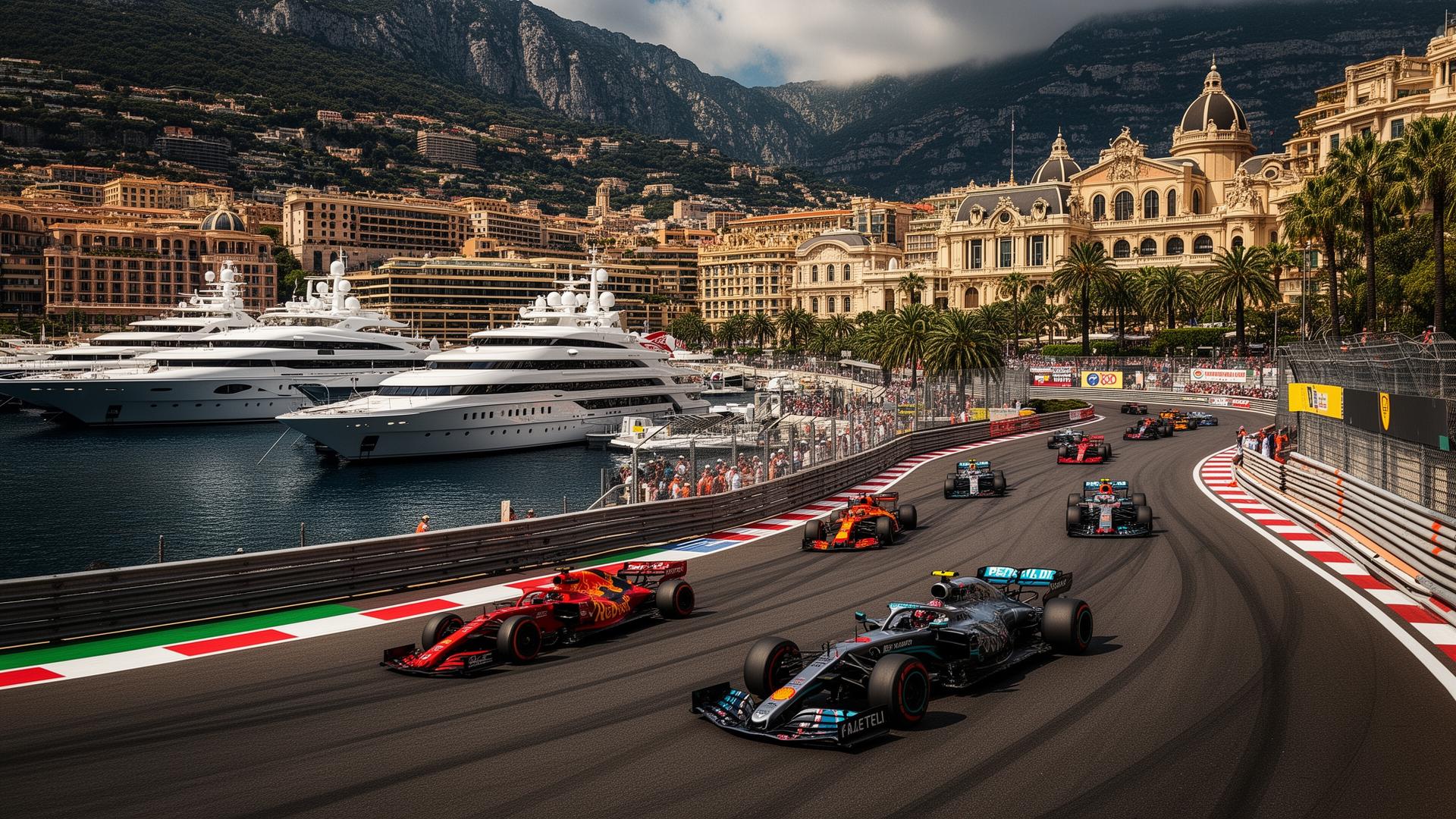
Every architectural decision in this guide traces back to one physical fact: the Circuit de Monaco is a 3.337 km street circuit (78 laps, 260.286 km total race distance) threaded through the narrow roads of a principality that covers barely two square kilometers. Grandstands, harbor-front terraces, and yachts moored along the marina sit within meters of the track, and tens of thousands of fans, guests, and staff concentrate into that footprint over the race weekend. That density is exactly what makes Monaco "the slowest, most physically demanding circuit on the calendar" for drivers, and it's also what makes it one of the hardest live environments in sport for mobile networks.
The circuit's tunnel section, running beneath the Fairmont Hotel, is a well-documented example of the problem in miniature. Radio and GPS reception are known to degrade noticeably through that stretch of track (a challenge F1 teams manage with signal repeaters mounted on trucks near the circuit), and broadcast engineers spent years solving the same problem for TV coverage before ground-based antenna networks fixed the on-board camera feed. Any app that promises "live" driver tracking or timing has to assume the same kind of signal dropout will happen to consumer devices in that zone, and needs to interpolate or gracefully pause rather than show a driver icon frozen or teleporting on the map.
| Circuit Reality | Engineering Implication for App Teams |
|---|---|
| 3.337 km lap in a ~2 km² principality | Extreme concurrent-user density per cell tower; fan and hospitality apps must handle tens of thousands of sessions within a few city blocks |
| Tunnel beneath the Fairmont Hotel degrades GPS and radio signal | Race-tracking and driver-tracker features need to interpolate position and time-out gracefully during dropouts, not display stale or broken data |
| Grandstands, terraces, and yachts stacked within meters of the track | Location-based push notifications need tight geofencing so hospitality guests aren't blasted with irrelevant alerts meant for an adjacent zone |
| One event weekend a year, then near-zero traffic for months | Backend infrastructure must scale elastically for a short, extreme peak rather than being sized for steady-state load |
The practical takeaway for anyone scoping this kind of project: treat "works reliably on a spotty, overloaded network in a dense urban canyon" as a hard requirement from day one, not an edge case to patch later. That single constraint drives most of the architecture decisions covered in the next four sections.
Fan Experience App: Core Features & Architecture
A Monaco Grand Prix fan-experience app has to do the same job as any large-event app (orient a visitor, keep them on schedule, and get them through the gate) while assuming the network underneath it will be unreliable at exactly the moments that matter most. That means offline-first design isn't optional: core content like the schedule, venue map, and a fan's own ticket needs to be cached on-device and readable with zero connectivity, with the app syncing opportunistically whenever it does get a signal.
Core Fan Experience Modules
- Interactive venue map: Grandstands, food and beverage, restrooms, medical points, and exits overlaid on the circuit, cached for offline use and updated with real-time crowd or closure alerts.
- Live, personalized schedule: Practice, qualifying, and race session times with countdowns, automatically adjusted to the fan's local time zone for the large share of attendees traveling internationally.
- Mobile ticket wallet: Digital tickets as Apple Wallet and Google Wallet passes that work at the gate even without a live connection, since network congestion is heaviest right at entry.
- Push notification engine: Session-start alerts, weather changes, and schedule adjustments, geofenced so messages stay relevant to where a fan actually is on the circuit.
- Multilingual content: French, English, and Italian at minimum, reflecting Monaco's own bilingual culture and the largest visitor nationalities the race typically draws.
Whether that experience should be a native app or a Progressive Web App depends on which of those modules matter most to the specific client. A PWA can cover the map, schedule, and news content well and skips app-store review delays before race week, useful if the platform needs to ship or update quickly. But wallet-pass integration, reliable offline caching, and background push notifications are all meaningfully more dependable in a native app, which tends to matter more at Monaco than at a typical event given the connectivity constraints covered above. Many teams land on a hybrid approach: a native app for ticket holders and a lightweight PWA for casual visitors who just want the schedule.
Real-Time Race Tracking & Live Timing Systems
The official Formula 1 app sets the bar fans expect here: a free live-timing leaderboard with driver and constructor standings, an interactive driver-tracker map, and, for F1 TV Access subscribers, telemetry detail down to tyre data, lap times, speed, and DRS status. Building a comparable experience, whether as a companion app, a hospitality-branded partner app, or a broadcast second-screen product, starts with the same foundational decision: lap times, sector splits, and car telemetry come from FIA/F1 timing infrastructure and have to be licensed through Formula 1's commercial data providers. This isn't data you scrape or reverse-engineer; it's a data-rights relationship that needs to be established before a single line of the tracking feature gets built.
Once the data rights are in place, the architecture question becomes delivery latency. Polling a REST endpoint every few seconds is the wrong pattern for anything marketed as "live": it introduces visible lag exactly when fans care most, during overtakes and pit stops. Production race-tracking apps push updates over WebSockets or a comparable persistent-connection protocol, so a lap time or position change reaches the device the moment it's available rather than on the next poll cycle. That same connection needs a fallback state for the tunnel dropout described earlier: rather than freezing a driver icon mid-track, a well-built app interpolates position based on recent speed and known circuit geometry until the signal resumes.
| Data Layer | Typical Update Cadence | Delivery Pattern |
|---|---|---|
| Official lap & sector times | Near real time, sub-5-second | Licensed timing feed pushed via WebSocket |
| Driver position / tracker map | Continuous | Streamed position updates with client-side interpolation through signal gaps |
| Weather & track status | Every few minutes | REST polling is acceptable: low urgency, low change frequency |
| Standings & results | After each session | Event-driven push on session completion |
The Fairmont Hairpin, the slowest corner on the entire Formula 1 calendar at roughly 45-50 km/h, is a good reminder of the granularity fans and broadcasters now expect: not just "where's the car," but throttle, gear, and speed trace through every meter of a 3.337 km lap.
VIP Hospitality, Yacht & Guest Management Platforms
Monaco's harbor is arguably as famous as its circuit. The race passes directly along the marina, and superyachts moored trackside have become one of the event's signature images. That creates a category of software that most sports events never need: yacht and VIP hospitality management, which is really a specialized CRM and operations platform disguised as a booking app. Independent hospitality operators sell packages ranging from single-day terrace passes to multi-day yacht cabins, and industry pricing for these packages spans an enormous range: general grandstand seats can start around €50-€65 for a practice day, while premium race-day grandstands and hospitality terraces run into the hundreds or low thousands of euros, and full-service yacht cabin packages are commonly priced from roughly €600 per day up to $14,000-$18,000 for a multi-day cabin depending on the operator and vessel.
Managing that spread of inventory and price tiers by spreadsheet works for a small operator, but breaks down fast once a hospitality business is running multiple vessels, corporate group bookings, and a five- or six-figure catering budget across one weekend. Purpose-built software earns its cost here by turning a fragile manual process into a system that can be trusted with high-value transactions and demanding guests.
VIP Hospitality Platform Modules
- Guest & cabin manifest management: Tracking who is booked into which cabin, terrace, or table, with the accurate guest lists that Monaco's access-control checkpoints require.
- Multi-day tiered pricing engine: Handling the day-by-day and multi-day package pricing structures common across yacht and grandstand hospitality, including early-bird and group discounts.
- Concierge & request ticketing: A structured way to log and route guest requests (transfers, restaurant reservations, dietary needs) so nothing depends on a single staff member's memory.
- Catering & F&B logistics: Coordinating supply orders, headcounts, and service timing against the live session schedule so catering peaks align with when guests are actually on board.
- Corporate invoicing & multi-guest booking: Supporting the B2B side of the business: a single corporate client booking and paying for a block of ten or twenty guest passes at once.
This is also the layer where enterprise-grade software practices matter most in the whole project: the guest data involved is sensitive, the transaction values are high, and a booking error at this tier isn't a minor inconvenience: it's a client relationship worth tens of thousands of dollars.
Mobile Ticketing, Payments & Access Control
Ticketing for an event at Monaco's price range has to serve two very different transaction profiles inside the same checkout flow: a fan buying a modest general-admission pass and a corporate client purchasing a multi-guest yacht package worth thousands of dollars. Both need to feel equally frictionless, and both are subject to the same underlying rule: any app processing card payments needs to meet PCI DSS (Payment Card Industry Data Security Standard) requirements, typically by routing transactions through a PCI-compliant payment processor and tokenizing card data rather than storing it directly in the app's own database.
On the access-control side, mobile tickets as Apple Wallet or Google Wallet passes with QR or NFC validation at turnstiles have become the practical standard for high-value events, both for speed of entry and for reducing the counterfeit and resale problems that prestige events like Monaco are especially exposed to. A well-built system ties each digital ticket to a single validated scan, flags duplicate-use attempts in real time, and gives gate staff a fallback manual-verification path for the inevitable edge cases (a phone that died, a guest who never installed the app) without opening a security hole. For hospitality clients specifically, ticketing often needs to integrate directly with the guest-manifest system described in the previous section, since a yacht guest's "ticket" is really an access credential tied to a specific cabin and day.
Data Privacy & Compliance: GDPR, Monaco's Data Protection Law & PCI DSS
Monaco is not a European Union member state, so GDPR does not technically apply to it as a matter of EU law. In practice, this rarely simplifies anything for an app built around the Grand Prix, because the overwhelming majority of attendees, ticket buyers, and hospitality guests are EU or UK citizens, meaning any platform collecting their personal data still needs to meet GDPR's obligations for that population regardless of where the event itself is held. On top of that, Monaco modernized its own data protection framework with Law No. 1.565, effective December 3, 2024, which is explicitly designed to be GDPR-aligned and is enforced by the principality's data protection authority, the APDP, with fines that can reach roughly €10 million or 4% of global turnover for the most serious violations, figures that mirror GDPR's own upper-tier penalties.
For a development team, the practical implication is to build to GDPR-equivalent standards as the baseline rather than trying to work out which framework technically governs a given guest's data. That means consent management for marketing communications, a genuine right to erasure and data portability for guest manifests, data minimization on anything collected at the gate or through concierge requests, and careful handling of cross-border data transfer given how many hospitality operators, payment processors, and cloud providers involved in a Monaco GP platform are based outside Monaco itself. Layered on top of that is PCI DSS for anything touching payment card data, covered in the previous section. Together, these three frameworks form the compliance floor for any serious Monaco Grand Prix platform, not an optional add-on for later.
Development Cost, Timeline & Team Structure
Budgets for this category of project scale with which of the three problem areas (fan experience, race tracking, hospitality management) the platform actually needs to cover, and how many third-party integrations (data licensing, payment processors, hospitality operators) it has to connect to before launch.
| Scope | Typical Budget | Typical Timeline |
|---|---|---|
| Fan-experience app only (schedule, maps, mobile tickets, push) | $80,000-$250,000 | 3-4 months |
| Fan app + licensed real-time race tracking | $250,000-$600,000 | 4-6 months |
| Full platform: fan app + race tracking + VIP hospitality/yacht management | €500,000-€2,000,000+ | 6-12 months |
| Off-season maintenance & next-edition updates (annual retainer) | 10-20% of build cost / year | Ongoing |
The wide range at the top end reflects how much the hospitality layer alone can vary: a platform serving one operator's yacht bookings is a fundamentally smaller project than one built to onboard a dozen independent hospitality businesses, each with its own pricing rules, inventory, and payment relationships. A realistic team for the full-platform tier typically includes mobile engineers for iOS and Android (or a strong cross-platform stack), a backend/real-time infrastructure engineer for the WebSocket and data-streaming layer, an integrations engineer to manage the timing-data licensing relationship and payment processor connections, a hospitality-operations specialist who understands guest-management workflows, a security and compliance lead covering the GDPR/PCI requirements above, and dedicated QA focused specifically on peak-load testing, since the entire platform's hardest problem only shows up once a year, for one weekend, and there's no room to discover a scaling issue live during the race.
Because the usage pattern is so seasonal, it's worth budgeting for the retainer line above from the start rather than treating it as an afterthought: rules and pricing tiers change year to year, hospitality partners rotate, and the connectivity conditions described earlier mean load-testing before each edition isn't optional. Teams that plan for this upfront, sometimes as part of a phased MVP-first build that proves out the fan-experience layer before committing to the full hospitality platform, tend to spend less overall than teams that build everything at once and rework it after the first live weekend exposes gaps.
Why Frenchy Digital for Motorsport & Prestige Event Apps
Frenchy Digital builds custom mobile and web applications for the exact combination this guide describes: consumer-facing fan experience layered on real-time data streaming, backed by enterprise-grade guest management and payment infrastructure for high-value hospitality clients. That combination of skills (mobile engineering, real-time backend architecture, and compliance-aware systems for GDPR, Monaco's data protection law, and PCI DSS) is directly transferable to a Monaco Grand Prix-scale platform, whether the project is a standalone fan app, a licensed race-tracking integration, or a full VIP hospitality and yacht management system.
Frenchy Digital is headquartered in Los Angeles, with international teams in Geneva, Switzerland and Paris, France, giving clients a partner with genuine European working-hours coverage and cultural fluency for an event rooted in the French Riviera, alongside US-based product and engineering leadership. For teams that need a security audit of an existing hospitality or ticketing system before the next race weekend, or full MVP development for a new fan-experience or race-tracking product, that international footprint means the team scoping the work understands both the technical requirements and the on-the-ground realities of building for Monaco.
Ready to build your fan experience, race tracking, or VIP hospitality platform for the Monaco Grand Prix? Schedule your free discovery call and get a scoped plan (architecture, timeline, and budget) before the next race weekend.
Ready to Build a Monaco GP-Grade App Platform?
Get a scoped plan for your fan experience, race tracking, or VIP hospitality platform, from architecture to launch timeline, in a free discovery call.
1517 S Bentley Ave Suite 204, Los Angeles CA 90025
Frequently Asked Questions
Sources & References
- 1Formula 1: Louis Vuitton Grand Prix de Monaco 2026 Full Timetable↗
- 2Automobile Club de Monaco: Official Race Organizer↗
- 3FIA: Fédération Internationale de l'Automobile↗
- 4Government of Monaco: Protection of Personal Data↗
- 5PCI Security Standards Council↗
- 6Precedence Research: Sport App Market Size Report↗
- 7Apple Developer: Wallet Passes Documentation↗