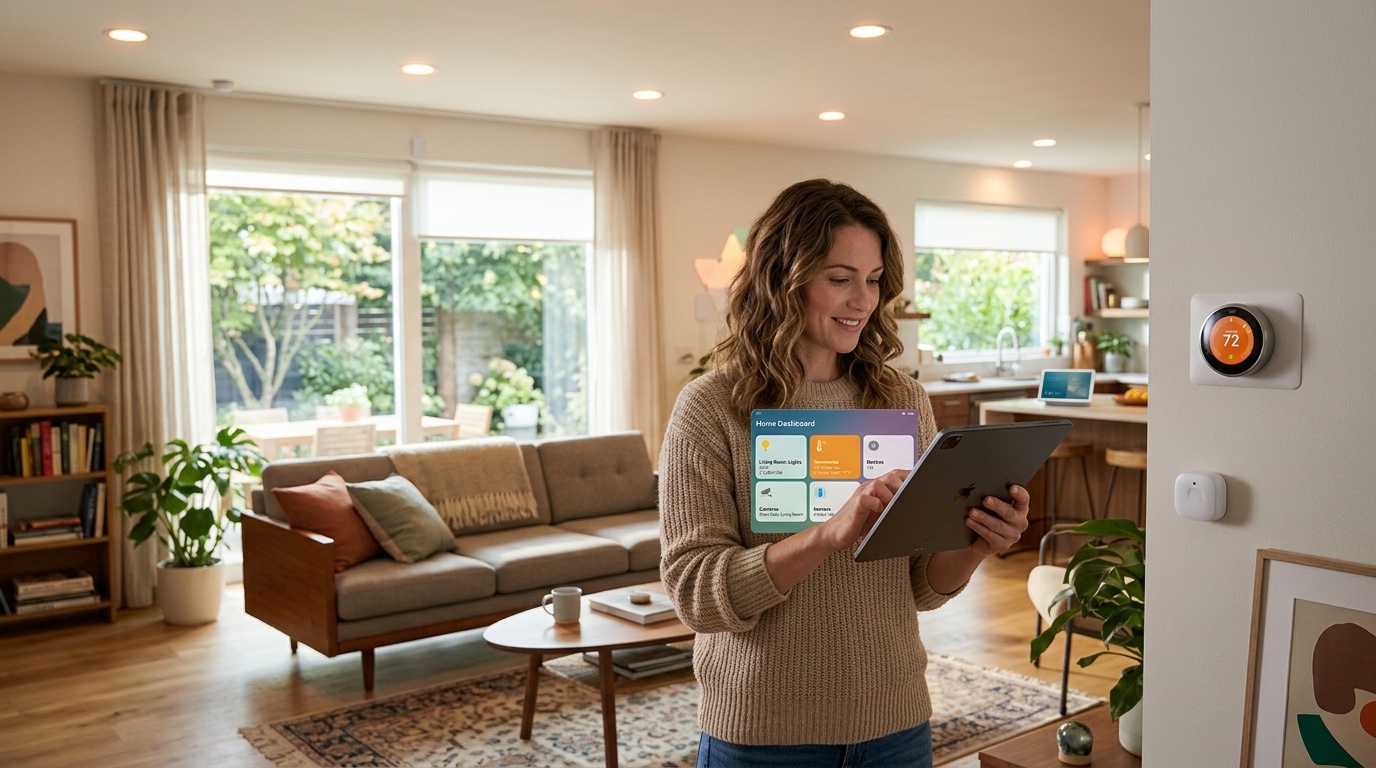
Building connected applications for smart devices, wearables, and industrial IoT: everything Los Angeles businesses need to know about IoT app development in 2026.
| Metric | Value |
|---|---|
| Connected IoT devices by 2030 | 75B+ |
| IoT market value | $1.1T |
| Annual IoT growth rate | 25% |
| Typical IoT app development cost | $100K+ |
Key Takeaways
- The global IoT market is projected to exceed $4 trillion by 2032, with connected devices expected to reach 29 billion by 2030.
- IoT apps serve as the interface between users and connected devices, handling real-time data, device control, alerts, and intelligent automation.
- React Native enables cross-platform IoT app development at 40-50% cost savings, supporting BLE, MQTT, WebSockets, and all major IoT protocols.
- AI-powered IoT (AIoT) is the fastest-growing segment: predictive maintenance, anomaly detection, and autonomous optimization drive real business ROI.
- Frenchy Digital builds IoT apps for healthcare wearables, smart home systems, fitness devices, and industrial platforms from Los Angeles with global reach.
Table of Contents
- What Is IoT App Development?
- Why IoT Matters for Your Business in 2026
- Types of IoT Applications
- IoT App Architecture: How It All Connects
- Communication Protocols for IoT Apps
- The IoT App Development Tech Stack
- AI Meets IoT: The AIoT Revolution
- IoT App Development by Industry
- Edge Computing and 5G: The Infrastructure Shift
- IoT Security: Protecting Connected Systems
- IoT App Development Costs in Los Angeles
- Frenchy Digital's IoT Development Process
- Common IoT Development Mistakes
- The Future of IoT App Development
- Frequently Asked Questions
Your thermostat learns your schedule and adjusts itself before you arrive home. Your fitness tracker detects irregular heart rhythms and alerts your cardiologist. Your factory floor sensors predict equipment failure three days before it happens, saving hundreds of thousands in downtime costs. Behind every one of these experiences is an IoT application: the software layer that transforms raw sensor data into actionable intelligence.
IoT app development is one of the most technically demanding and commercially rewarding areas of mobile development in 2026. The global IoT applications market was valued at nearly $596 billion in 2023 and is projected to exceed $4 trillion by 2032, growing at a compounding rate of over 24% annually. IDC projects global IoT investment reaching $3.4 trillion by 2026, with the United States representing the largest geographic market at roughly 35% of total spend.
For Los Angeles businesses (from healthcare startups in the Cedars-Sinai corridor to entertainment companies in Hollywood to manufacturing operations across Southern California), IoT represents a massive opportunity to build connected products, optimize operations, and create entirely new revenue streams. This guide covers everything you need to know about building IoT applications in 2026, from architecture and protocols to AI integration and security. And it explains how Frenchy Digital delivers IoT solutions that connect the physical and digital worlds.
What Is IoT App Development?
IoT app development is the discipline of building software applications that communicate with physical connected devices. Unlike a standard mobile app that pulls data from a web server, an IoT app must interface with hardware: sensors, actuators, microcontrollers, gateways, and edge devices, each with their own communication protocols, power constraints, and data formats.
The IoT application is not just a remote control for your device. It is the entire experience layer: the onboarding flow that pairs a new device, the dashboard that visualizes sensor data in real time, the notification system that alerts you when something needs attention, the automation engine that triggers actions based on conditions, and the analytics platform that reveals patterns in historical data.
Building an IoT app requires expertise that spans multiple engineering disciplines. You need mobile developers who understand React Native or Flutter for the user interface. You need backend engineers who can handle real-time data streaming at scale. You need embedded systems knowledge to understand device constraints. And increasingly, you need AI/ML expertise to transform raw sensor data into predictions and automations that deliver real business value.
The Three Layers of IoT
Every IoT system consists of three interconnected layers, and your IoT app must integrate seamlessly with all of them:
Device Layer: The physical hardware: sensors, microcontrollers (Arduino, ESP32, Raspberry Pi), actuators, and embedded systems. These devices collect data from the physical world (temperature, motion, heart rate, pressure, location) and send it to the cloud.
Connectivity Layer: The communication infrastructure: Bluetooth Low Energy (BLE), Wi-Fi, cellular (4G/5G), LoRaWAN, Zigbee, Z-Wave, MQTT brokers, and API gateways. This layer handles how data moves between devices, the cloud, and the user's phone.
Application Layer: The software your users actually interact with: the mobile app, web dashboard, admin panel, and automation engine. This is where Frenchy Digital specializes, building the application layer that makes connected hardware useful, intuitive, and valuable.
Why IoT Matters for Your Business in 2026
IoT is not a future concept. It is a present-day competitive advantage. By 2026, over 18 billion IoT devices are actively connected worldwide, and that number is accelerating toward 29 billion by 2030. Industries from healthcare to agriculture are deploying connected solutions at scale, and businesses that fail to adopt IoT risk falling behind competitors who leverage real-time data for better decisions.
Market Reality: The enterprise IoT market reached $269 billion in 2023 and is projected at $301+ billion in 2024, with 15% CAGR through 2030. The highest IoT deployments are in utilities, retail, transportation, and government, with healthcare and manufacturing growing fastest.
Here is why IoT app development should be on your 2026 roadmap:
New Revenue Streams. Connected products create subscription opportunities. A fitness device company does not just sell hardware: they sell a monthly coaching service powered by their IoT app. A smart home manufacturer charges for premium automation features. A healthcare device company bills for remote monitoring services. The app transforms a one-time hardware sale into recurring revenue.
Operational Efficiency. Industrial IoT (IIoT) applications reduce downtime through predictive maintenance, optimize energy consumption through smart building management, and improve logistics through real-time fleet tracking. Komatsu Australia, for example, used IoT and machine learning to cut analytics costs by approximately 49% and improve operational performance by 25-30%.
Customer Experience. IoT apps create differentiated experiences that commodity hardware alone cannot deliver. The device is the entry point; the app is the relationship. A well-designed IoT application with personalized dashboards, intelligent notifications, and seamless device management creates loyalty that competitors cannot easily replicate.
Data-Driven Decision Making. Connected sensors generate continuous data streams that reveal patterns invisible to human observation. Temperature trends, usage patterns, environmental conditions, and performance metrics, when aggregated and analyzed through your IoT platform, inform product improvements, operational changes, and strategic decisions.
Types of IoT Applications
IoT applications span an enormous range of use cases, spanning six major categories: smart home, healthcare, industrial, wearable, agricultural, and smart city. Understanding which category your project falls into helps determine the technical requirements, communication protocols, and development approach:
Consumer IoT Apps
Smart home controllers (lighting, thermostats, security cameras, locks), connected audio systems, pet trackers, baby monitors, and home appliance managers. These apps prioritize intuitive UX, fast device pairing, and reliable push notifications. BLE and Wi-Fi are the primary connectivity protocols.
Healthcare IoT (IoMT) Apps
Remote patient monitoring platforms, wearable health trackers, connected medical devices (glucose monitors, blood pressure cuffs, pulse oximeters), telehealth companions, and medication management systems. Healthcare IoT apps require HIPAA compliance, encrypted data transmission, and clinical-grade data accuracy. This is one of Frenchy Digital's core specializations.
Industrial IoT (IIoT) Apps
Predictive maintenance dashboards, asset tracking systems, environmental monitoring platforms, quality control automation, and supply chain visibility tools. IIoT apps handle high-frequency data from hundreds or thousands of sensors, often requiring edge computing for latency-sensitive operations and robust offline capabilities for environments with intermittent connectivity.
Wearable IoT Apps
Companion apps for smartwatches, fitness trackers, smart clothing, AR glasses, and health monitoring wearables. These apps must handle continuous data streams (heart rate, step count, GPS location, sleep patterns) while minimizing battery drain on both the wearable and the phone. Apple HealthKit and Android Health Connect integration are standard requirements.
Smart City and Infrastructure IoT Apps
Traffic management systems, smart parking solutions, environmental monitoring (air quality, noise levels), public safety platforms, and utility management dashboards. These large-scale deployments often involve thousands of devices, multi-tenant architectures, and integration with government data systems.
Agricultural IoT Apps
Soil moisture monitoring, irrigation automation, crop health tracking (via drone or satellite imagery), livestock monitoring, and weather-integrated farm management platforms. Agricultural IoT requires reliable operation in rural areas with limited connectivity, making offline-first architecture essential.
Building a Connected Product? Start With the Right Strategy.
Frenchy Digital's $5,000 IoT research phase evaluates your device ecosystem, communication requirements, and user experience goals before you invest in development.
IoT App Architecture: How It All Connects
IoT app architecture is fundamentally different from standard mobile app architecture because data flows in multiple directions: from devices to cloud, from cloud to devices, and between devices, all in real time. A well-designed IoT architecture handles these data flows reliably at scale while remaining responsive to user interactions.
Device Communication Layer
The mobile app connects to IoT devices through BLE for short-range pairing (wearables, smart home devices within room range), Wi-Fi for local network devices (smart speakers, cameras, appliances), and cellular/internet for remote devices (industrial sensors, fleet vehicles, agricultural monitors). Each protocol has different range, power consumption, data throughput, and reliability characteristics that influence your architecture decisions.
Message Broker / Real-Time Layer
Real-time IoT data flows through message brokers that handle the publish-subscribe pattern. MQTT (Message Queuing Telemetry Transport) is the standard protocol: lightweight enough for constrained devices, reliable enough for mission-critical data. AWS IoT Core, Google Cloud IoT, and Azure IoT Hub provide managed MQTT brokers that handle millions of simultaneous device connections.
Backend Processing Layer
The backend receives, processes, stores, and analyzes device data. This layer handles device authentication and provisioning, data validation and transformation, time-series database storage (InfluxDB, TimescaleDB), event processing and rule evaluation, and API endpoints for the mobile app. Node.js and Python are the most common backend languages for IoT applications, with Firebase providing a serverless option for simpler deployments.
Mobile Application Layer
The React Native or Flutter frontend provides the user experience: device onboarding wizards, real-time data visualization, control interfaces, notification management, and analytics dashboards. The mobile layer must handle intermittent connectivity gracefully, caching data locally and syncing when connection is restored.
Analytics and AI Layer
The intelligence layer processes historical and real-time data to generate insights. Machine learning models detect anomalies, predict failures, optimize automations, and personalize user experiences. This layer runs in the cloud for batch processing and increasingly at the edge for real-time inference.
Communication Protocols for IoT Apps
Choosing the right communication protocol is one of the most critical IoT architecture decisions. Each protocol optimizes for different trade-offs between range, power, bandwidth, and reliability:
| Protocol | Range | Power | Data Rate | Best Use Case |
|---|---|---|---|---|
| Bluetooth Low Energy (BLE) | 10-100m | Very Low | 1-2 Mbps | Wearables, health monitors, beacons |
| Wi-Fi | 50-100m | High | Up to 9.6 Gbps (Wi-Fi 6E) | Smart home, cameras, streaming devices |
| MQTT | Internet (any) | Low | Varies | Cloud messaging, telemetry, remote devices |
| Zigbee / Z-Wave | 10-100m (mesh) | Very Low | 250 Kbps / 100 Kbps | Smart home mesh networks |
| LoRaWAN | 2-15 km | Very Low | 0.3-50 Kbps | Agriculture, smart city, remote sensors |
| Cellular (5G/LTE-M) | Unlimited | Medium-High | Up to 10 Gbps (5G) | Fleet tracking, industrial, remote monitoring |
| NFC | < 10 cm | Very Low | 424 Kbps | Tap-to-pair, contactless payments, ID tags |
Most IoT applications use multiple protocols simultaneously. A smart home system might use BLE for initial device pairing, Wi-Fi for ongoing data transfer, and MQTT for cloud synchronization. A healthcare wearable might use BLE to communicate with the phone, which then relays data via Wi-Fi or cellular to the cloud backend. Your IoT development partner must understand these protocol interactions to design a reliable, efficient system.
The IoT App Development Tech Stack
A modern IoT application in 2026 combines several technology layers. Here is the stack Frenchy Digital recommends for most IoT projects:
| Layer | Technology | Purpose |
|---|---|---|
| Mobile Frontend | React Native + TypeScript | Cross-platform iOS/Android app with native BLE support |
| Web Dashboard | React.js + D3.js / Recharts | Admin and analytics dashboards for web browsers |
| Backend API | Node.js + Express | REST/GraphQL APIs, business logic, device management |
| Real-Time Messaging | MQTT (Mosquitto / AWS IoT Core) | Device-to-cloud and cloud-to-device communication |
| Database | PostgreSQL + InfluxDB | Relational data + time-series sensor data |
| Cloud Infrastructure | AWS IoT Core / Firebase | Device registry, message broker, serverless functions |
| AI/ML | TensorFlow / Python + scikit-learn | Predictive analytics, anomaly detection, personalization |
| Device SDK | BLE libraries + custom native modules | Bluetooth pairing, device firmware updates (OTA/DFU) |
AI Meets IoT: The AIoT Revolution
The convergence of artificial intelligence and the Internet of Things, known as AIoT, is the most transformative development in the IoT space in 2026. Raw sensor data alone has limited value. AI transforms that data into predictions, automations, and intelligent decisions that create exponential business impact.
Predictive Maintenance: Machine learning models analyze vibration, temperature, and performance data from industrial equipment to predict failures days or weeks before they occur. This shift from reactive to predictive maintenance can reduce downtime by 30-50% and maintenance costs by 20-40%. Organizations like Komatsu have proven these savings at scale.
Anomaly Detection: AI models learn the normal patterns of your IoT data (whether it is heart rate from a wearable, energy consumption from a smart building, or production output from a factory) and alert when something deviates. This catches problems that rule-based systems miss because the AI adapts to each device's unique baseline.
Intelligent Automation: Rather than simple if-then rules (if temperature exceeds 75°F, turn on AC), AI-powered automation considers multiple variables simultaneously (occupancy patterns, weather forecasts, energy prices, user preferences) to optimize outcomes holistically.
Natural Language Device Control: Integrating OpenAI GPT-4 or Claude AI into IoT apps enables conversational device management. Instead of navigating complex settings menus, users can say "set the living room to a comfortable temperature for movie night" and the AI translates that intent into specific device commands.
Frenchy Digital integrates AI capabilities into IoT applications using both cloud-based models (OpenAI, Claude AI, Google Vertex AI) and on-device inference (TensorFlow Lite) depending on latency, privacy, and connectivity requirements. Our approach ensures AI adds genuine value rather than complexity.
AIoT Impact: According to Gartner, 40% of enterprise applications will integrate task-specific AI agents by end of 2026. In the IoT context, this means AI-powered device management, predictive analytics, and autonomous optimization are becoming standard features rather than premium add-ons.
IoT App Development by Industry
Healthcare IoT
Healthcare IoT is among the fastest-growing IoT segments. Remote patient monitoring platforms connect blood pressure monitors, glucose meters, pulse oximeters, and ECG devices to mobile apps that relay data to clinicians in real time. HIPAA compliance is mandatory, requiring encrypted data at rest and in transit, audit logging, and BAA-compliant hosting. Frenchy Digital has delivered HIPAA-compliant IoT healthcare platforms that handle sensitive patient data with clinical-grade reliability.
Fitness and Wellness IoT
Fitness IoT applications connect wearables, smart gym equipment, body composition scales, and sleep trackers into unified wellness ecosystems. These apps aggregate data from multiple devices, generate AI-powered insights (recovery recommendations, workout intensity optimization, sleep quality analysis), and create engaging social features that drive retention.
Smart Home IoT
Smart home apps manage lighting, thermostats, security systems, locks, cameras, audio systems, and appliances. The key challenge is interoperability: making devices from different manufacturers work together seamlessly. The Matter protocol, backed by Apple, Google, Amazon, and Samsung, is standardizing smart home communication in 2026, simplifying cross-device integration.
Industrial IoT (IIoT)
Manufacturing, logistics, and infrastructure applications demand high reliability, real-time data processing, and integration with legacy operational technology (OT) systems. IIoT apps visualize production data, manage maintenance schedules, track assets across facilities, and provide executive dashboards with KPIs derived from thousands of sensor inputs.
Real Estate IoT
Smart building applications manage HVAC, lighting, access control, energy metering, and occupancy monitoring for commercial and residential properties. These platforms optimize energy consumption, improve tenant experience, and provide property managers with actionable data across their portfolios.
Edge Computing and 5G: The Infrastructure Shift
Two infrastructure developments are reshaping IoT app development in 2026: edge computing and 5G networks.
Edge computing processes data locally (on the device, on a gateway, or on nearby edge servers) rather than sending everything to the cloud. For IoT, this is transformational. An industrial safety system cannot wait 200 milliseconds for a cloud round-trip to detect a hazardous condition. A healthcare monitor cannot lose data during a network outage. An autonomous vehicle cannot depend on cellular connectivity for split-second decisions. Edge computing solves these problems by keeping time-sensitive processing local while still syncing data to the cloud for long-term analytics.
5G connectivity complements edge computing by providing the bandwidth and low latency needed for dense IoT deployments. With speeds up to 100 times faster than 4G and the ability to support over a million devices per square kilometer, 5G enables applications that were previously impractical: real-time HD video from hundreds of cameras, massive sensor networks with millisecond data delivery, and immersive AR overlays on physical IoT systems.
For Los Angeles businesses, the extensive 5G rollout across the metro area makes the city ideal for next-generation IoT deployments. Frenchy Digital's LA-based team designs IoT architectures that leverage both edge computing and 5G to deliver responsive, reliable connected experiences.
IoT Security: Protecting Connected Systems
IoT security is not optional: it is existential. A compromised smart home device becomes a surveillance tool. A hacked medical device endangers patient safety. A breached industrial system threatens physical infrastructure. IoT applications must implement security at every layer:
Device Authentication: Every device must prove its identity before connecting to your system. Certificate-based authentication, hardware security modules (HSMs), and device provisioning protocols ensure only authorized devices communicate with your platform.
Encrypted Communication: All data in transit must be encrypted using TLS 1.3 for internet communication and AES-128/256 for BLE connections. Certificate pinning prevents man-in-the-middle attacks even on compromised networks.
Secure Firmware Updates: IoT devices need regular security patches delivered through signed, encrypted over-the-air (OTA) firmware updates. The update mechanism itself must be secure: a compromised update channel is a direct path to device takeover.
Data Privacy and Compliance: IoT data often includes sensitive personal information: health metrics, location data, home activity patterns. GDPR, CCPA, and HIPAA regulations apply depending on the data type and user geography. Your IoT platform must implement proper consent management, data minimization, and user deletion capabilities.
Network Segmentation: IoT devices should operate on isolated network segments to prevent compromised devices from accessing other systems. This is particularly important in enterprise and healthcare environments where IoT devices share networks with critical business systems.
IoT App Development Costs in Los Angeles
IoT app development costs vary significantly based on the complexity of device integration, real-time data requirements, and compliance needs:
| IoT App Type | Complexity | Cost Range (LA Market) | Timeline |
|---|---|---|---|
| Simple Companion App | Single device, BLE pairing, basic controls, notifications | $40,000-$70,000 | 3-4 months |
| Multi-Device Platform | Multiple device types, dashboards, automation rules, user management | $80,000-$150,000 | 4-7 months |
| Healthcare IoT Platform | Medical device integration, HIPAA compliance, EHR connectivity, AI analytics | $120,000-$200,000 | 5-8 months |
| Industrial IoT System | Thousands of sensors, real-time processing, predictive maintenance, multi-tenant | $150,000-$300,000+ | 6-12 months |
Frenchy Digital's phased approach reduces IoT development risk:
Research Phase ($5,000): We evaluate your device ecosystem, communication requirements, and user needs. Deliverables include a technical architecture document, protocol recommendations, and accurate cost projections.
Prototype Phase ($13,000): We build a working proof-of-concept that demonstrates device pairing, data visualization, and core interactions, validating that the technical approach works before investing in full development.
Development (Starting at $80,000): Full React Native app with device integration, real-time dashboards, backend infrastructure, and deployment to both app stores. Our cross-platform approach delivers iOS and Android from a single codebase at significant savings compared to native development. Review our complete cost guide for detailed breakdowns.
Maintenance (Starting at $11,000/year): Ongoing support including OS compatibility updates, device firmware coordination, security patches, and feature enhancements.
Ready to Connect Your Product to the IoT?
From healthcare wearables to smart home systems to industrial platforms, Frenchy Digital builds IoT applications that transform physical devices into intelligent connected experiences.
Frenchy Digital's IoT Development Process
IoT projects require more upfront planning than standard app development because hardware constraints, communication protocols, and device lifecycles add complexity that must be addressed before writing application code. Here is how we approach IoT engagements:
Step 1: Device Ecosystem Assessment
We analyze your hardware: existing devices you need to integrate with, new devices being developed, communication protocols in use, firmware capabilities, and data formats. This assessment determines the technical architecture for everything that follows.
Step 2: Protocol and Architecture Design
Based on your device ecosystem, we design the communication architecture: BLE pairing flows, MQTT topic structures, data ingestion pipelines, and edge processing requirements. We select cloud infrastructure (AWS IoT Core, Firebase, or custom) based on scale, latency, and cost optimization.
Step 3: UX Design for Connected Experiences
IoT app UX is uniquely challenging. Device pairing must be foolproof for non-technical users. Real-time data must be visualized clearly without overwhelming the interface. Notifications must be intelligent: alerting on important events without creating notification fatigue. Our design team specializes in creating IoT experiences that feel simple despite complex underlying technology.
Step 4: Agile Development with Hardware Integration
We develop in parallel with your hardware team, using device simulators and test fixtures during early sprints and integrating with actual hardware as it becomes available. React Native's hot reload capability accelerates the development cycle when iterating on device interactions.
Step 5: Comprehensive IoT Testing
IoT testing goes beyond standard app QA. We test device pairing across different phones and OS versions, stress-test real-time data flows under load, verify offline behavior and data sync, validate security protocols, and test edge cases like battery-depleted devices, firmware mismatches, and network interruptions.
Step 6: Launch and Connected Device Support
We handle app store submissions, app store optimization, and coordinate with your hardware team on launch timing. Post-launch support includes monitoring device connectivity health, coordinating firmware updates with app updates, and continuously optimizing the user experience based on real-world usage data.
Common IoT Development Mistakes
IoT projects carry unique risks that standard mobile app development does not. Here are the mistakes we see most frequently, and how to avoid them:
1. Building the app before the hardware is stable. If device firmware is still changing, your app will need constant rework to match. Start app development after the device communication API is reasonably stable, or use simulators during early phases.
2. Ignoring offline scenarios. IoT devices lose connectivity: Bluetooth drops, Wi-Fi disconnects, cellular coverage gaps. Your app must handle these gracefully with local data caching, queued commands, and automatic reconnection.
3. Underestimating device pairing complexity. Bluetooth pairing is the single most frustrating user experience in IoT. Different phone models, OS versions, and Bluetooth chipsets behave differently. Budget significant testing time for device pairing across your target device matrix.
4. Not planning for device lifecycle management. IoT devices need firmware updates, factory resets, re-pairing, and eventual decommissioning. Your app must support the entire device lifecycle, not just the happy path of first-time setup.
5. Sending too much data to the cloud. Raw sensor data at high frequency generates enormous data volumes and bandwidth costs. Implement edge filtering and aggregation to send only meaningful data, reducing cloud costs by 50-90% while maintaining analytical value.
6. Treating security as an afterthought. IoT security must be designed into the architecture from day one. Encrypting communication, authenticating devices, securing firmware updates, and protecting user data are non-negotiable requirements that become exponentially more expensive to retrofit.
The Future of IoT App Development
Several trends will shape IoT app development in the coming years:
AIoT Becomes Standard. AI integration will become a baseline expectation in IoT applications, not a premium feature. Every connected device platform will incorporate predictive analytics, anomaly detection, and intelligent automation powered by machine learning models that continuously improve from device data.
Matter Protocol Adoption. The Matter smart home standard, backed by Apple, Google, Amazon, and Samsung, will simplify interoperability across device manufacturers. IoT apps will shift from managing device-specific protocols to leveraging Matter's unified communication layer, reducing development complexity for smart home applications.
Digital Twins. Virtual replicas of physical IoT systems (digital twins) will become mainstream for industrial and smart building applications. The IoT app provides the interface to both the physical devices and their digital counterparts, enabling simulation, predictive planning, and remote troubleshooting.
Ambient Computing. IoT interfaces will increasingly move beyond screens. Voice control, gesture recognition, spatial computing (AR/VR overlays on physical devices), and contextual automation will create ambient computing experiences where technology recedes into the background and intelligence emerges naturally from the environment.
Sustainability-Driven IoT. Energy monitoring, carbon tracking, and resource optimization applications will grow as businesses face increasing regulatory and consumer pressure to demonstrate sustainability. IoT provides the data foundation for measuring and reducing environmental impact, and the app makes that data actionable.
Build the Future of Connected Experiences
From concept to connected product, Frenchy Digital delivers IoT applications that transform hardware into intelligent, user-friendly platforms. 100+ apps launched. 5.0-star Clutch rating.
Frequently Asked Questions About IoT App Development
What is IoT app development?
IoT app development is building mobile and web applications that communicate with connected physical devices: sensors, wearables, smart home gadgets, industrial equipment, and medical monitors. The app serves as the control interface, data visualizer, and intelligence layer for the connected device ecosystem.
How much does IoT app development cost in 2026?
Costs range from $40,000 for simple companion apps to $300,000+ for complex industrial platforms. Frenchy Digital offers a phased approach starting at $5,000 for research and validation, ensuring you invest wisely before committing to full development.
What technologies power IoT apps?
React Native for cross-platform mobile frontend, Node.js for backend, MQTT for device messaging, BLE for device pairing, AWS IoT Core or Firebase for cloud infrastructure, and TensorFlow for AI analytics. The specific stack depends on your device types and requirements.
Can React Native build IoT apps?
Yes. React Native supports BLE, MQTT, WebSockets, push notifications, and background processing, covering the requirements of most IoT applications. Native modules handle specialized protocols when needed. Frenchy Digital builds IoT apps with React Native for 40-50% cost savings.
What industries benefit most from IoT apps?
Healthcare (remote monitoring), smart home, fitness (wearables), industrial manufacturing (predictive maintenance), agriculture (soil/irrigation monitoring), logistics (fleet tracking), energy (smart meters), and real estate (smart buildings). The market is projected to exceed $4 trillion by 2032.
How does AI enhance IoT?
AI transforms IoT data into predictions and automations: predicting equipment failures, detecting health anomalies, optimizing energy consumption, and enabling conversational device control. Frenchy Digital integrates OpenAI, Claude AI, and TensorFlow into IoT applications.
What communication protocols do IoT apps use?
BLE for short-range device pairing, MQTT for cloud messaging, Wi-Fi for local network devices, LoRaWAN for long-range low-power sensors, Zigbee/Z-Wave for mesh networks, and 5G/LTE for cellular-connected devices. Most apps use multiple protocols simultaneously.
How do you secure IoT apps?
Multi-layer security: encrypted device-to-cloud communication (TLS 1.3), device certificate authentication, encrypted local storage, signed firmware updates, role-based access control, and compliance with HIPAA/GDPR/CCPA as applicable. Security is built into architecture from day one.
What is edge computing in IoT?
Edge computing processes data locally on or near the device rather than sending everything to the cloud. This reduces latency, lowers bandwidth costs, improves reliability during connectivity outages, and enhances privacy for sensitive data.
How long does IoT app development take?
Simple companion apps take 3-4 months. Multi-device platforms take 4-7 months. Complex industrial or healthcare IoT systems take 6-12 months. Frenchy Digital's phased approach begins with a 2-week research phase to validate the concept and set realistic timelines.
Conclusion: Connect Your Business to What Matters
The Internet of Things is not a technology trend: it is a fundamental shift in how businesses operate, serve customers, and create value. With 29 billion connected devices projected by 2030 and a market racing toward $4 trillion, the opportunity for businesses that build intelligent connected experiences is enormous.
But IoT app development is also uniquely complex. It demands expertise in mobile development, backend architecture, real-time communication protocols, device hardware, AI integration, and security, all working together seamlessly. This is not a project for generalist developers.
Frenchy Digital brings the specialized cross-disciplinary expertise that IoT projects require. Our React Native foundation delivers cross-platform efficiency. Our AI integration experience enables intelligent automation. Our compliance expertise ensures healthcare and enterprise IoT applications meet regulatory requirements. And our transparent pricing ensures you know exactly what your IoT investment buys.
Whether you are connecting a medical wearable to a patient monitoring platform, building a smart home ecosystem, developing an industrial predictive maintenance system, or launching the next generation of fitness technology: Frenchy Digital transforms your hardware into an intelligent connected experience that users love and businesses depend on.
Ready to build? Schedule your free IoT discovery call with Frenchy Digital and explore how connected technology can drive your next competitive advantage.
Related Services
Recognition: 5.0★ Rating on Clutch | Over 100 Apps Delivered