
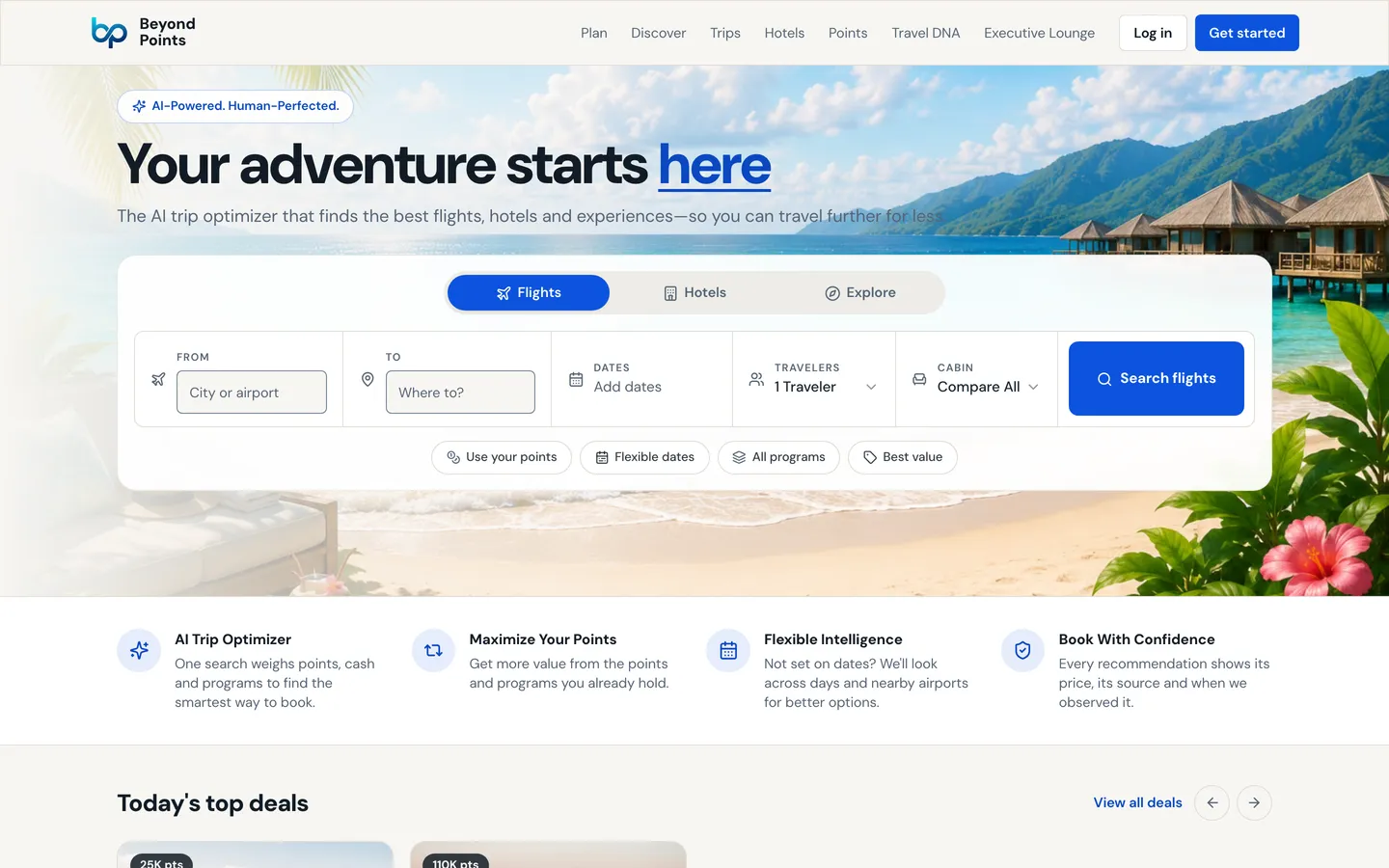
The founder's problem
Gregory Zaks, founder of Beyond Points AI, was sitting on a good idea and a half-built product. Travelers hold hundreds of billions of dollars of unused points every year, and the people who do redeem them well are experts in transfer-partner matrices, award calendars and sweet spots that change monthly. Everyone else either books cash and lets points rot, or burns them at a fraction of their value.
Beyond Points already had a Supabase-backed platform that could show a user their balances. What it could not do was the hard part: reason across every account a traveler holds, compare award inventory against cash fares in real time, and then actually move points and complete a booking. That work was still manual, across a dozen airline and hotel sites, and it was the whole value proposition.
Why Beyond Points came to Frenchy Digital
- An agent layer, not a chatbot: The brief was a fully autonomous booking platform that transfers points and completes bookings, with user checkpoints, on top of the existing Supabase backend.
- Judgment as the moat: In the founder's words, Beyond Points is not a search engine. It has to explain why one option beats another, in cents per point, and be right.
- Speed with guardrails: The product touches real money and real loyalty balances. Automation had to be fast and still impossible to run without a human's say-so.
How AI is used
Two AI layers with different jobs
The conversational layer runs on Google Gemini 2.5 Flash with server-sent streaming. It exposes thirteen tools to the model, from award search and hotel calendars to transfer math and itinerary optimization, so the chat never guesses at a fare it could look up. Dedicated edge functions handle points optimization and itinerary optimization as separate, testable calls.
The autonomous layer is a Claude-based multi-agent system speaking the Model Context Protocol (MCP). An orchestrator delegates to loyalty, transfer, browser, flight-booking and hotel-booking agents, plus a code-reviewer agent and a set of fifteen executable skills. The cost model pairs a Sonnet-class orchestrator with Haiku-class sub-agents so that long-running work stays cheap.
Three MCP servers
browser-mcp
loyalty-mcp
travel-mcp
The journey optimizer
Search results feed a gateway planner that assembles hybrid points-plus-cash journeys, considers nearby airports and flexible dates, and scores each candidate in cents per point. The ranking is deterministic: eight identical concurrent searches return byte-identical results, with session de-duplication, cancellation via AbortSignal and stale-run guards so a slow provider can never overwrite a newer answer.
How we built it
The original proposal sketched a microservice fleet on Kubernetes with a separate planning model. We rejected it during discovery. The founder needed a product he could operate, not a platform team. What shipped is a React and TypeScript single-page app on Cloudflare Pages, a single Supabase project carrying Postgres, Auth, Realtime and 71 Deno edge functions across roughly 70 migrations, and one VPS running the browser agent. Every table has row-level security.
Timeline
- October 2025: First commit. Core platform, auth and points portfolio.
- February 2026: Agent-layer engagement scoped: autonomous search, transfers and booking with user checkpoints, on an eight-week launch plan.
- June 2026: Infrastructure cutover to Cloudflare Pages, a fresh Supabase project and the browser-agent VPS. Architecture docs consolidated.
- August 2026: Sprints 3 to 5: optimizer hardening, live provider validation, timing-claim remediation, vendor de-risking, founder beta readiness.
Problems worth talking about
Silent adapter drift
Claims that could not be proven
An 11-day email outage nobody saw
Fewer vendors, better data
Where it stands
Measured, not marketed
In the pre-beta live run of thirty real searches, the platform averaged 4.7 orchestrator calls and about nine HTTP calls per search, returned ranked journeys for 29 of 30 queries with a 3.3% empty-result rate and a 0% error rate, and measured cents-per-point on 25 of the 29. Median wall time was 20 seconds. Those are the numbers we publish because they are the ones we can reproduce.
Beyond Points is in founder beta. We deliberately do not quote user counts, bookings or dollars saved here, because the product has not opened to the public yet. When it does, this page will be updated with real figures.
Not a search engine. Our moat is judgment.
— Beyond Points AI product principle
What This Project Does Well
Technologies Used
React 18, TypeScript, Vite, Tailwind CSS, shadcn/ui, TanStack Query, Supabase (Postgres, Auth, Realtime, 71 Deno edge functions, ~70 migrations, RLS), Google Gemini 2.5 Flash, Claude API + MCP multi-agent system, Puppeteer browser agent in Docker on a VPS behind Caddy, seats.aero, Travelpayouts, SearchAPI, AwardTool Hotel API, Amex / Chase / Capital One rewards APIs, Cloudflare Pages, Resend
Ready to Build Something Similar?
Let's discuss how we can help transform your business with a custom digital solution.