The problem
A person who wants a puppy or a kitten from a breeder must do a lot of research. The data exists, but it is in many places: kennel club registries, breed clubs, shelter databases and thousands of breeder websites. It is in many languages and many formats.
A buyer who searches for one breed near one town usually finds a marketplace that lists animals like products, or an old forum thread. Breeders and shelters have a different problem. They have no single place where they can show their work and keep their information correct.
The budget was a second problem. A directory needs years to earn search traffic. A stack with monthly fees for each user, each row or each seat can stop the project before the traffic arrives.
The idea
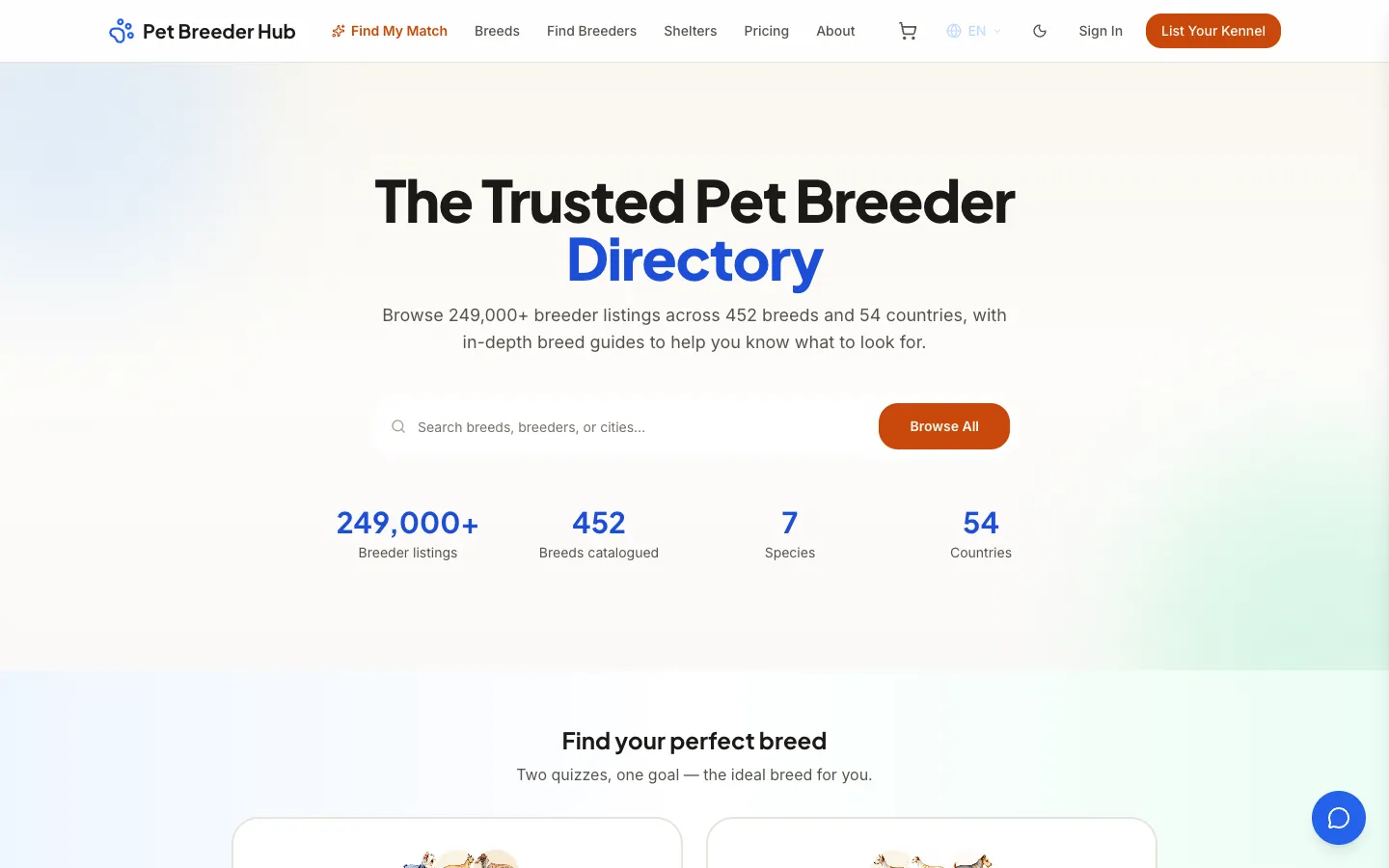
Pet Breeder Directory is a Frenchy Digital product, founded by Chris Machetto. The idea was to collect the public breeder data in one searchable place, and to give each breeder and shelter a profile that they can claim and manage.
The second part of the idea was the method. A small team cannot write a directory of this size by hand in a few months. We used Claude Code, the coding agent from Anthropic, as the main engineer, and we kept a person in charge of each decision. We wanted to learn what this method can build, and what it needs from the people who use it.
What the directory is, and is not
- Aggregated, not vetted: The listings come from public sources. A small number are claimed by their owners or verified after a review. The site never says that breeders are screened as a group.
- Majority European by coverage: The largest country counts are the Czech Republic, France, the United States and the United Kingdom. The United States and Canada are the sales focus, not the main coverage.
- Early on the paid side: Billing works, but this page reports what the code does. It does not report traction that the product has not earned yet.
How it was built, month by month
The first commit is from March 22, 2026, and the most recent is from October 25, 2026. That is about eight months of work. The commit counts below come from the git history.
- March 2026, 98 commits: Claude Code wrote the Next.js scaffold, the database schema, the design system and the homepage on the first day, from a sequence of numbered prompts. In the same week it added 9 international breeder scrapers, the breed health data and the breed quiz.
- April 2026, 243 commits: The busiest month of the early build. Claude added the puppy search page, the breeder data enrichment pipeline and the admin email campaign manager. It also added lead capture for Google sign in and the Sentry error setup.
- May and June 2026, 81 commits: Billing became complete: cancellation emails, retries for failed payments, refunds by country and file delivery for digital products.
- July and August 2026, 114 commits: Claude added search and filters on the directory pages, paid boosts at the top of results and the Claimed badge. A scheduled job now confirms each breeder website again.
- September 2026, 70 commits: Breeder profiles began to list available and sold dogs with prices. The breed quiz became a lead form, and the unsubscribe flow got its own page.
- October 2026, 813 commits: The largest month. About 300 commits were search and indexing work. Claude also built the support inbox, a social media pipeline and a check for every blog article title and description.
How Claude Code was used
The project memory
Claude Code reads a file named CLAUDE.md at the start of each session. In this project the file has 605 lines. It holds the stack, the deploy steps, an audit table of production numbers and the rules for the copy. 8 more rule files cover the API, sign in, code style, the database, email, git and tests.
The file is not documentation for people only. It is the reason that session 500 knows what session 50 learned. When a mistake costs time, the fix goes into the code, and the lesson goes into CLAUDE.md or into a test.
Skills and subagents
10 project skills
12 subagents
A person stays in charge
What we learned
Tests can guard words
More pages is not more traffic
Memory is the main tool
Repeat work becomes a skill
Where it stands
Reported honestly
The directory is live at petbreederdirectory.com. The numbers on this page come from the git history and from the dated audit table in the project rules. We do not publish revenue or subscriber counts here, because they are small. For the architecture of the platform, read the Pet Breeder Directory platform case study.
Describe what a feature does, never promise content that does not exist.
— Pet Breeder Directory project rules
What This Project Does Well
Technologies Used
Claude Code (CLAUDE.md, rule files, skills, subagents, headless runs), Next.js 15, React 19, TypeScript, Tailwind CSS 4, Drizzle ORM, PostgreSQL 16 with PostGIS, Meilisearch, MinIO, Stripe, Resend and React Email, Sentry, Vitest, Playwright, Bun, Docker, Coolify, Cloudflare
Ask AI for a summary of Pet Breeder Directory by Frenchy Digital.
Open your assistant of choice with the question already written.
Ready to Build Something Similar?
Let's discuss how we can help transform your business with a custom digital solution.