





What Is a Full-Lifecycle Mobile App Agency?
A full-lifecycle mobile app agency handles every stage of a mobile application's existence, not just the initial build. This is fundamentally different from the fragmented vendor model where one agency designs, another develops, and a third (or no one) maintains.
The full-lifecycle approach exists because mobile apps are living products, not static deliverables. They exist in an ecosystem that changes constantly: iOS and Android release major OS updates annually, third-party SDKs deprecate features, app store policies evolve, security vulnerabilities emerge, and user expectations rise. An agency that disappears after launch leaves you with a depreciating asset.
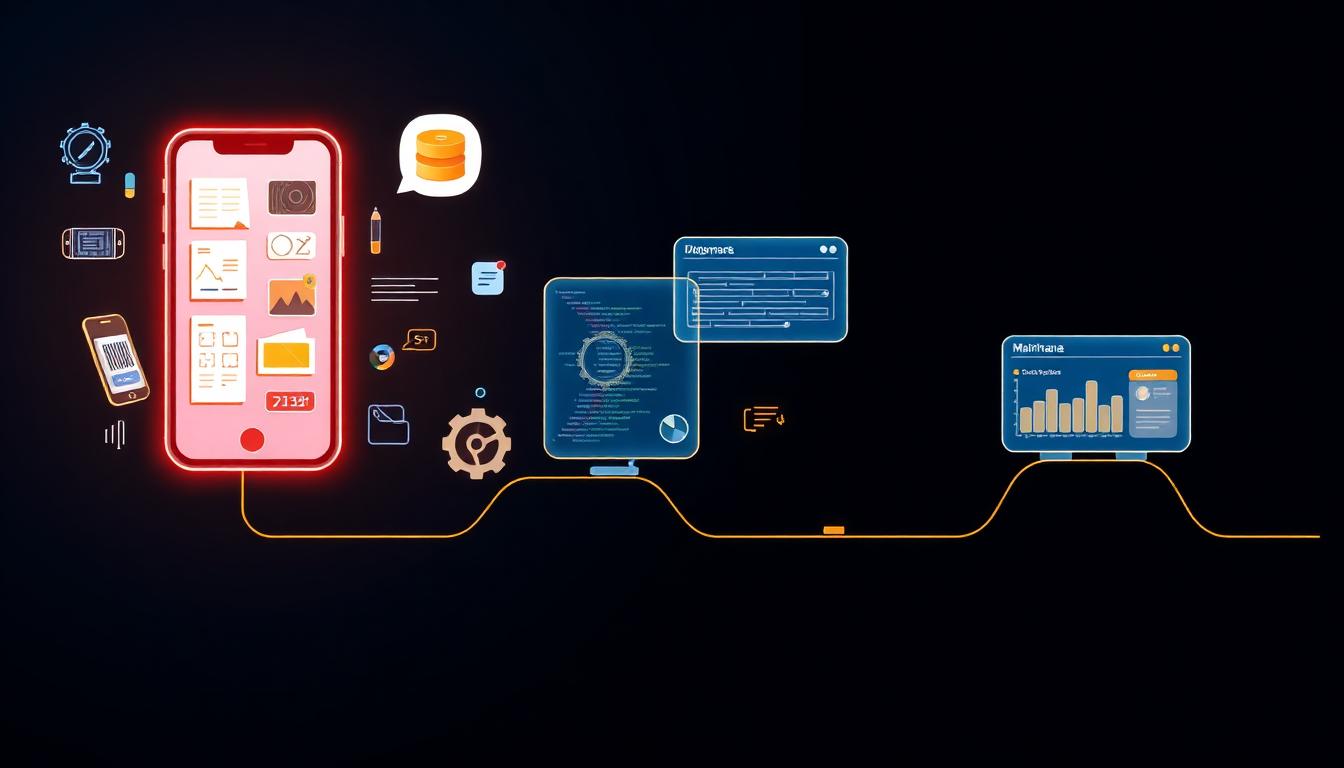
- Design phase: User research, competitive analysis, information architecture, wireframing, visual design, interaction design, prototyping, and usability testing. The design phase answers 'what should we build?' before engineering answers 'how do we build it?'
- Develop phase: Technical architecture, backend API development, mobile engineering (iOS, Android, or cross-platform), third-party integrations, quality assurance, and app store preparation. The develop phase turns validated designs into working software.
- Maintain phase: OS update compatibility, SDK updates, security patches, performance monitoring, bug triage and fixes, app store compliance, analytics review, infrastructure maintenance, and continuous feature iteration. The maintain phase keeps the app alive and competitive.
Design: User Research to Design System
Mobile app design is not making screens look good. It is understanding user needs, mapping mental models, defining interaction patterns, and creating a scalable system that engineers can implement consistently.
- User research: 8-15 interviews with target users to understand pain points, current workarounds, and desired outcomes. Research before design prevents building features nobody needs.
- Competitive teardown: Analysis of 5-10 competitor apps, identifying UX patterns that work, friction points that frustrate users, and differentiation opportunities.
- Information architecture: Structuring content and navigation around user tasks, not organizational hierarchy. Mobile IA must account for one-handed use, thumb zones, and interruption-prone contexts.
- Wireframing & prototyping: Low-fi to high-fi prototypes tested with users before a single line of code is written. Every major flow should be validated with 5-8 users.
- Visual design system: Colors, typography, spacing, motion, and component behaviors documented as reusable patterns. Not just screens: a language that scales.
- Accessibility: WCAG 2.1 AA compliance for color contrast, touch targets (>44pt), screen reader support, and dynamic type. Accessibility is market reach and legal compliance.
The best full-lifecycle agencies embed designers in engineering standups and engineers in design critiques. This cross-functional collaboration prevents the classic handoff failure where beautiful designs are technically impossible or perform poorly.
Good mobile design is not just what an app looks like. It is how the app works, including on an older Android device with a cracked screen in bright sunlight.
Develop: Engineering & Architecture for Mobile
Mobile engineering in 2026 is a mature discipline with clear best practices. The key decision is React Native versus native, and it is less controversial than it used to be.
| Factor | React Native | Native iOS + Android | Recommendation |
|---|---|---|---|
| Code sharing | Code shared between platforms | 0%: separate codebases | React Native wins for most apps |
| Development speed | Faster to MVP | Baseline | React Native for speed to market |
| Performance | Near-native for most UIs | Maximum performance | Native for >60fps gaming or AR |
| Hardware access | Via native modules | Direct, unlimited | Native for custom hardware |
| Team size needed | 1-2 mobile engineers | 2-4 mobile engineers | React Native for lean teams |
| Maintenance cost | Single codebase updates | Double updates (iOS + Android) | React Native for lower maintenance |
| Ecosystem maturity | Mature (payments, maps, auth) | Most mature | Either works for common features |
| Best for | Consumer apps, marketplaces, SaaS | Games, AR/VR, hardware-heavy | React Native as default |
The 2026 standard stack for React Native: Expo or bare React Native, TypeScript, React Navigation, Redux/Zustand for state, React Query for server state, Stripe for payments, Firebase or Supabase for backend services, Sentry for error tracking, and Fastlane for CI/CD.
Maintain: The Forgotten 80% of Mobile App Success
Most founders budget for build and forget maintenance. This is the most expensive mistake in mobile app ownership. Maintenance is not an add-on. It is the phase where products survive or die.
| Maintenance Category | Frequency | Impact If Neglected | Typical Cost |
|---|---|---|---|
| OS updates (iOS/Android) | 2× per year (major releases) | App crashes, feature breaks, store rejection | $15K-$40K per update cycle |
| Security patches | Continuous (critical within 48h) | Data breaches, compliance violations, user trust loss | $5K-$15K per critical patch |
| SDK updates & deprecations | Quarterly | Build failures, broken features, compliance issues | $8K-$20K per quarter |
| Performance optimization | Monthly monitoring, quarterly deep-dive | Slow UX, battery drain, negative reviews | $10K-$25K per optimization sprint |
| Bug fixes & crash triage | Continuous | User churn, 1-star reviews, uninstalls | $5K-$15K per sprint |
| App store compliance | As policies change | Rejection, delisting, account suspension | $3K-$10K per compliance update |
| Analytics & monitoring | Ongoing | Flying blind on user behavior and crashes | Included in retainer |
| Feature iteration | Every 2-4 weeks (active products) | Stagnation, competitive disadvantage | $15K-$40K per feature sprint |
The total annual maintenance cost for a typical consumer app is 20-30% of the initial build cost. For actively iterated products (social, marketplaces, SaaS), it is 30-40%. This is not waste. It is the investment that keeps the product competitive, secure, and compatible.
Full-Lifecycle vs. Point Vendors: The Hidden Costs
Many founders hire a design agency, then a dev shop, then hope their internal team can maintain. The coordination costs are invisible until they are painful.
| Dimension | Design + Dev + Maintain (separate) | Full-Lifecycle Agency | Cost Impact |
|---|---|---|---|
| Handoff friction | High: lost context at every transition | None: shared team memory | Budget savings |
| Design feasibility | Designers unaware of mobile constraints | Engineers inform design in real time | Fewer unbuildable designs |
| Maintenance context | New team must learn codebase | Same team that built it maintains it | Faster bug resolution |
| Accountability | Fragmented: who owns retention? | Single partner owns outcomes | Clear escalation path |
| Timeline coordination | Sequential, delays cascade | Parallel workstreams, unified schedule | Faster overall delivery |
| Post-launch iteration | Often forgotten or deprioritized | Planned from kickoff | Continuous improvement |
The full-lifecycle model is not just more convenient. It produces better products. When the same team that researched users also designs screens, engineers features, and monitors retention, they develop intuition about what works that no handoff document can capture.
Top 12 Agencies for Design, Develop & Maintain 2026
These agencies were selected for verified full-lifecycle delivery: design sprints with user research, engineering with documented architecture, and maintenance contracts with named support engineers and SLAs.
| Agency | HQ | Specialization | Build Range | Maintenance Model |
|---|---|---|---|---|
| Frenchy Digital | Los Angeles / Paris / Geneva | Cross-platform, AI-native, full-lifecycle | $80K-$800K | Retainer $8K-$30K/mo with named engineers |
| Fueled | New York / London | Consumer mobile, luxury, brand apps | $150K-$600K | Retainer + dedicated support |
| Rapidrise | San Francisco | B2B SaaS, developer tools, startup speed | $120K-$400K | Monthly iteration sprints |
| MindSea | Halifax, Canada | Healthtech, wellness, regulated apps | $90K-$300K | Compliance-focused maintenance |
| Netguru | Poznań, Poland | Fintech, proptech, marketplace | $100K-$400K | Agile retainers with SLA |
| Ustwo | London / New York / Malmö | Premium mobile, games, human-centered | $200K-$1M | White-glove ongoing support |
| Work & Co | Brooklyn / Portland / Copenhagen | Product design + engineering | $250K-$1.5M | Embedded team model |
| MojoTech | Providence, RI | Enterprise SaaS, data platforms | $200K-$1M | Enterprise SLA maintenance |
| STX Next | Poznań, Poland | Python, data-heavy, fintech | $80K-$350K | European timezone support |
| Appster (restructured) | Melbourne / London | Consumer mobile, marketplaces | $100K-$350K | Growth-oriented iteration |
| WillowTree | Charlottesville, VA | Enterprise mobile, media, finance | $300K-$1.5M | Fortune 500 support programs |
| Y Media Labs | Redwood City, CA | Consumer, health, entertainment | $200K-$800K | Silicon Valley iteration speed |
Pricing Across the Full Lifecycle
Full-lifecycle pricing reflects three distinct phases, each with its own cost structure and risk profile.
| Phase | Model | Range | What It Covers |
|---|---|---|---|
| Design | Fixed-price sprint | $15K-$40K | Research, IA, wireframes, prototypes, design system, usability testing |
| Develop | Milestone-based sprints | $30K-$100K/month | Architecture, engineering, QA, integrations, app store prep |
| Launch | Fixed-price | $10K-$30K | Submission, ASO, beta, monitoring setup |
| Standard Maintenance | Monthly retainer | $5K-$15K/month | OS updates, security patches, bug fixes, monitoring |
| Active Iteration | Monthly retainer | $15K-$40K/month | Everything in standard + feature sprints, A/B testing, growth |
| First Year Total | Cumulative | $150K-$400K | Build + 12 months active maintenance for typical consumer app |
Mobile Tech Stack 2026
The modern mobile stack in 2026 is TypeScript-first, cloud-native, and AI-ready by default.
| Layer | Primary | Alternative | When to Choose Alternative |
|---|---|---|---|
| Framework | React Native (Expo) | Flutter | Flutter if Dart team exists or specific UI requirements |
| Language | TypeScript | Swift / Kotlin | Native for hardware-heavy or performance-critical apps |
| Navigation | React Navigation v7 | Expo Router | Expo Router for file-based routing simplicity |
| State management | Zustand + React Query | Redux Toolkit | Redux for complex undo/redo or time-travel debugging |
| Backend | Supabase / Firebase | Node.js + PostgreSQL | Custom backend for complex business logic |
| Auth | Supabase Auth / Clerk | Auth0 | Auth0 for enterprise SAML requirements |
| Payments | Stripe React Native | RevenueCat | RevenueCat for subscription management across platforms |
| Push notifications | Firebase Cloud Messaging | OneSignal | OneSignal for cross-platform orchestration |
| Analytics | PostHog / Mixpanel | Amplitude | Amplitude for enterprise-scale event volume |
| Error tracking | Sentry | Bugsnag | Bugsnag for detailed breadcrumb tracking |
| CI/CD | EAS Build / GitHub Actions | Bitrise / Codemagic | Bitrise for native-heavy builds |
| AI | OpenAI API + embeddings | Anthropic / Gemini | Anthropic for longer context windows |
Handling iOS & Android OS Updates
Apple and Google each release one major OS update annually, with 4-6 minor updates throughout the year. Each update has the potential to break your app.
- WWDC (June) and Google I/O (May): Monitor beta releases and test your app on beta simulators within 2 weeks. Identify breaking changes early.
- Major release compatibility (September/October): Update SDKs, fix deprecated APIs, test on physical devices running the new OS, and submit an update before the OS adoption curve peaks.
- App Store policy changes: Apple and Google update policies throughout the year. Privacy, payment, and content policies are the most common sources of rejection.
- Third-party SDK deprecations: Facebook, Firebase, Stripe, and other SDKs deprecate features. Automated dependency scanning (Dependabot, Snyk) catches these before they break builds.
- Device compatibility: New devices (iPhone, Pixel, Galaxy) introduce new screen sizes, notches, and hardware capabilities. Test on actual devices, not just simulators.
Performance Optimization & Monitoring
Mobile users are unforgiving of slow load times. Performance is not a feature: it is the foundation.
| Metric | Target | How to Monitor | Common Fixes |
|---|---|---|---|
| Cold start time | <2 seconds | Firebase Performance, custom timers | Lazy loading, reduce initial bundle, preload critical data |
| Time to interactive | <3 seconds | Lighthouse, Web Vitals | Code splitting, image optimization, reduce JS execution |
| Frame rate | 60fps consistently | Flipper, Xcode Instruments | Optimize re-renders, useFlatList, reduce shadow complexity |
| APK/IPA size | <50MB ideal, <100MB acceptable | Android Studio, Xcode | Asset compression, remove unused dependencies, app thinning |
| Memory usage | <150MB average | Xcode Memory Graph, Android Profiler | Fix memory leaks, optimize image caching, reduce background tasks |
| Battery drain | Minimal background activity | Instruments Energy Log | Reduce location polling, optimize network requests, use push over polling |
| Crash-free rate | >99.5% | Sentry, Firebase Crashlytics | Fix top 5 crashes, null safety, type checking, boundary testing |
Performance monitoring should be continuous, not a one-time audit. The best agencies set performance budgets in CI: if a PR increases bundle size beyond threshold or slows startup by >100ms, it is blocked until optimized.
Security & Compliance Maintenance
Mobile apps handle sensitive data: payments, location, contacts, health data. Security is not a one-time audit; it is continuous vigilance.
- Dependency scanning: Automated checks (Snyk, Dependabot) for known vulnerabilities in third-party libraries. Updated weekly.
- Certificate pinning: Prevent man-in-the-middle attacks by pinning SSL certificates. Update pins before certificate expiry.
- Data encryption: AES-256 for data at rest, TLS 1.3 for data in transit. Keychain/Keystore for sensitive tokens.
- Obfuscation & hardening: Code obfuscation (ProGuard, R8) and anti-tampering measures for apps handling payments or proprietary logic.
- Compliance alignment: GDPR (EU users), CCPA (California), HIPAA (health data), PCI-DSS (payments). Privacy policy and consent flows kept current.
- Penetration testing: Annual third-party pentest for apps handling sensitive data. Remediation of findings within 30 days.
10 Red Flags When Choosing a Full-Lifecycle Agency
The mobile app agency market is crowded. These red flags separate pretenders from professionals.
- No user research in design phase: If the agency starts with mockups before talking to users, they are decorating, not designing.
- Maintenance not discussed in first meeting: An agency that avoids maintenance conversations plans to disappear after launch.
- No written SLA for bug response: Without response time commitments, critical issues sit unresolved for weeks.
- Template portfolios: Every app looks the same because they reuse the same codebase. Your app will not differentiate.
- Offshore teams without transparency: There is nothing wrong with global talent, but hiding who builds your app prevents accountability.
- Fixed bid without discovery: A quote after one call is a guess, not a proposal. Expect change orders or corner-cutting.
- No named maintenance engineer: If you cannot meet the person who will fix your bugs, you cannot hold them accountable.
- IP retention or licensing clauses: You must own your code, designs, and data. Any retention is a structural risk.
- No OS update plan: An agency without a documented process for handling annual iOS and Android updates has not maintained apps long-term.
- No performance monitoring: If the agency does not discuss Sentry, Firebase Performance, or equivalent tools, they are not measuring quality.
Frenchy Digital: Design, Develop, and Maintain, All Under One Roof
Frenchy Digital is a full-lifecycle mobile app partner with 50+ apps launched and maintained across iOS, Android, and cross-platform. We do not hand off: we own the entire journey.
- Design sprints with real user testing: Every app starts with validated user research, not assumptions. Tested prototypes before engineering commits.
- Senior-led engineering: Named tech leads, React Native and native specialists, full-stack teams with modern TypeScript stacks.
- Continuous maintenance: Named support engineers, documented OS update process, 48-hour critical bug SLA, and automated dependency scanning.
- Performance obsession: Performance budgets in CI, continuous monitoring, and optimization sprints every quarter.
- Security-first: Automated scanning, compliance documentation, annual pentests, and 48-hour critical patch commitment.
- Growth engineering: Analytics, onboarding optimization, and ASO built into v1.0 and continuously iterated.
| Engagement | Scope | Timeline | Investment |
|---|---|---|---|
| Design Sprint | Research, prototype, design system | 3-4 weeks | $12K-$25K |
| MVP Build | Core features, single platform, launch | 12-16 weeks | $80K-$150K |
| Full Product | Multi-platform, integrations, admin | 5-8 months | $150K-$400K |
| Standard Maintenance | OS updates, security, bugs, monitoring | Ongoing | $8K-$18K/month |
| Active Iteration | Standard + feature sprints, growth, A/B testing | Ongoing | $18K-$35K/month |
We have maintained apps in production for 5+ years, through 10+ iOS and Android major releases, policy changes, SDK deprecations, and platform migrations. That continuity is the value of a true full-lifecycle partner.
Need a mobile app designed, built, and maintained?
Book a free 30-minute discovery call with Frenchy Digital. We will map your full mobile app lifecycle, recommend React Native or native, and give you an honest build and maintenance budget, whether or not you work with us.
1517 S Bentley Ave Suite 204, Los Angeles CA 90025