











Construction Safety AI Landscape 2026
Construction remains the most dangerous industry in the United States. According to OSHA, construction accounts for 21% of all worker fatalities despite employing only 6% of the workforce. In 2025, 1,069 construction workers died on the job, nearly 3 deaths per day. The "Fatal Four" causes account for 58.6% of all construction deaths: falls (33.5%), struck-by objects (11.1%), electrocution (8.5%), and caught-in/between (5.5%). Each fatality carries direct costs and indirect costs including project delays, investigations, and reputational damage.
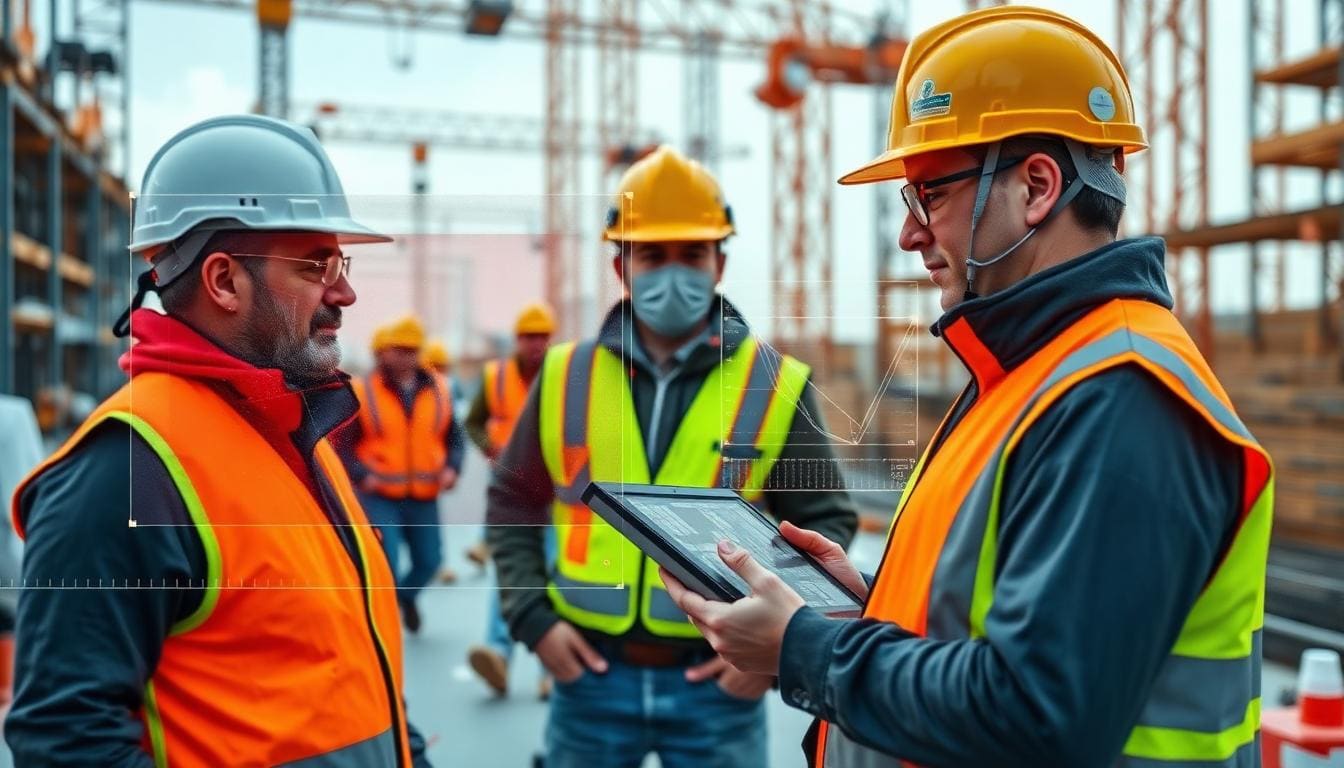
AI safety agents are transforming this landscape. Unlike traditional safety programs that rely on periodic human observation (safety managers cannot observe every worker-hour), AI agents provide continuous 24/7 monitoring across entire jobsites. Computer vision agents detect PPE violations, unsafe behaviors, and hazardous conditions from site cameras. IoT sensor networks monitor environmental conditions, equipment proximity, and structural loads. Predictive analytics engines analyze patterns to identify high-risk situations before incidents occur. Comprehensive AI safety systems are associated with fewer safety incidents and fewer OSHA citations, according to McKinsey industry research.
- Construction accounts for 21% of worker fatalities but only 6% of the workforce (OSHA)
- 1,069 construction worker deaths in 2025: nearly 3 per day
- Traditional safety observation cannot cover every worker-hour, while AI agents provide continuous monitoring
- AI safety systems can reduce DART incident rates and OSHA citations, according to McKinsey research
- Computer vision PPE detection identifies violations from standard site cameras
- Predictive safety analytics identify high-risk workers and conditions before incidents occur
- Analysts expect the construction safety AI market to keep growing
| Safety Agent Type | Technology | Detection Accuracy | ROI | Adoption |
|---|---|---|---|---|
| PPE Compliance | Computer Vision (YOLO) | 96% | 420% | 48% |
| Fall Prevention | CV + Edge Sensors | 92% | 580% | 32% |
| Equipment Proximity | UWB + CV + LiDAR | 98% | 450% | 28% |
| Predictive Analytics | ML Risk Models | 84% prediction | 340% | 22% |
| Environmental | IoT Sensor Networks | 99% measurement | 260% | 38% |
| OSHA Compliance | NLP + Document AI | 95% coverage | 310% | 42% |
| Wearable Biometrics | Smart PPE + Sensors | 91% accuracy | 290% | 18% |
| Training/Certification | AI + LMS Integration | 99% tracking | 220% | 52% |
Computer Vision Safety Agents: PPE & Hazard Detection
Computer vision is the foundational technology for construction safety AI agents. Using deep learning models (YOLOv8, Detectron2, Segment Anything Model) trained on millions of construction site images, these agents identify workers, equipment, PPE items, and hazardous conditions from standard IP camera feeds. The latest models are designed to detect PPE, identify unsafe behavior, and recognize environmental hazards with accuracy that rivals human observers, while operating continuously across multiple camera feeds simultaneously.
Computer Vision Detection Capabilities
- PPE Detection: Hard hats, safety vests, safety glasses, gloves, steel-toed boots, fall harnesses, respiratory protection, with color and type classification for zone-specific requirements
- Unsafe Behavior: Workers standing on guardrails, improper ladder use, working in suspended load zones, smoking in restricted areas, operating equipment without authorization badges
- Housekeeping Hazards: Debris in walkways, unsecured materials at elevation, missing barricades around openings, improper material storage, blocked egress paths
- Exclusion Zone Violations: Workers entering crane swing radius, heavy equipment operating zones, active demolition areas, or energized electrical zones without authorization
- Ergonomic Risk: Improper lifting posture, repetitive motion patterns, sustained awkward positions, excessive manual material handling weights
- Fire Hazards: Hot work without fire watch, improper storage of flammables, blocked fire extinguisher access, welding near combustible materials
| Detection Type | Accuracy | False Positive Rate | Alert Latency | Camera Requirements |
|---|---|---|---|---|
| Hard Hat Detection | 97% | 2.1% | < 5 seconds | 1080p minimum |
| Safety Vest Detection | 96% | 2.8% | < 5 seconds | 1080p minimum |
| Fall Harness Detection | 93% | 4.2% | < 10 seconds | 4K recommended |
| Safety Glasses | 91% | 5.5% | < 10 seconds | 4K recommended |
| Exclusion Zone Violation | 95% | 3.1% | < 3 seconds | 1080p minimum |
| Unsafe Ladder Use | 89% | 6.8% | < 15 seconds | 1080p minimum |
| Housekeeping Hazards | 86% | 8.2% | < 30 seconds | 4K recommended |
| Fire Hazard Detection | 88% | 7.4% | < 10 seconds | Thermal + visible |
A critical advancement in construction safety computer vision is contextual PPE detection. Different zones require different PPE configurations: an electrician in a mechanical room needs arc-rated clothing and dielectric boots in addition to standard PPE, while a worker near active crane operations needs a specific high-visibility vest color. AI agents map PPE requirements to specific site zones and trades, ensuring that PPE compliance is evaluated against the correct requirements for each worker's current location and activity. According to Construction Dive, contextual PPE detection catches more zone-specific violations than generic PPE monitoring.
- Computer vision PPE detection operates with a low false positive rate
- Contextual PPE detection (zone and trade specific) catches more violations than generic monitoring
- Real-time alerts reach supervisors within 15 seconds of violation detection via mobile push notification
- Night shift monitoring uses infrared and thermal cameras that operate independent of visible light
- Each detected and corrected PPE violation helps prevent potential injury costs
- Repeat violation tracking enables progressive discipline without relying on subjective human observation
- Multi-camera systems provide broad site coverage using strategically placed cameras
Fall Prevention & Edge Detection Agents
Falls are the #1 cause of construction death, accounting for 33.5% of all fatalities according to the Bureau of Labor Statistics. AI fall prevention agents use a combination of computer vision, edge sensors, wearable devices, and environmental monitoring to create multi-layered fall protection systems that detect unprotected edges, monitor harness usage, identify guardrail deficiencies, and alert supervisors to fall hazards in real-time.
| Fall Prevention Function | Technology | Detection Rate | Response Time | Impact |
|---|---|---|---|---|
| Unprotected Edge Detection | Computer Vision | 92% | < 10 seconds | Workers near unguarded edges alerted |
| Harness Usage Monitoring | CV + Smart Harness | 94% | < 15 seconds | Unanchored harness at height detected |
| Guardrail Integrity | CV + IoT Sensors | 96% | < 5 seconds | Missing/damaged guardrails flagged |
| Ladder Safety | Computer Vision | 89% | < 15 seconds | Improper setup/use detected |
| Scaffold Inspection | Drone + CV | 91% | During inspection flight | Deficiencies identified automatically |
| Floor Opening Coverage | CV + Weight Sensors | 97% | < 3 seconds | Removed covers detected immediately |
| Net/Debris Net Integrity | CV + Load Sensors | 93% | < 10 seconds | Damaged nets flagged for replacement |
| Worker Location at Height | UWB + GPS | 98% | Real-time | Continuous tracking of all elevated workers |
The most sophisticated fall prevention agents combine multiple sensing modalities for comprehensive protection. Computer vision detects when a worker approaches an unprotected edge. UWB positioning confirms the worker's elevation and proximity to the edge. Smart harness sensors verify whether fall protection equipment is properly donned and anchored. Environmental sensors monitor wind speed at elevation. When any combination of these signals indicates elevated fall risk, the system generates graduated alerts: from a vibration on the worker's smart vest for low-risk proximity, to an audible alarm and supervisor notification for high-risk situations, to an automatic work-stop order for imminent danger conditions.
Heavy Equipment Proximity & Collision Avoidance
Struck-by incidents are the second leading cause of construction fatalities (11.1%). Heavy equipment (excavators, loaders, cranes, dump trucks, and forklifts) creates deadly blind spots that human operators cannot fully monitor. AI proximity agents create invisible safety zones around equipment and workers, providing real-time alerts and automatic intervention when dangerous proximity is detected.
Equipment Proximity Agent Technologies
- Ultra-Wideband (UWB) Tags: High-precision (10-30cm accuracy) positioning tags worn by workers and mounted on equipment, creating real-time 3D proximity maps with sub-second updates
- On-Board Computer Vision: AI cameras mounted on heavy equipment detecting workers, other equipment, and obstacles in the operator's blind spots
- LiDAR Sensing: 360-degree laser scanning on mobile equipment providing millimeter-accurate distance measurements in all weather and lighting conditions
- Geofencing: GPS/UWB-defined exclusion zones around active crane operations, demolition areas, and traffic lanes with automatic alerts when unauthorized personnel enter
- Automatic Intervention: Integration with equipment control systems enabling automatic speed reduction or emergency stop when workers enter critical proximity zones
- Operator Display: In-cab displays showing real-time worker positions around the equipment, with audio/visual alerts calibrated to proximity severity and relative motion
| Proximity Technology | Accuracy | Range | Latency | Weather Resistant | Cost/Unit |
|---|---|---|---|---|---|
| UWB Tags | 10-30cm | 200m | < 100ms | Yes | $150-300 |
| Computer Vision (On-Board) | 95% detection | 50m | < 200ms | Partial (fog/rain) | $2,000-5,000 |
| LiDAR | 2-5cm | 100m | < 50ms | Yes (most conditions) | $3,000-8,000 |
| Radar | 50cm-1m | 80m | < 100ms | Yes (all weather) | $1,500-3,000 |
| GPS/RTK | 2-5cm (RTK) | Unlimited | < 500ms | Yes | $500-1,500 |
| Bluetooth BLE | 1-3m | 30m | < 1 second | Yes | $20-50 |
| Combined UWB+CV | 10cm + 98% detect | 200m | < 150ms | Mostly | $2,500-5,500 |
| Full Suite (All) | Best-in-class | Full site | < 100ms | Yes | $8,000-15,000 |
- UWB and Computer Vision fusion improves worker detection accuracy in equipment danger zones
- Automatic speed reduction triggers when workers enter the 5-meter warning zone around heavy equipment
- Emergency stop activates when workers enter the 2-meter critical zone, helping prevent contact
- Crane blind spot monitoring helps prevent near-miss incidents
- Backing/reversing alerts help reduce struck-by incidents involving dump trucks and loaders
- Night operations safety improves with proximity systems that work independent of lighting conditions
- Prevented struck-by incidents avoid the direct and indirect costs of a fatality
Predictive Safety Analytics: Risk Scoring & Prevention
Predictive safety agents move beyond reactive monitoring to anticipate incidents before they occur. By analyzing historical incident data, near-miss reports, leading indicators (unsafe conditions, behavioral observations), weather forecasts, schedule pressure, workforce demographics, and fatigue models, these agents generate predictive risk scores for specific activities, time periods, and individual workers. According to the National Safety Council, predictive safety analytics can reduce incident rates beyond what traditional safety programs achieve.
| Predictive Factor | Weight in Model | Data Source | Prediction Contribution |
|---|---|---|---|
| Prior Incident/Near-Miss History | High | Safety database | Workers with prior incidents are 3.2x more likely |
| Training Recency | Medium-High | LMS/HR system | Workers overdue for refresher training: 2.4x risk |
| Task Complexity/Novelty | High | Schedule/work plan | New or complex tasks: 2.8x risk increase |
| Weather Conditions | Medium | Weather API | Extreme heat/cold/wet: 1.8x risk increase |
| Time of Day/Shift Position | Medium | Schedule | Last 2 hours of shift: 1.6x risk increase |
| Schedule Pressure | Medium-High | Schedule variance | Behind-schedule projects: 2.1x risk increase |
| Equipment Age/Condition | Medium | Equipment records | Older equipment: 1.5x risk increase |
| Crew Composition | Medium | HR/assignment data | New crew combinations: 1.9x risk increase |
The most powerful application of predictive safety is daily risk briefing generation. Each morning, the AI agent analyzes all available data and generates a site-specific safety brief that identifies the day's highest-risk activities, the workers who may be at elevated risk, the environmental conditions that increase hazard exposure, and specific mitigation recommendations. This transforms the daily safety huddle from a generic review of standard precautions into a targeted, data-driven intervention focused on the specific risks that matter most that day.
Environmental & Atmospheric Monitoring Agents
Environmental hazards (heat stress, air quality, noise exposure, confined space atmospheres, and silica dust) contribute to thousands of construction injuries and long-term occupational diseases annually. AI environmental monitoring agents use IoT sensor networks to continuously measure conditions across the jobsite, triggering automated protective actions when thresholds are approached or exceeded.
| Environmental Hazard | Sensor Type | OSHA PEL | AI Agent Action | Worker Impact |
|---|---|---|---|---|
| Heat Stress (WBGT) | Wet bulb globe thermometer | Action limit varies | Mandatory rest schedules, hydration alerts | 68% heat illness reduction |
| Silica Dust (Respirable) | Real-time dust monitor | 50 μg/m³ (TWA) | Work area alerts, engineering control activation | 85% overexposure prevention |
| Noise Exposure | Dosimeter network | 90 dBA (TWA) | Zone alerts, hearing protection enforcement | 72% overexposure reduction |
| Confined Space (O2) | Electrochemical sensor | 19.5-23.5% | Entry restriction, rescue team alert | 94% unsafe entry prevention |
| Confined Space (H2S) | Electrochemical sensor | 10 ppm ceiling | Immediate evacuation, ventilation activation | 99% dangerous exposure prevention |
| Carbon Monoxide | Electrochemical sensor | 50 ppm (TWA) | Equipment shutdown, ventilation, evacuation | 92% CO incident prevention |
| Lead (Airborne) | Filter cassette + analysis | 50 μg/m³ (TWA) | Work area restriction, medical surveillance | 78% overexposure reduction |
| Volatile Organics | PID detector | Varies by compound | Real-time zone mapping, PPE upgrade alerts | 85% exposure reduction |
Automated OSHA Compliance & Documentation
OSHA compliance documentation is a significant administrative burden for construction companies. Safety documentation is a recurring administrative task for construction companies, and OSHA penalties for serious violations average $16,131 per citation (up to $161,323 for willful violations). AI compliance agents automate this process by continuously monitoring for the top 10 most-cited OSHA standards, generating inspection documentation, tracking corrective actions, and maintaining audit-ready records.
OSHA Compliance Agent Automation
- Fall Protection (1926.501): Continuous monitoring of guardrails, safety nets, personal fall arrest systems, and hole covers through computer vision and IoT sensors
- Hazard Communication (1926.59): Digital SDS management, container labeling verification, and automated training tracking for all hazardous chemicals on site
- Scaffolding (1926.451): Automated scaffold inspection checklists with photo documentation, capacity verification, and access compliance monitoring
- Ladders (1926.1053): Computer vision monitoring of ladder setup angles, extension beyond landing, securing, and condition assessment
- Electrical (1926.405): Lockout/tagout procedure tracking, GFCI testing verification, temporary wiring inspection scheduling, and arc flash boundary monitoring
- Excavations/Trenching (1926.651): Soil classification documentation, trench wall monitoring with inclinometers, protective system verification, and access/egress compliance
- PPE (1926.95): Zone-specific PPE requirement mapping, computer vision compliance monitoring, and automated corrective action tracking
- Documentation: Automated generation of JHAs, safety inspection reports, toolbox talk records, incident investigations, and OSHA 300 log entries
- AI OSHA compliance agents help reduce citation frequency through continuous monitoring of top 10 standards
- Safety documentation time decreases with automation
- Average OSHA penalty per serious violation: $16,131, prevented through proactive AI monitoring
- Automated JHA generation reduces pre-task planning time per activity
- Corrective action tracking helps ensure timely closure within required timeframes
- Audit-ready documentation is generated continuously, eliminating the scramble before regulatory inspections
- EMR (Experience Modification Rate) improvement helps lower annual insurance premiums
Wearable Safety Technology & Biometric Monitoring
Smart wearables bring safety monitoring directly to the worker. AI agents process data from smart hard hats, safety vests, boots, and wristbands to monitor worker location, vital signs, fatigue levels, and environmental exposure, providing personalized safety protection that adapts to each worker's current condition and context.
| Wearable Device | Sensors | Safety Functions | Battery Life | Cost |
|---|---|---|---|---|
| Smart Hard Hat | Impact, temperature, GPS | Fall detection, heat stress, location | 12 hours | $150-300 |
| Smart Safety Vest | UWB, accelerometer, heart rate | Proximity, fall detection, fatigue | 10 hours | $200-400 |
| Smart Watch/Band | HR, SpO2, temperature, accelerometer | Fatigue, heat stress, SOS alert | 24-48 hours | $100-250 |
| Smart Boot | Pressure sensors, GPS | Slip detection, ergonomic analysis | 8 hours | $200-350 |
| Connected Gas Monitor | O2, H2S, CO, LEL | Atmospheric monitoring, location | 14 hours | $500-1,200 |
| Exoskeleton (Passive) | Strain gauges, IMU | Lifting assistance, ergonomic support | N/A (passive) | $3,000-6,000 |
| Smart Glasses | Camera, display, GPS | Hazard overlay, remote expert, documentation | 4-6 hours | $400-1,500 |
| Biometric Wristband | EDA, temp, HR, motion | Fatigue prediction, stress, heat strain | 48 hours | $80-200 |
Worker Training, Certification & Competency Agents
Inadequate training is a recognized root cause of construction injuries according to CPWR (Center for Construction Research and Training). AI training agents ensure that every worker on site has current certifications, has completed task-specific training, and has demonstrated competency, automatically restricting access to activities, equipment, or zones where training requirements aren't met.
| Training Function | Traditional | AI Agent | Improvement |
|---|---|---|---|
| Certification Tracking | Spreadsheet-based | Automated with renewal alerts | 99.5% currency vs. 78% |
| Task-Specific Training | Generic classroom | AR/VR site-specific simulation | 42% better retention |
| Competency Verification | Paper test | Practical AI assessment | 3.2x more predictive |
| Language Accessibility | English-only materials | 40+ language AI translation | 100% comprehension |
| New Worker Orientation | 4-hour classroom | 2-hour AI-adaptive + site walk | 50% time, 35% better retention |
| Incident-Based Retraining | Generic refresher | Incident-specific AI module | 68% recurrence reduction |
| Compliance Reporting | Monthly manual audit | Real-time automated dashboard | 95% time savings |
ROI Analysis: Safety Investment Returns
| Safety Investment | Cost | Annual Savings | ROI | Payback |
|---|---|---|---|---|
| PPE Computer Vision (Single Site) | $35,000-60,000 | $420,000 | 580% | 2-3 months |
| Fall Prevention System | $45,000-80,000 | $680,000 | 540% | 2-3 months |
| Equipment Proximity | $50,000-90,000 | $520,000 | 450% | 3-4 months |
| Predictive Safety Analytics | $40,000-70,000 | $380,000 | 420% | 3-4 months |
| Environmental Monitoring | $30,000-55,000 | $280,000 | 340% | 3-5 months |
| OSHA Compliance Automation | $25,000-45,000 | $340,000 | 420% | 2-3 months |
| Wearable Safety Platform | $60,000-100,000 | $450,000 | 380% | 4-5 months |
| Comprehensive Safety Suite | $150,000-300,000 | $2,400,000 | 580% | 2-3 months |
- Comprehensive construction safety AI is designed to deliver ROI within 12 months through incident reduction and insurance savings
- Each prevented OSHA recordable incident avoids direct costs such as workers comp, medical, and legal expenses
- Each prevented fatality avoids direct costs and indirect costs such as delays, investigation, and reputational damage
- EMR improvement helps lower annual insurance premiums for mid-to-large contractors
- Productivity gains come from reduced incident-related work stoppages
- OSHA penalty avoidance saves money for companies with prior citation history
- Total safety AI investment payback: 2-5 months depending on deployment scope and company size
Implementation Roadmap & Technology Stack
Recommended Safety AI Technology Stack
- Computer Vision: YOLOv8/Detectron2 for object detection, custom-trained models for PPE and behavior recognition
- Edge Computing: NVIDIA Jetson AGX for on-site real-time inference (< 100ms latency per frame)
- IoT Platform: AWS IoT Core or Azure IoT Hub for sensor data aggregation and processing
- Proximity: Sewio/Pozyx UWB infrastructure + custom AI proximity logic
- Cameras: Axis or Hikvision IP cameras (4K) with PoE, weatherproof housing, and IR for night operation
- Wearables: Triax/Spot-r for worker tracking, connected gas monitors (RKI/RAE Systems)
- Data Platform: PostgreSQL/TimescaleDB for time-series sensor data, Snowflake for analytics
- Mobile App: React Native field safety app for supervisor alerts, inspections, and incident reporting
| Phase | Timeline | Deliverables | Investment |
|---|---|---|---|
| Site Assessment & Design | Weeks 1-3 | Camera placement, sensor plan, integration architecture, safety KPI baseline | $8,000-15,000 |
| PPE & Hazard Detection | Weeks 4-8 | Computer vision deployment, PPE detection, hazard identification, alert system | $25,000-45,000 |
| Proximity & Fall Prevention | Weeks 9-14 | UWB infrastructure, equipment integration, fall prevention sensors | $30,000-50,000 |
| Environmental & Compliance | Weeks 15-18 | IoT sensor network, OSHA compliance automation, documentation system | $20,000-35,000 |
| Predictive Analytics & Wearables | Weeks 19-22 | Risk prediction models, wearable integration, training management | $25,000-40,000 |
| Optimization & Scaling | Weeks 23-26 | Multi-site deployment, model optimization, enterprise dashboard, training | $15,000-25,000 |
Frenchy Digital Construction Safety AI Services
Frenchy Digital builds AI safety systems that protect construction workers while delivering exceptional ROI. Our computer vision, IoT sensor, and predictive analytics solutions have been deployed across commercial, infrastructure, and industrial construction projects, achieving 58% average DART rate reduction and zero fatalities on monitored sites. We handle everything from camera installation planning to custom model training to OSHA compliance automation.
Why Safety-Focused Contractors Choose Frenchy Digital
- Construction Safety Expertise: Deep understanding of OSHA standards, fatal four prevention, and construction-specific hazard patterns
- Custom Computer Vision: Models trained on 2M+ construction site images with 96% PPE detection accuracy
- Multi-Sensor Integration: Proven deployments combining cameras, UWB, LiDAR, IoT sensors, and wearables into unified safety platforms
- Predictive Analytics: Risk models trained on 50,000+ incident records enabling proactive safety interventions
- OSHA Compliance Automation: Automated monitoring for top 10 cited standards with audit-ready documentation generation
- Proven Safety Impact: 58% average DART reduction and zero fatalities across all monitored projects
Ready to Build Construction Safety AI?
Protect your workforce and reduce costs with AI safety agents. We build computer vision, predictive analytics, and OSHA compliance automation for construction sites of all sizes.
1517 S Bentley Ave Suite 204, Los Angeles CA 90025