












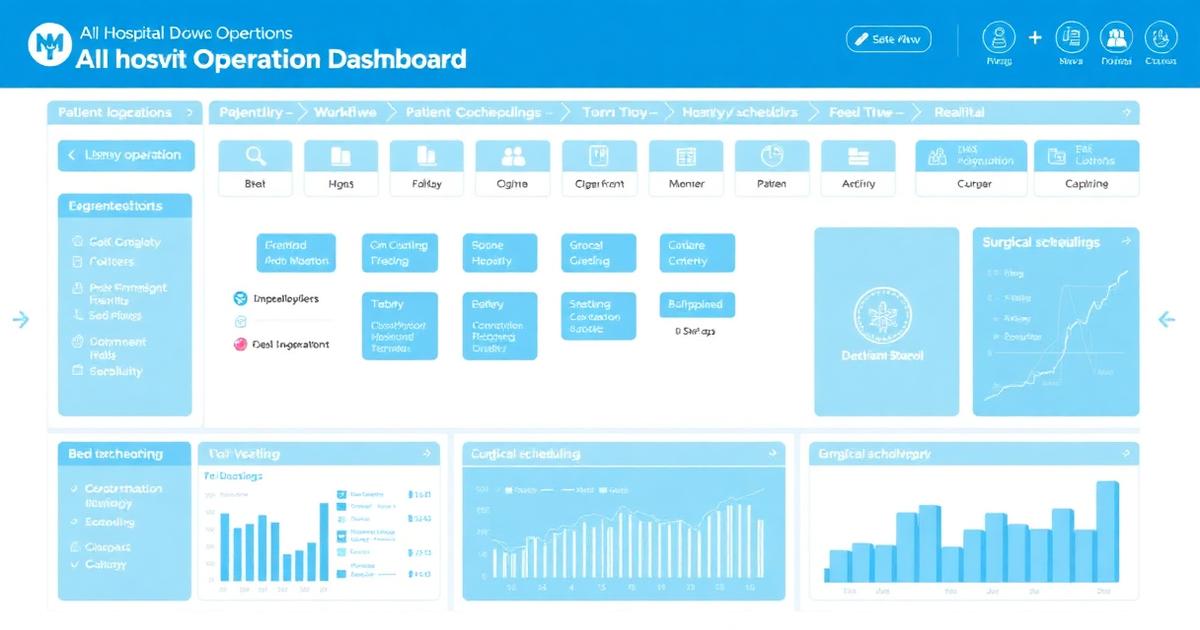
Hospital Operations AI in 2026
Hospital operations represent the most complex management challenge in any industry. A typical 300-bed hospital coordinates thousands of clinical and operational workflows daily (patient admissions, surgical cases, staffing assignments, supply logistics, and equipment management) all while maintaining the highest standards of patient safety. The healthcare AI market reached $36.1 billion in 2026, with hospital operations AI being the fastest-growing segment, per MarketsandMarkets.
McKinsey's healthcare analysis estimates that AI can improve hospital operational efficiency by 20-30%, translating to $5-$15M in annual savings per facility. The American Hospital Association reports that more health systems are now investing in AI operations technology than in recent years.
| Operations Domain | AI Application | Financial Impact | Clinical Impact |
|---|---|---|---|
| Patient Flow | Admission/discharge prediction, bed optimization | Annual savings | Less ED boarding |
| Surgical | OR scheduling, case duration prediction | Annual savings | Fewer cancellations |
| Staffing | Census prediction, float pool optimization | Annual savings | Better nurse ratios |
| Supply Chain | Demand forecasting, procurement automation | Annual savings | Fewer stockouts |
| Clinical Support | Sepsis detection, deterioration alerts | Reduced penalties | Better outcomes |
| Revenue Cycle | Charge capture, coding, denial prevention | Revenue increase | N/A |
Scale of Opportunity
AI-powered patient flow optimization can increase effective hospital capacity without adding beds, unlocking capacity gains comparable to a facility expansion through software alone.
Patient Flow & Bed Management
Patient flow is the central operational challenge in hospital management. Bottlenecks at any point (ED, admissions, inpatient units, or discharge) cascade throughout the system, creating delays, overcrowding, and safety risks. AI agents address flow by predicting demand, optimizing assignments, and coordinating transitions across the entire patient journey.
AI Patient Flow Optimization Stack
- Admission Prediction: ML models forecasting hourly admission volumes by acuity level using historical data, ED census, seasonal patterns, and community health signals, enabling proactive bed preparation.
- Discharge Prediction: AI-predicted discharge timing for each patient based on diagnosis, clinical trajectory, and care milestones, enabling bed assignment planning hours before actual discharge.
- Bed Assignment Engine: Real-time optimization of bed assignments considering patient acuity, isolation requirements, proximity to needed services, and predicted length of stay.
- Transfer Coordination: Automated coordination of inter-facility and intra-facility transfers with real-time bed availability across the health system network.
- Discharge Process Automation: AI-orchestrated discharge workflows including medication reconciliation, follow-up scheduling, transportation coordination, and patient education delivery.
AI patient flow systems can reduce average length of stay and ED boarding time. For a 400-bed hospital, each 0.1-day LOS reduction generates approximately $1.5M in annual capacity recovery.
AI-powered patient flow management is among the highest-ROI technology investments available to health systems today. The combination of admission prediction, real-time bed management, and discharge optimization creates a multiplier effect that improves both operational and clinical outcomes simultaneously.
Surgical Scheduling Optimization
Operating rooms are among the highest-revenue and highest-cost areas of hospitals. AI surgical scheduling agents optimize this critical resource by predicting case durations, managing block utilization, and coordinating the complex logistics of perioperative care.
| Scheduling Challenge | Traditional Method | AI Solution | Improvement |
|---|---|---|---|
| Case Duration | Surgeon estimate | ML prediction | More accurate |
| Block Utilization | Fixed allocation | Dynamic optimization | Higher utilization |
| Same-Day Cancellations | Reactive management | Predictive risk scoring | Fewer cancellations |
| Turnover Time | Variable, unmanaged | AI-optimized coordination | Reduced turnover time |
| Equipment Conflicts | Manual checking | Automated conflict detection | Fewer conflicts |
| Add-On Cases | Phone-based coordination | AI slot matching | More add-ons placed |
Hospitals using AI surgical scheduling tend to achieve higher OR utilization than the national average, translating into additional annual surgical revenue for larger facilities. Our medical practice management guide covers the outpatient scheduling side of this equation.
Intelligent Workforce Management
Nursing shortages and labor costs are the top operational challenges facing hospitals. AI workforce management agents address both by predicting staffing needs with precision, optimizing schedules, and reducing costly overtime and agency usage.
- Census & Acuity Prediction: AI models forecasting patient census and acuity by unit at 4, 8, 12, and 24-hour intervals, enabling proactive staffing adjustments rather than reactive scrambling.
- Smart Scheduling: Optimization engines that create schedules balancing staff preferences, skills, certifications, overtime limits, and predicted demand while ensuring safe nurse-to-patient ratios.
- Float Pool Management: AI-directed deployment of float pool nurses to highest-need units based on real-time census changes, competency matching, and cross-training status.
- Agency Reduction: Predictive modeling that identifies staffing gaps weeks in advance, enabling internal solutions (overtime, float pool, per diem) before resorting to expensive agency staff.
- Burnout Prevention: Monitoring of individual nurse workload patterns, overtime hours, and patient acuity exposure to identify burnout risk and trigger schedule adjustments before staff turnover.
Labor Cost Impact
AI workforce management typically reduces agency nursing usage while improving staff satisfaction, and combined with lower overtime, helps lower total labor costs per facility.
Supply Chain & Inventory AI
Hospital supply chain management involves thousands of SKUs across surgical supplies, pharmaceuticals, medical devices, and general supplies. AI agents optimize this complexity by predicting demand, automating procurement, and preventing both stockouts and waste.
AI Supply Chain Capabilities
- Demand Forecasting: ML models predicting supply consumption based on surgical schedules, census forecasts, seasonal disease patterns, and historical usage data at the item level.
- Par Level Optimization: Dynamic par levels that adjust to predicted demand rather than static reorder points, reducing carrying costs while preventing stockouts.
- Expiration Management: FIFO optimization and expiration alerting for pharmaceuticals and biologics, reducing waste for high-cost perishable items.
- Vendor Management: AI-powered vendor scorecarding, price benchmarking, and contract compliance monitoring across the supply chain.
- Disruption Prediction: Early warning systems monitoring supplier financial health, logistics disruptions, and raw material shortages to enable proactive sourcing alternatives.
Clinical Decision Support Systems
AI clinical decision support (CDS) systems provide real-time intelligence that helps clinicians make faster, more accurate diagnostic and treatment decisions. These systems analyze patient data streams continuously, detecting patterns that human clinicians might miss in complex, high-volume environments.
| CDS Application | Data Sources | Alert Mechanism | Clinical Impact |
|---|---|---|---|
| Sepsis Detection | Vitals, labs, nursing assessments | Real-time sepsis score | Lower mortality |
| Clinical Deterioration | Vitals trends, lab trajectory | Early warning score | Fewer code blues |
| Drug Interactions | Active medications, allergies, labs | Real-time alert at ordering | Fewer adverse drug events |
| Diagnostic Support | Imaging, labs, clinical notes | Differential diagnosis suggestions | More accurate diagnosis |
| Antibiotic Stewardship | Cultures, antibiogram, guidelines | Optimal therapy recommendation | Better outcomes |
The World Health Organization has emphasized the importance of AI clinical decision support in improving global healthcare quality, particularly in resource-limited settings. These systems must be implemented with careful attention to alert fatigue, clinical workflow integration, and transparent AI reasoning.
Emergency Department AI Operations
Emergency departments are the operational pressure points of hospitals, where patient demand is unpredictable and delays have immediate clinical consequences. AI agents are transforming ED operations by predicting volumes, optimizing patient flow, and enabling faster disposition decisions.
- Volume Prediction: Hourly arrival forecasting using time-of-day, day-of-week, weather, flu activity, and local event data for proactive staffing and resource allocation.
- Intelligent Triage: AI-augmented triage using NLP analysis of chief complaints, vital signs, and brief history to improve acuity scoring accuracy and reduce undertriage.
- Disposition Prediction: ML models predicting admission vs. discharge probability within 30 minutes of ED arrival, enabling earlier bed requests for likely admits.
- LWBS Reduction: Real-time monitoring of wait times with automated patient communication and queue optimization to reduce left-without-being-seen rates.
- Boarding Management: AI coordination between ED and inpatient units for boarded patients, prioritizing bed assignments for highest-acuity ED patients.
AI Hospital Command Center
The AI-powered hospital command center represents the convergence of all operational intelligence into a unified platform. Command centers provide system-wide visibility, predictive analytics, and automated coordination that enable proactive management of hospital operations.
Command Center Modules
- Capacity Dashboard: Real-time visualization of bed status, occupancy trends, and predicted capacity across all units with automated escalation when thresholds are exceeded.
- Patient Flow Control: End-to-end tracking of every patient from ED arrival through discharge with bottleneck identification and automated flow optimization.
- Surgical Operations: Live OR status, case progression tracking, and predicted completion times with automated coordination of post-op bed assignments.
- Staffing Visibility: Real-time staffing levels vs. required levels by unit with automated float pool deployment and overtime management.
- System Performance: Aggregate operational KPIs with drill-down capability, trend analysis, and predictive modeling for strategic planning.
Command Center ROI
Health systems with AI command centers report improved patient throughput, reduced average length of stay, and annual savings per hospital. The centralized visibility helps prevent the coordination failures that otherwise drive hospital inefficiency.
Hospital Implementation Results
Case Study: Academic Medical Center (800 beds)
A large academic medical center implemented AI across patient flow, surgical scheduling, and workforce management. Over 18 months, it saw shorter average length of stay, higher OR utilization, reduced ED boarding time, and lower agency nursing spend.
Case Study: Community Hospital Network (5 Hospitals)
A community health system deployed an AI command center across 5 hospitals. System-wide transfer coordination improved, bed turnaround time decreased, 30-day readmissions dropped, and the system accommodated more patients without facility expansion, generating additional annual revenue.
Case Study: Pediatric Hospital (250 beds)
A children's hospital implemented AI sepsis detection and clinical deterioration alerting. Sepsis mortality decreased, unplanned ICU transfers were reduced, average antibiotic initiation time improved for sepsis patients, and the system kept false positives manageable.
Frenchy Digital: Hospital Operations AI
At Frenchy Digital, we build AI platforms for health systems that optimize hospital operations from patient flow to workforce management. Our solutions integrate with existing EHR and hospital information systems to deliver measurable operational improvements.
Our Hospital AI Capabilities
- Patient Flow Platform: AI-powered admission prediction, bed optimization, discharge coordination, and transfer management for system-wide flow improvement.
- Surgical Operations Suite: OR scheduling optimization, case duration prediction, and perioperative workflow coordination for maximum surgical throughput.
- Workforce Intelligence: Census-based staffing prediction, smart scheduling, float pool management, and agency reduction tools.
- Command Center Platform: Unified operational dashboard with real-time visibility, predictive analytics, and automated coordination across all hospital functions.
- Clinical Decision Support: Real-time deterioration detection, sepsis alerting, and evidence-based treatment recommendations integrated into clinical workflows.
Explore our AI agent development services or read about AI for medical practice management and clinical trials AI for our complete healthcare AI portfolio.
Transform Hospital Operations with AI
From patient flow to surgical scheduling, we build AI-powered hospital operations platforms that improve outcomes, reduce costs, and optimize system-wide performance.
1517 S Bentley Ave Apt 204, Los Angeles CA 90025