










Healthcare AI for Practice Management in 2026
The healthcare AI market reached $17.8 billion in 2026, with practice management AI representing one of the fastest-growing segments, according to Grand View Research. The driving force is unmistakable: administrative tasks continue to take time away from physicians' patient care.
AI agents for medical practices address this crisis by automating the administrative machinery that consumes physician time: clinical documentation, scheduling optimization, billing and coding, prior authorizations, and patient communications. McKinsey estimates that AI could automate 30-40% of healthcare administrative functions, representing $200-$360 billion in annual savings for the US healthcare system.
| Practice Function | AI Application | Revenue Impact |
|---|---|---|
| Documentation | Ambient AI scribe | More patients seen |
| Scheduling | Predictive optimization | Higher revenue potential |
| Billing/Coding | Auto-coding + scrubbing | More collections |
| Prior Auth | Auto-submission + tracking | Faster care delivery |
| Patient Comms | AI triage + messaging | Higher satisfaction |
| Referrals | Smart routing + tracking | Reduced care gaps |
Industry Reality
Physicians can lose potential revenue to documentation time, scheduling inefficiencies, and billing errors. AI practice management tools can help recover some of that revenue while simultaneously improving physician wellness and patient satisfaction.
Intelligent Patient Scheduling
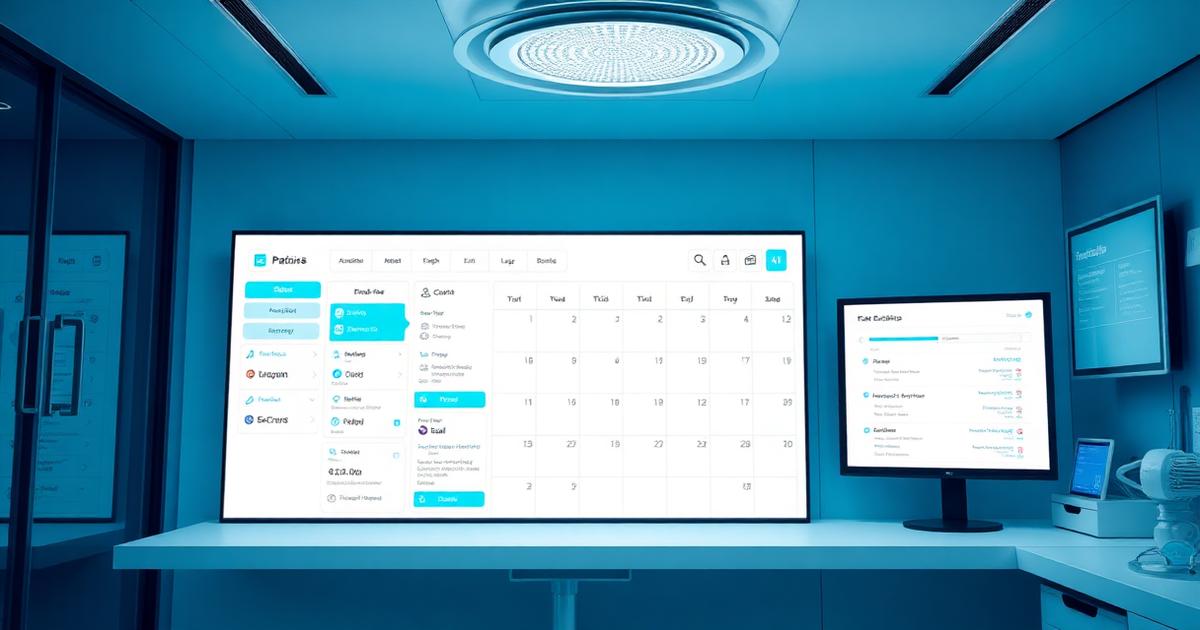
Patient scheduling in medical practices involves far more complexity than simple calendar management. AI scheduling agents must consider appointment type durations, provider specialty requirements, equipment and room availability, insurance verification status, patient no-show probability, and urgent care prioritization.
AI Scheduling Optimization Features
- No-Show Prediction: ML models scoring appointment no-show probability based on patient history, appointment type, lead time, weather, and day-of-week patterns, enabling targeted reminder interventions.
- Smart Overbooking: Calculated overbooking that accounts for predicted no-shows and cancellations, maximizing provider utilization without creating excessive wait times.
- Duration Estimation: AI-predicted appointment durations based on visit type, patient complexity (chronic conditions, new vs. return), and provider work patterns.
- Waitlist Management: Automated backfilling of cancelled slots from smart waitlists, matched by urgency, appointment type compatibility, and patient proximity.
- Multi-Provider Coordination: Scheduling across multiple providers for patients requiring same-day visits with different specialists, minimizing patient trips.
Practices using AI scheduling report improvements in no-show rates and daily patient volume, which can support additional revenue over time. Our health data analytics guide explores the predictive models underlying these scheduling systems.
Ambient Clinical Documentation
Ambient clinical documentation represents the most transformative AI application in medical practice management. These systems use natural language processing to listen to patient-provider conversations and automatically generate structured clinical notes, eliminating the hours physicians spend on charting.
Ambient AI documentation aims to reduce charting time and give providers more time back in their day. This time recovery can translate to either more patients seen or improved work-life balance, or both.
| Documentation Feature | Traditional EHR | AI Ambient Scribe | Improvement |
|---|---|---|---|
| Note Generation | Manual typing | Auto-generated, quick review | Faster documentation |
| Coding Suggestions | Post-visit lookup | Real-time from conversation | Faster, more accurate |
| Medication Lists | Manual updates | Auto-detected from dialogue | Fewer errors |
| Care Plan | Template-based | Context-aware generation | More personalized |
| Patient Instructions | Generic printouts | Visit-specific generation | Higher compliance |
| After-Hours Charting | Extra time after hours | Near-zero | Work-life balance |
Revenue Cycle Management AI
Revenue cycle management is where AI delivers the most immediate and measurable financial impact for medical practices. AI agents address every stage of the revenue cycle: charge capture, coding accuracy, claim scrubbing, submission, denial management, and patient collections.
- AI Charge Capture: Automated identification of billable services from clinical documentation, helping reduce missed charges and capture additional revenue per provider.
- Coding Optimization: NLP-powered CPT and ICD-10 code suggestions based on documentation context, helping reduce coding errors and improve code specificity for higher reimbursement.
- Claim Scrubbing: Pre-submission claim validation against payer-specific rules, improving first-pass acceptance rates and reducing resubmission costs.
- Denial Prevention: Predictive models that flag claims likely to be denied before submission, enabling proactive corrections that prevent potential denials.
- Automated Appeals: AI-generated appeal letters with supporting clinical documentation for denied claims, helping improve overturn rates while reducing staff time.
- Patient Collections: Personalized payment plans and communication strategies based on patient financial profiles, helping improve self-pay collection rates.
Revenue Recovery
Multi-provider practices can leave revenue on the table due to missed charges, coding errors, and preventable denials. AI revenue cycle management typically helps recover some of that revenue, with implementation costs paid back over time.
Patient Communication Automation
Patient communication represents a significant operational burden for medical practices. AI communication agents handle routine interactions while ensuring critical messages receive immediate human attention, dramatically improving both efficiency and patient experience.
AI Patient Communication Workflows
- Intelligent Triage: NLP-powered message classification routing urgent symptoms to on-call providers, medication questions to pharmacy, and routine inquiries to automated responses.
- Appointment Management: Multi-channel reminders (SMS, email, voice) with smart timing based on no-show risk, plus self-service rescheduling that maintains schedule optimization.
- Lab Result Delivery: AI-generated patient-friendly explanations of normal lab results with contextualized reference ranges, freeing providers to focus on abnormal results.
- Preventive Care Outreach: Automated identification and outreach for patients due for screenings, immunizations, and wellness visits based on clinical guidelines and individual health profiles.
- Post-Visit Follow-Up: Automated check-ins for medication adherence, symptom monitoring, and care plan compliance, with escalation protocols for concerning responses.
Prior Authorization Automation
Prior authorizations remain a persistent administrative burden for medical practices. AI agents are transforming this bottleneck by automating form completion, submission, tracking, and appeals processes.
| Prior Auth Step | Manual Process | AI-Automated Process |
|---|---|---|
| Form Completion | Staff manually enters clinical data | Auto-populated from EHR records |
| Clinical Justification | Provider writes letter | AI drafts from documentation |
| Submission | Fax or portal entry | Electronic API submission |
| Status Tracking | Phone calls to payer | Automated polling + alerts |
| Appeal (if denied) | Manual letter + resubmission | AI appeal with evidence |
Practices implementing AI prior authorization report reductions in staff time spent on authorizations and improvements in approval rates due to more complete and accurate submissions. The impact on patient care is equally significant: faster authorizations mean earlier treatment initiation, which is especially critical for oncology, rheumatology, and other time-sensitive specialties.
Care Coordination & Referral Management
Care coordination failures cost the US healthcare system through duplicate testing, missed follow-ups, and preventable complications. AI agents address these gaps by automating referral management, tracking care transitions, and ensuring continuity across providers.
- Smart Referral Routing: AI matches patients with specialists based on insurance coverage, location, wait times, clinical subspecialty, and outcome quality metrics.
- Referral Loop Closure: Automated tracking of referral completion with escalation alerts when patients don't schedule or attend specialist appointments.
- Care Gap Detection: AI analysis of patient records to identify missed screenings, overdue lab work, and unaddressed diagnosis codes requiring follow-up.
- Transition Management: Automated post-discharge follow-up protocols for hospital-to-practice transitions, reducing 30-day readmission rates.
- Multi-Provider Coordination: Unified care timelines visible across all treating providers, preventing conflicting treatments and medication interactions.
HIPAA Compliance & Security Framework
Implementing AI in medical practices requires rigorous compliance with HIPAA regulations and emerging AI governance frameworks. Every AI system handling PHI must meet stringent security, privacy, and audit requirements.
HIPAA-Compliant AI Implementation Requirements
- Data Encryption: AES-256 encryption for data at rest, TLS 1.3 for data in transit, with encryption key management meeting NIST SP 800-57 standards.
- Access Controls: Role-based access with multi-factor authentication, automatic session timeouts, and minimum necessary access principles for all AI system users.
- Audit Logging: Comprehensive audit trails for all PHI access, modifications, and AI decision points, retained for minimum 6 years per HIPAA requirements.
- Business Associate Agreements: BAAs with all AI vendors, cloud providers, and integration partners specifying PHI handling obligations and breach notification procedures.
- AI Model Governance: Documentation of training data sources, bias testing results, model performance metrics, and clinical validation evidence for all AI decision-support features.
Deep Dives: One Guide Per Workflow
Each workflow above has its own guide, written against primary sources and current as of August 2026. Where the published evidence is thin or the widely quoted figures do not survive checking, these say so.
- Revenue cycle and denials: What agents do well across eligibility, claim scrubbing, denial triage and appeals, and the ROI math without the vendor numbers. Read: /blog/ai-agents-medical-billing-revenue-cycle-2026
- Prior authorization: What CMS-0057-F actually requires in 2026 versus 2027, the WISeR model, and the appeal-overturn gap most practices never claim. Read: /blog/ai-agents-prior-authorization-automation-2026
- Ambient documentation: A buyer's guide that reports the null findings alongside the wins, plus the consent law that HIPAA does not preempt. Read: /blog/ai-medical-scribe-ambient-documentation-2026
- Front-desk voice agents: TCPA limits, state disclosure rules, and why every phone benchmark in the category is unsourceable. Read: /blog/ai-voice-agents-medical-front-desk-2026
- Scheduling and no-shows: The randomized-trial evidence on what actually reduces no-shows, and why the standard cost figures are marketing. Read: /blog/ai-agents-patient-scheduling-no-shows-2026
- HIPAA-compliant architecture: How to build an agent that touches PHI: BAAs, audit logging, de-identification, and AI risks the Security Rule never contemplated. Read: /blog/hipaa-compliant-ai-agent-architecture-2026
- Medical coding: Where autonomous coding works, why no independent accuracy benchmark exists, and how to audit your own. Read: /blog/ai-agents-medical-coding-cpt-icd10-2026
- Dental practices: FDA-cleared imaging AI stated accurately, practice-management API access, and the fabricated economics to refuse. Read: /blog/ai-agents-dental-practice-management-2026
- Behavioral health: The state laws that prohibit AI therapy, what remains permitted, and 42 CFR Part 2 obligations. Read: /blog/ai-agents-mental-health-private-practice-2026
- EHR integration: Why the federal API mandate is read-only, and what that means for every agent that needs to write back. Read: /blog/ai-agents-ehr-integration-fhir-2026
Start with the compliance architecture guide if you are evaluating vendors, or the EHR integration guide if you are scoping a build. If you are already comparing named products, our ranking of AI agents for medical practices scores them on what a practice can verify (whether a BAA is publicly offered, which EHRs are documented rather than merely claimed, and which vendors publish a price at all), and refuses to rank on accuracy, because no independent benchmark of these products exists.
Frenchy Digital: Healthcare Practice AI Solutions
At Frenchy Digital, we build HIPAA-compliant AI solutions for medical practices of all sizes. Our healthcare AI expertise spans ambient documentation, intelligent scheduling, revenue cycle optimization, and patient engagement platforms.
Our Healthcare AI Capabilities
- Ambient Documentation Platform: AI-powered clinical documentation that integrates with major EHRs, reducing charting time by 50%+ while improving note quality and coding accuracy.
- Practice Intelligence Suite: Unified scheduling, billing, and patient communication platform with predictive analytics for operational optimization.
- Revenue Cycle AI: End-to-end revenue cycle management with AI coding, claim scrubbing, denial prediction, and automated appeals.
- Patient Engagement Engine: Multi-channel communication platform with AI triage, preventive care outreach, and chronic disease management workflows.
- Compliance Framework: Built-in HIPAA compliance with encryption, audit logging, access controls, and BAA management for all system components.
Explore our AI agent development services or read our health data analytics guide for more on healthcare AI architectures.
Transform Your Medical Practice with AI
From ambient documentation to revenue cycle optimization, we build HIPAA-compliant AI solutions that reduce administrative burden and improve patient outcomes.
1517 S Bentley Ave Suite 204, Los Angeles CA 90025