













What Cross-Platform App Development Actually Means in 2026
Cross-platform app development refers to the creation of mobile applications that function seamlessly across multiple operating systems (primarily iOS and Android) using a single, unified codebase. Unlike traditional native development, where separate teams build distinct versions of the same app for each platform using Swift for iOS and Kotlin/Java for Android, cross-platform development enables developers to write code once and deploy it across all target platforms with minimal platform-specific adjustments.
The fundamental transformation that has occurred in 2026 is that cross-platform frameworks have reached near-native performance parity for approximately 95% of business applications. Research from BolderApps confirms that users can no longer reliably distinguish between well-built cross-platform apps and their native counterparts in terms of performance, with both achieving smooth 60 FPS rendering and responsive interactions. Leading frameworks like Flutter and React Native have both matured significantly.

Modern cross-platform architecture enables near-native performance through optimized bridges and native rendering
According to Statista's 2025 research, Flutter holds approximately 46% of the cross-platform market share, compared to React Native's 35-38%, with both frameworks experiencing substantial growth. The cross-platform frameworks market itself has grown from $50 billion in 2025 and is projected to climb at a 20% CAGR through 2033, eventually reaching $546.7 billion. Industry analysts at Gartner have recognized cross-platform as the dominant mobile development paradigm.
The Evolution From Compromise to Competitive Advantage
Five years ago, cross-platform development was viewed as a budget-conscious compromise, a way to cut corners at the expense of user experience. In 2026, that perception has completely reversed. Leading companies including Alibaba, BMW, eBay, and Google Ads now rely on cross-platform frameworks for their flagship applications serving billions of users globally.
TechLoy's 2026 analysis reports that over 67% of all new mobile app development projects are now executed using a cross-platform approach, representing a 58% increase from 42% in 2023. This dramatic shift reflects fundamental improvements in framework capabilities, developer tooling, and enterprise adoption patterns. Apple's SwiftUI and Android's Jetpack Compose have also evolved, but cross-platform economics remain compelling.
Key Market Statistics 2026
- • 67% of new mobile projects use cross-platform (up from 42% in 2023)
- • Flutter: 46% market share | React Native: 35-38%
- • Market projected to reach $546.7B by 2033 (20% CAGR)
- • 95% of business apps achieve near-native performance
The Business Case: Why Cross-Platform Development Dominates in 2026
Dramatic Cost Reduction
The most compelling argument for cross-platform development remains its substantial cost savings. According to research from McKinsey Digital, cross-platform frameworks can save 30-40% in initial development costs compared to building separate native applications.
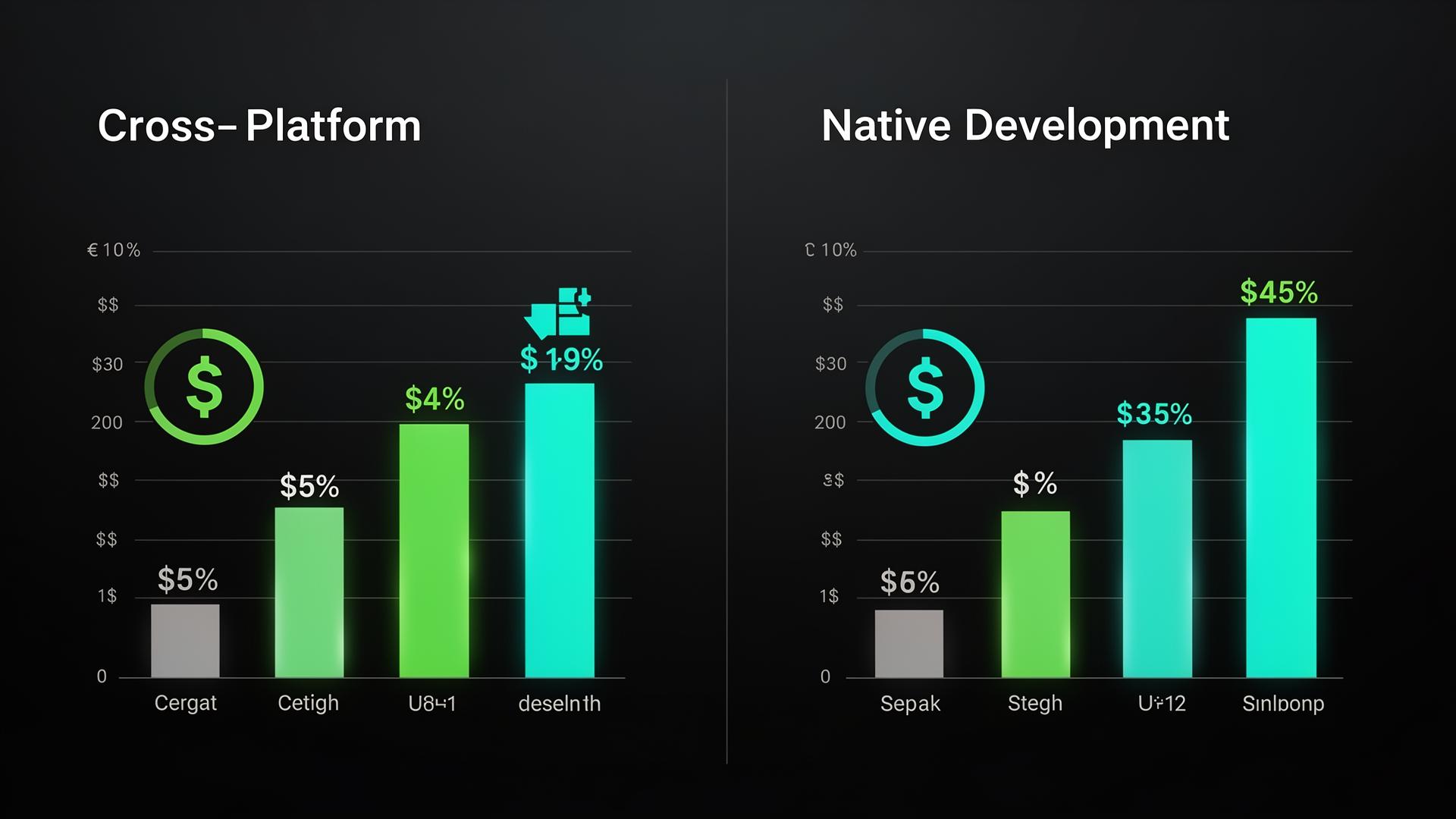
Cross-platform development delivers 40-60% cost savings across all complexity levels
Development Team Costs: Native development requires two completely separate teams: iOS developers proficient in Swift/SwiftUI and Android developers expert in Kotlin/Jetpack Compose. According to TechAhead's 2026 salary research, senior Flutter developers command $135,000-$180,000 annually, while React Native developers average $125,000-$160,000. Contrast this with the $200,000+ combined cost of maintaining separate iOS and Android developer positions.
Time-to-Market Acceleration: Devtrios reports that cross-platform MVPs typically launch in 12-16 weeks versus 20-28 weeks for separate native apps, a 30-40% reduction in development timeline. For startups competing in rapidly evolving markets, this time advantage can mean the difference between capturing market share and arriving too late.
| Cost Category | Native (iOS + Android) | Cross-Platform | Savings |
|---|---|---|---|
| Simple MVP | $80,000-$120,000 | $40,000-$70,000 | 50% |
| Medium Complexity | $150,000-$250,000 | $80,000-$150,000 | 47% |
| Complex Enterprise | $250,000-$500,000+ | $150,000-$300,000 | 40% |
| Annual Maintenance | $80,000-$120,000 | $35,000-$55,000 | 54% |
Consistent User Experience Across Platforms
One frequently underestimated advantage of cross-platform development is the consistency it provides. When maintaining separate native codebases, slight variations inevitably emerge: a button that works differently on iOS versus Android, a feature available on one platform but not the other, inconsistent navigation patterns that confuse users switching between devices.
Xenia Tech's analysis emphasizes that unified codebases ensure identical functionality, appearance, and behavior across all platforms. This consistency strengthens brand identity, reduces user confusion, and simplifies quality assurance testing since there's only one implementation to validate rather than two separate versions.
Faster Feature Deployment and Innovation Cycles
Cross-platform development fundamentally changes the economics of innovation. With native development, every new feature requires implementation twice (once for iOS, once for Android) by different teams who must coordinate closely to ensure feature parity. This coordination overhead slows innovation cycles and increases the likelihood of implementation discrepancies.
Research from Medium's 2026 trends analysis shows that businesses using cross-platform development reduce development time by up to 40% while maintaining consistent user experiences. This efficiency enables companies to iterate faster, respond more quickly to user feedback, and test new features with less financial risk.
The Leading Cross-Platform Frameworks in 2026
Flutter: The Performance Leader
Google's Flutter has emerged as the dominant cross-platform framework in 2026, capturing 46% market share according to Stack Overflow's Developer Survey. Flutter's approach fundamentally differs from other frameworks: rather than wrapping native components, Flutter includes its own rendering engine that compiles directly to native ARM code for both iOS and Android.
Flutter Technical Advantages
- Predictable Performance: Because Flutter controls the entire rendering pipeline, performance is consistent across all devices. Apps typically achieve 60 FPS on standard hardware and 120 FPS on devices with high refresh-rate displays.
- Design Control: Flutter's widget-based architecture gives developers pixel-perfect control over every visual element. Fintech apps, digital banking platforms, and media applications frequently choose Flutter for this reason.
- Hot Reload: Developers can see code changes reflected instantly without restarting the app, dramatically accelerating development iteration cycles.
According to Foresight Mobile's extensive Flutter analysis, major UK financial institutions including Virgin Money and Tide have adopted Flutter for production applications. Tide, serving over 650,000 members in the UK (approximately 13% market share) and 350,000 in India, uses Flutter's platform team structure to enable rapid feature deployment across regions.
Flutter's Limitations
Crustlab's comprehensive comparison identifies several considerations:
- Learning Curve: Dart is less common than JavaScript, requiring developers to learn a new language. Finding experienced Dart developers can be more challenging than recruiting JavaScript talent.
- Larger App Size: Flutter apps typically run 4-8 MB larger than React Native equivalents because they include the Flutter rendering engine.
- Limited Third-Party Libraries: While growing rapidly, Flutter's ecosystem (pub.dev with ~33,000 packages) remains smaller than JavaScript's npm registry (1.8 million packages).
React Native: The JavaScript Powerhouse

React Native's developer experience enables rapid iteration with hot reload and JavaScript familiarity
Meta's React Native holds 35-38% of the cross-platform market, making it the second-most popular framework. React Native takes a fundamentally different approach from Flutter: instead of using its own rendering engine, React Native leverages actual native UI components, creating a bridge between JavaScript code and native platform APIs.
React Native Technical Advantages
- Massive Developer Pool: JavaScript is the world's most widely used programming language, present in 94.5% of all websites. This ubiquity means companies can more easily find React Native developers.
- Code Sharing with Web: Companies with existing React web applications can share significant code between web and mobile platforms, reducing total development effort.
- Over-The-Air Updates: React Native's 15-year-old OTA ecosystem allows developers to push bug fixes and features directly to users without requiring app store approval.
TechBrandHopper's 2026 budget analysis confirms that React Native apps typically run 2-4 MB smaller than Flutter apps because they don't include a rendering engine, relying instead on native platform components.
Kotlin Multiplatform: The Native Performance Option
Kotlin Multiplatform (KMP) has grown from 7% to 18% developer adoption between 2024 and 2025, representing the fastest-growing cross-platform technology. KMP takes a unique approach: rather than attempting to share UI code, KMP focuses exclusively on sharing business logic while allowing developers to build native UIs for each platform.
This architecture appeals particularly to companies with existing native applications who want to reduce duplication of business logic without abandoning their carefully crafted native user interfaces. Netflix and McDonald's have adopted KMP to share business logic between their existing native iOS and Android codebases without requiring complete application rewrites.
| Framework | Market Share | Best For | Language |
|---|---|---|---|
| Flutter | 46% | Design control, performance | Dart |
| React Native | 35-38% | JavaScript teams, web code sharing | JavaScript/TypeScript |
| Kotlin Multiplatform | 18% | Existing native apps, shared logic | Kotlin |
Strategic Framework Selection: Matching Technology to Business Needs
When to Choose Flutter
Fullestop's strategic analysis recommends Flutter for specific business scenarios:
- Visual Fidelity Requirements: Choose Flutter when brand consistency and design control are paramount. Digital banking apps, fintech platforms, and media companies requiring total control over every pixel should default to Flutter.
- Performance on Low-End Devices: In global markets including India, Southeast Asia, and Latin America where users frequently operate mid-range Android devices, Flutter's engine significantly outperforms JavaScript-based bridges.
- Desktop and Web Expansion: Flutter's support for Windows, macOS, and Linux will be fully production-ready throughout 2026. If your roadmap includes internal desktop dashboards or web applications, Flutter enables using the same codebase.
Flutter Success Example
A highly secure, visually stunning banking app requiring complex animated graphs and custom biometric login flows. The development team chose Flutter for its ability to render charts at 60 FPS on low-end devices in rural markets and compile to native ARM for security compliance. Result: A 4.8-star app looking identical on iPhone and Android, built by a team of 4 Dart developers.
When to Choose React Native
- Existing React Web Applications: For SaaS businesses with React web dashboards, React Native represents the natural mobile extension, enabling significant code sharing between platforms.
- Rapid Prototyping Requirements: React Native's massive JavaScript ecosystem accelerates development of standard business applications where time-to-market is the primary concern.
- Flexibility Over Fidelity: Choose React Native when flexibility, instant updates via OTA, and scaling with existing web teams matters more than pixel-perfect design control.
React Native Success Example
A companion mobile app for an existing CRM platform used by sales teams. The development team chose React Native because they already had a React web CRM, enabling code and UI component reuse. Result: Launched 6 weeks faster than a native build would have allowed, with 70% code reuse from the web platform.
When Native Development Still Makes Sense
While cross-platform dominates in 2026, native development retains advantages for specific scenarios:
- Hyper-Intensive 3D Games: Applications requiring extremely low-level hardware interaction, advanced graphics processing, or cutting-edge gaming experiences still benefit from native development's performance ceiling.
- Immediate Platform Feature Access: Native apps can implement new iOS or Android features immediately upon OS release, while cross-platform frameworks typically lag by weeks or months.
- Deep Hardware Integration: Applications requiring advanced AR functionality, complex sensor interactions, or novel hardware features may need native implementation.
Wearepresta's definitive 2026 guide estimates native development costs at $100,000-$250,000 for both platforms combined versus $60,000-$150,000 for cross-platform alternatives delivering near-identical results for standard business applications.
Need Help Choosing the Right Framework?
Our cross-platform experts can analyze your requirements and recommend the optimal approach for your project.
Real-World Cost Analysis: Cross-Platform vs. Native Development in 2026

Cross-platform development accelerates time-to-market by 30-40% compared to dual native development
Total Cost of Ownership: Beyond Initial Development
Smart businesses evaluate total cost of ownership over 3-5 years, not just initial development expenses:
| Cost Category | Native (Annual) | Cross-Platform (Annual) | Savings |
|---|---|---|---|
| iOS Maintenance Team | $40,000-$60,000 | N/A (unified) | - |
| Android Maintenance Team | $40,000-$60,000 | N/A (unified) | - |
| Total Maintenance | $80,000-$120,000 | $35,000-$55,000 | 54% |
| 3-Year Maintenance Total | $240,000-$360,000 | $105,000-$165,000 | $135K-$195K saved |
Over a 3-year period, cross-platform development can save $135,000-$195,000 in maintenance costs alone, according to Xenia Tech's long-term cost analysis.
Hidden Cost Advantages
Several less obvious cost benefits favor cross-platform development:
- Quality Assurance Efficiency: Testing a single codebase requires approximately 50% less QA effort than testing two separate native applications. This translates to both time and budget savings.
- Feature Parity Guaranteed: With native development, ensuring identical features across platforms requires constant coordination between separate teams. Cross-platform development eliminates this coordination overhead entirely.
- Analytics Simplification: Unified tracking systems save both time and money while providing more accurate insights than attempting to correlate data from two separate analytics implementations.
- Knowledge Transfer: When developers leave, cross-platform codebases are easier for new team members to understand and contribute to compared to inheriting two separate native applications requiring different skill sets.
Common Cross-Platform Development Challenges and Solutions in 2026
Performance Optimization
While cross-platform frameworks have achieved near-native performance for most use cases, developers must understand performance optimization techniques:
Challenge: Abstraction layers can introduce latency, causing slower load times, animation lag, and poor responsiveness.
Solution: TechLoy's technical guide recommends several approaches:
- Native Modules for Critical Components: For performance-critical sections, write native modules in Swift/Kotlin while maintaining cross-platform logic for the majority of the application.
- Rendering Optimization: Minimize unnecessary widget re-renders using state management techniques like the BLoC pattern in Flutter or Redux for React Native.
- Performance Monitoring: Use Flutter DevTools and React Native performance monitors to identify bottlenecks and eliminate them systematically.
Platform-Specific Design Compliance
Each platform maintains distinct design guidelines (Apple's Human Interface Guidelines and Google's Material Design), creating tension with the "write once, run everywhere" promise.
Challenge: Flutter components share identical appearance across platforms, potentially violating platform-specific design expectations.
Solution: Modern frameworks provide platform-adaptive widgets that automatically adjust to native design patterns. Developers can implement platform detection logic to present iOS-style navigation on Apple devices and Material Design patterns on Android devices, all from the same codebase.
Third-Party Plugin Integration
Both Flutter and React Native ecosystems rely on community-maintained plugins for accessing device features like cameras, location services, and biometric authentication.
Challenge: Third-party plugins can introduce version compatibility issues, security vulnerabilities, and maintenance headaches when community maintainers abandon projects.
Solution: Prioritize plugins with active maintenance, large user bases, and corporate backing. Evaluate plugin quality by examining GitHub activity, issue response times, and the number of contributors. For critical functionality, budget for developing custom native modules with controlled maintenance.
Cross-Platform Development at Frenchy Digital
At Frenchy Digital, we've built our entire mobile development practice around React Native, delivering over 100 cross-platform applications since 2019. Our standardized approach enables us to deliver enterprise-grade mobile applications at 40-50% cost savings compared to native development alternatives.
Our Cross-Platform Development Process
| Phase | Deliverables | Investment |
|---|---|---|
| Discovery & Strategy | Requirements analysis, architecture planning, feasibility assessment, project roadmap | $5,000 |
| Prototyping & Design | Interactive prototype, platform-adaptive UI/UX, user testing, design system documentation | $13,000 |
| Full Development | React Native app, native module integration, QA testing, App Store/Google Play submission | $80,000-$300,000 |
| Annual Maintenance | Performance monitoring, OS updates, feature enhancements, security patches | $11,000+ |
Cross-Platform Success Stories
SnapFit Corporate Wellness Platform
Built entirely with React Native for Snapchat's corporate wellness program, enabling employees across iOS and Android devices to participate in fitness challenges, track progress, and earn rewards. The cross-platform approach enabled Snapchat to launch simultaneously on both platforms within 16 weeks rather than the 28+ weeks separate native development would have required.
CGSA Mental Health Clinic
HIPAA-compliant telemedicine application serving mental health professionals and patients. React Native enabled the development team to implement identical security protocols, encrypted communication, and electronic health record integration across both platforms from a single, auditable codebase,critical for healthcare compliance.
Why We Choose React Native
- JavaScript Ecosystem: Our development team's deep expertise in React and Node.js translates directly to React Native mobile development, enabling rapid onboarding and consistent code quality.
- Code Sharing: Clients with existing React web applications can share authentication logic, API integration, business rules, and UI components, typically achieving 60-70% code reuse.
- OTA Updates: React Native's over-the-air update capability enables us to deploy critical bug fixes and feature enhancements without waiting for app store approval.
- Proven Scale: With React Native powering apps used by over 2 billion people globally (Facebook, Instagram, Microsoft Office, Shopify), we have confidence in the framework's production readiness.
Industry-Specific Cross-Platform Application Strategies
Healthcare Applications: HIPAA Compliance with Cross-Platform Efficiency
Healthcare represents one of the most demanding industries for mobile app development, requiring strict HIPAA compliance, robust security protocols, and seamless integration with electronic health record (EHR) systems. Cross-platform development offers unique advantages for healthcare organizations.
Compliance Advantages: Implementing HIPAA security requirements in a single codebase ensures consistent encryption, authentication, and audit logging across both iOS and Android platforms. When security auditors review your application, they examine one implementation rather than two potentially divergent approaches.
Cost Considerations for Healthcare: The 40-60% cost savings from cross-platform development can mean the difference between implementing digital health solutions or continuing with paper-based workflows. For a typical telemedicine application, native development might cost $200,000-$350,000 for both platforms, while React Native development delivers equivalent functionality for $120,000-$210,000.
E-Commerce Applications: Performance Meets Rapid Iteration
E-commerce represents the largest mobile app category by revenue, with consumers expecting seamless shopping experiences, instant product search, real-time inventory updates, and secure payment processing.
Rapid Feature Deployment: E-commerce is intensely competitive, with companies constantly testing new features: personalized recommendations, augmented reality product visualization, social shopping features, and promotional campaigns. Cross-platform development's unified codebase enables e-commerce companies to deploy A/B tests, iterate based on conversion data, and roll out successful features to all users simultaneously.
Financial Services: Security, Compliance, and Real-Time Data
Financial services applications (mobile banking, investment platforms, insurance portals, and cryptocurrency exchanges) face the industry's strictest security and regulatory requirements.
Example Success: Virgin Money, a Tier-1 UK bank, unified their separate iOS and Android apps into a single Flutter codebase. The consolidation enabled faster feature delivery, consistent customer experience across platforms, and simplified compliance documentation,critical achievements for a regulated financial institution serving millions of customers.
Enterprise Applications: Scale, Security, and Integration
Enterprise applications serve internal business processes: employee directories, expense reporting, asset management, field service management, and CRM tools.
Cost Justification for Enterprises: When an enterprise deploys an app to 5,000-50,000 employees, the ongoing maintenance costs of dual native development become substantial. Cross-platform development's 40% maintenance cost reduction translates to hundreds of thousands of dollars in annual savings for large-scale enterprise deployments.
Technical Architecture Deep Dive
State Management Patterns
Effective state management becomes critical as cross-platform applications grow in complexity. Both React Native and Flutter provide multiple approaches:
React Native State Management Options
- Redux: Traditional centralized state management with predictable transitions. Best for complex apps with intricate data flows.
- MobX: Reactive state management with less boilerplate, suitable for medium-complexity applications.
- Context API + Hooks: React's built-in solution, sufficient for simpler applications.
- Recoil: Facebook's modern atom-based state management with excellent performance.
Flutter State Management Options
- BLoC (Business Logic Component): Google's recommended pattern, separating business logic through streams and reactive programming.
- Provider: The officially recommended solution, offering simple dependency injection for most applications.
- Riverpod: An evolution of Provider with compile-time safety and improved testability.
- GetX: Comprehensive solution combining state management, dependency injection, and routing.
Performance Metrics to Monitor
- Frame Rate: Applications should maintain 60 FPS during normal operation and 120 FPS on high-refresh-rate devices.
- App Startup Time: Users expect apps to become interactive within 2-3 seconds. Slow startup dramatically increases abandonment rates.
- Memory Consumption: Mobile devices have limited memory, and excessive usage leads to app termination by the OS.
- Network Request Performance: API latency directly impacts user experience. Monitor request timing, failure rates, and response sizes.
Security Best Practices
Mobile applications handle sensitive user data and must implement robust security measures:
- HTTPS/TLS: All network communication should use HTTPS with certificate pinning to prevent man-in-the-middle attacks
- Secure Storage: Platform-specific secure storage (iOS Keychain, Android Keystore) for cryptographic keys and tokens
- Biometric Authentication: Fingerprint and Face ID for device-level security
- Runtime Protection: Jailbreak/root detection, screen recording prevention, clipboard protection
The Future of Cross-Platform Development Beyond 2026
The trajectory of cross-platform development points toward continued dominance. Visiontech's trend analysis predicts that by 2027, over 75% of new mobile applications will use cross-platform frameworks, with the performance gap between cross-platform and native becoming imperceptible even for demanding applications.
Key Trends Accelerating Adoption
- Compiler Improvements: Both Flutter and React Native continue advancing their compilation technologies, with Flutter's ahead-of-time (AOT) compilation already producing binary code indistinguishable from native apps.
- Platform Convergence: As iOS and Android design patterns converge and device capabilities standardize, the value proposition of native development weakens while cross-platform benefits strengthen.
- Developer Economics: The persistent shortage of mobile developers makes cross-platform development's single-team approach increasingly attractive.
- Web Assembly (WASM) Integration: Flutter's support for Web Assembly enables high-performance web applications from the same codebase as mobile apps.
- AI Integration: Cross-platform frameworks are adding first-class support for on-device machine learning models, enabling AI features without separate implementations.
- 5G Network Optimization: Cross-platform frameworks are implementing 5G-optimized networking libraries that automatically adapt to available bandwidth.
Conclusion: Cross-Platform as Strategic Imperative
In 2026, cross-platform development has evolved from budget-conscious compromise to strategic competitive advantage. The combination of 40-60% cost savings, 30-40% faster time-to-market, near-native performance for 95% of applications, and dramatic maintenance efficiency makes cross-platform the default choice for most mobile development projects.
The question facing business leaders is no longer "should we consider cross-platform?" but rather "which cross-platform framework best serves our specific requirements?"
Start Your Cross-Platform Development Journey
Ready to explore how cross-platform development can accelerate your mobile app project while reducing costs by 40-60%? Our West LA-based team has delivered 100+ successful cross-platform applications.
Ready to Build Your Cross-Platform App?
Our React Native experts have delivered 100+ cross-platform applications. Get transparent pricing and proven enterprise compliance.
1517 S Bentley Ave Suite 204, Los Angeles CA 90025
Frequently Asked Questions
Sources & References
- 1Statista: Cross-Platform App Development Statistics↗
- 2BolderApps: Top Cross-Platform Frameworks 2026↗
- 3Medium: Mobile App Development Trends 2026↗
- 4TechLoy: Cross-Platform Development Challenges↗
- 5Primotech: Why Cross-Platform Apps Will Dominate↗
- 6Crustlab: Flutter vs React Native Comparison↗
- 7TechAhead: Flutter vs React Native 2026↗
- 8Fullestop: Strategic Guide to Mobile ROI↗
- 9Visiontech: Mobile App Development Trends↗
- 10Lovable: Mobile App Development Trends 2026↗
Related Articles You May Find Helpful
- Top 10 Swiss Cross-Platform Developers 2026
- Online Poker Platform Development: 2026 Guide
- React Native vs Native Development 2026: The Definitive Comparison
- Top 10 Cross-Platform Developers in Los Angeles 2026
- Custom Mobile App Development Guide 2026
- Healthcare App Development with HIPAA Compliance
- Mobile App Development Costs 2026