












The Fitness App Market in 2026
Plain step counters are dead. Basic calorie logs are dying. The fitness apps winning in 2026 are intelligent ecosystems that learn from your body, adapt to your recovery, adjust your nutrition in real time, correct your form through your phone camera, and connect you to a community that keeps you accountable. Users do not want a digital logbook. They want a coach that lives in their pocket.
The global online fitness market is generating $8.3 billion in revenue in 2025, with projections reaching $9.9 billion by 2030. The United States alone accounts for $2.5 billion, roughly 30% of the worldwide market. With over 1.5 billion projected fitness app downloads globally, the market is massive but fiercely competitive. The apps that succeed are not the ones with the longest feature lists: they are the ones that combine AI personalization, wearable data, and holistic wellness into experiences that genuinely change lives.
This guide is for founders, fitness brands, gym chains, personal trainers, and wellness companies who want to build a fitness app that stands out in 2026. It covers what features matter, how AI and wearables are reshaping the category, what it costs to build, and how Frenchy Digital develops fitness platforms from the heart of Los Angeles, America's wellness capital.
72% of fitness apps now operate at Level 2 health integration (performance tracking with advanced features), but only 5% reach Level 3 (clinical-grade capabilities), representing a massive strategic opportunity.
2026 Digital Fitness Ecosystem Report
The competitive landscape has intensified. Performance tracking and social engagement are the most crowded spaces. Differentiation now comes from finding underserved intersections: AI + clinical health, recovery + gamification, mental wellness + performance tracking. Fitness app developers who understand these intersections build products that capture and retain users in ways that single-function competitors cannot.
Consumer expectations have risen dramatically. Personalization is no longer exciting: it is expected. Wearable sync is no longer a differentiator: it is infrastructure. Users demand apps that understand their complete picture and adapt intelligently to their changing needs, not apps that deliver the same 12-week program to every user regardless of fitness level, recovery status, or life circumstances.
Types of Fitness Apps
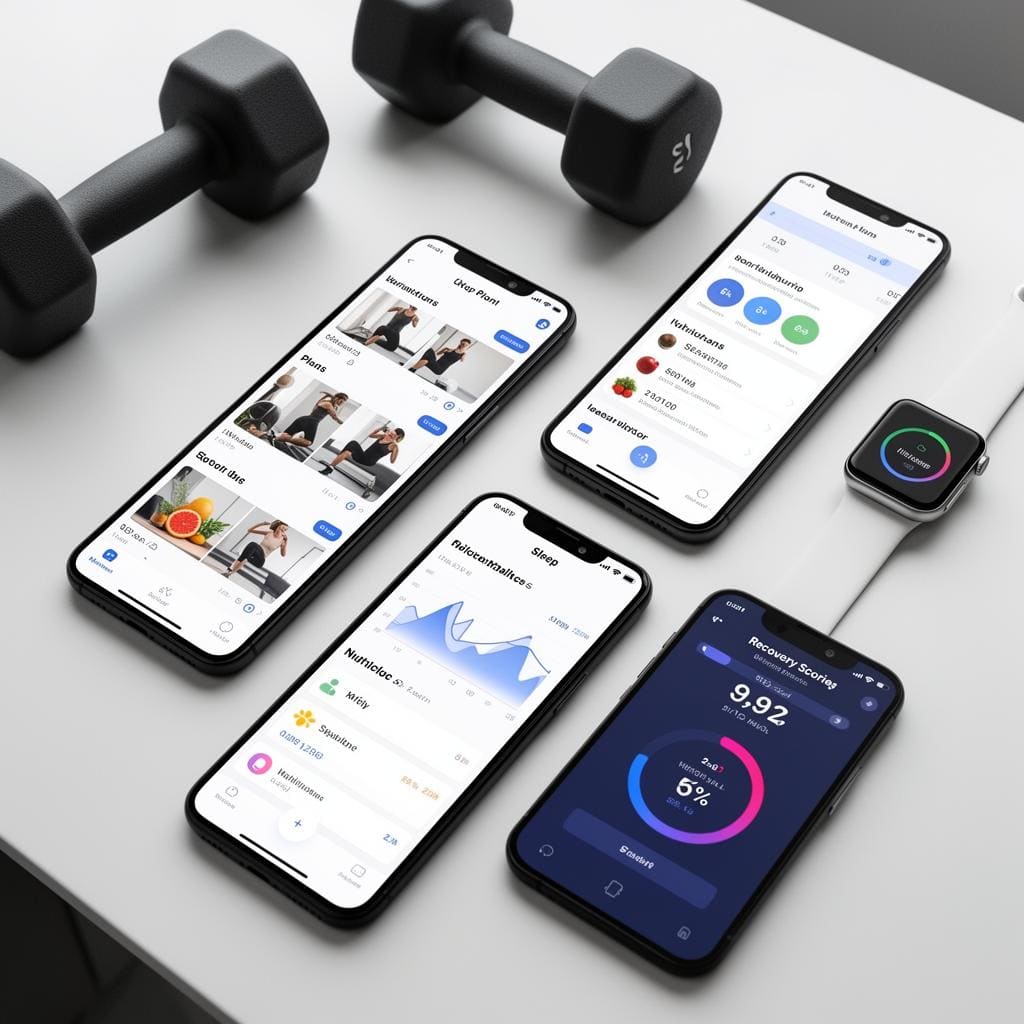
The fitness app ecosystem spans ten major categories, each requiring distinct technical capabilities and user experience design.
The fitness app category encompasses diverse product types, each targeting different users and solving different problems. Understanding these categories is essential for fitness app developers building competitive products in 2026.
AI Personal Trainer Apps
The fastest-growing category. These apps assess fitness level through onboarding assessments or wearable data, then build adaptive plans that evolve as the user progresses. Daily readiness scores adjust intensity based on sleep, HRV, and recovery metrics. Examples set the bar: apps that adjust sets, reps, load, and rest according to real-time biometric feedback.
Activity and Habit Trackers
Beyond simple step counting, 2026 habit apps log workouts, mobility breaks, hydration, sleep, posture, and meditation, then show cause-and-effect relationships between habits and outcomes like improved sleep scores, lower resting heart rate, or increased VO2 max. The technical challenge is steady background sync with wearables and battery-efficient data collection.
Strength Training Loggers
One of the fastest-growing segments. These apps provide 3D exercise demonstrations or AR overlays, track progressive overload, auto-log sets and loads, and visualize strength gains over time. Advanced versions use computer vision to count reps and assess form quality.
Running and Cycling GPS Apps
GPS-based tracking with route mapping, pace analytics, interval training, and social features like segment leaderboards. Strava's community model demonstrates how social competition drives engagement in endurance sports.
Yoga and Mindfulness Apps
Guided sessions with video instruction, breathing exercises, meditation timers, and progress tracking. These apps increasingly integrate biometric feedback: using HRV data to recommend meditation when stress is elevated or restorative yoga when recovery scores are low.
Nutrition and Meal Planning Apps
Calorie tracking, macro counting, meal planning, recipe databases, barcode scanning, and AI-powered food recognition through phone cameras. Integration with fitness tracking creates the complete picture of calories consumed versus calories burned. MyFitnessPal remains the benchmark with its 14+ million item food database.
Corporate Wellness Platforms
B2B applications that companies deploy to improve employee health. Features include team challenges, health metrics dashboards, rewards programs, and aggregate analytics for HR teams. Frenchy Digital has experience building corporate wellness platforms, including work with Snapchat on the SnapFit corporate wellness application.
Gym and Studio Management Apps
Tools for fitness businesses: class scheduling, membership management, check-in systems, trainer assignments, payment processing, and member engagement. These apps serve the business side of fitness rather than individual consumers.
Wellness Ecosystems
The aspirational category for 2026: comprehensive platforms that merge AI coaching, wearable data, social communities, nutrition guidance, sleep optimization, and mental health support into a single, intelligent experience. Building these requires the broadest technical capability and deepest domain understanding.
Essential Features for 2026
The feature expectations for fitness apps have evolved dramatically. What was "advanced" in 2024 is baseline in 2026. The following table maps the minimum viable feature set against what competitive apps must deliver to attract and retain users.
| Feature Category | Baseline (Must Have) | Competitive (2026 Standard) |
|---|---|---|
| Workout Delivery | Exercise library with video demos, customizable plans, timer/rest tracking | AI-adaptive plans, daily readiness adjustments, progressive overload automation |
| Tracking | Workout logging, progress charts, personal records | Wearable biometric sync, recovery scoring, predictive overtraining alerts |
| Nutrition | Calorie counter, macro tracking, water logging | AI meal suggestions, camera-based food recognition, activity-adjusted targets |
| Social | Profile creation, workout sharing | Challenges, leaderboards, community forums, trainer marketplace |
| Wearable Sync | Apple Health / Google Fit integration | Direct Fitbit, Garmin, WHOOP SDK sync, real-time HR during workouts |
| Personalization | Goal setting, basic difficulty levels | AI behavior analysis, HRV-based intensity adjustment, adaptive scheduling |
| Engagement | Push reminders, streak tracking | Smart notifications (AI-timed), gamification with rewards, milestone celebrations |
| Recovery | Rest day suggestions | Sleep analysis integration, recovery scoring, deload recommendations |
AI-Powered Coaching: The Core Differentiator
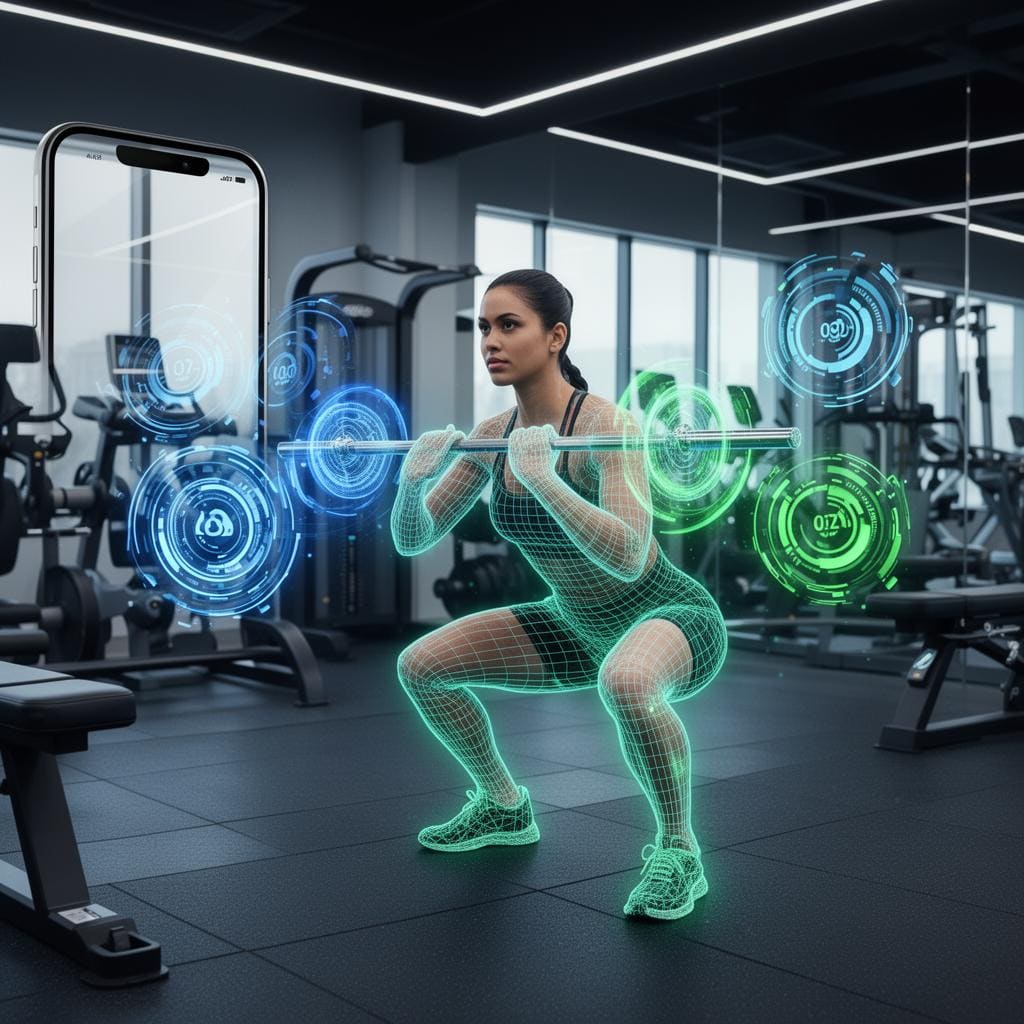
Computer vision and AI combine to create real-time coaching that was previously available only from elite personal trainers.
AI is not a feature in fitness apps: it is the foundation. The most successful fitness platforms in 2026 are built AI-first, with every user interaction informing a model that becomes more personalized over time. Static programs delivered identically to every user are the fitness app equivalent of a one-size-fits-all t-shirt: technically functional but not what anyone actually wants.
Adaptive Workout Generation
AI analyzes training history, biometric data (heart rate, HRV, sleep quality), self-reported fatigue levels, and performance trends to generate daily workout plans that adjust in real time. Poor sleep last night? The AI recommends a lighter session focused on mobility. HRV shows full recovery? Time for a high-intensity push. This level of responsiveness mimics what an elite personal trainer provides, except it scales to millions of users simultaneously.
Predictive Injury Prevention
Machine learning models detect patterns that precede injuries (sudden increases in training load, declining recovery metrics, movement asymmetries) and proactively warn users to adjust their programming. This feature moves fitness apps from reactive tracking to proactive health protection.
Personalized Nutrition
AI connects workout data with nutrition tracking to generate meal recommendations that support training goals. A natural bodybuilder in a cutting phase receives automatically adjusted protein recommendations when the AI detects through wearable data that yesterday's session was particularly intense. Activity-adjusted calorie targets ensure users fuel appropriately for their actual energy expenditure.
Conversational AI Coaching
Integration with advanced language models enables users to ask natural language questions about their training: "Should I train legs today given my sleep was poor?" or "What should I eat before my evening run?" The AI responds with personalized guidance based on the user's complete data profile, making expert coaching accessible to everyone, not just those who can afford $100+/hour personal trainers.
Frenchy Digital integrates these AI capabilities using advanced language models combined with on-device inference through TensorFlow Lite for real-time biometric analysis. Our AI integration services for fitness apps are production-deployed, not experimental.
Wearable Integration: The Non-Negotiable
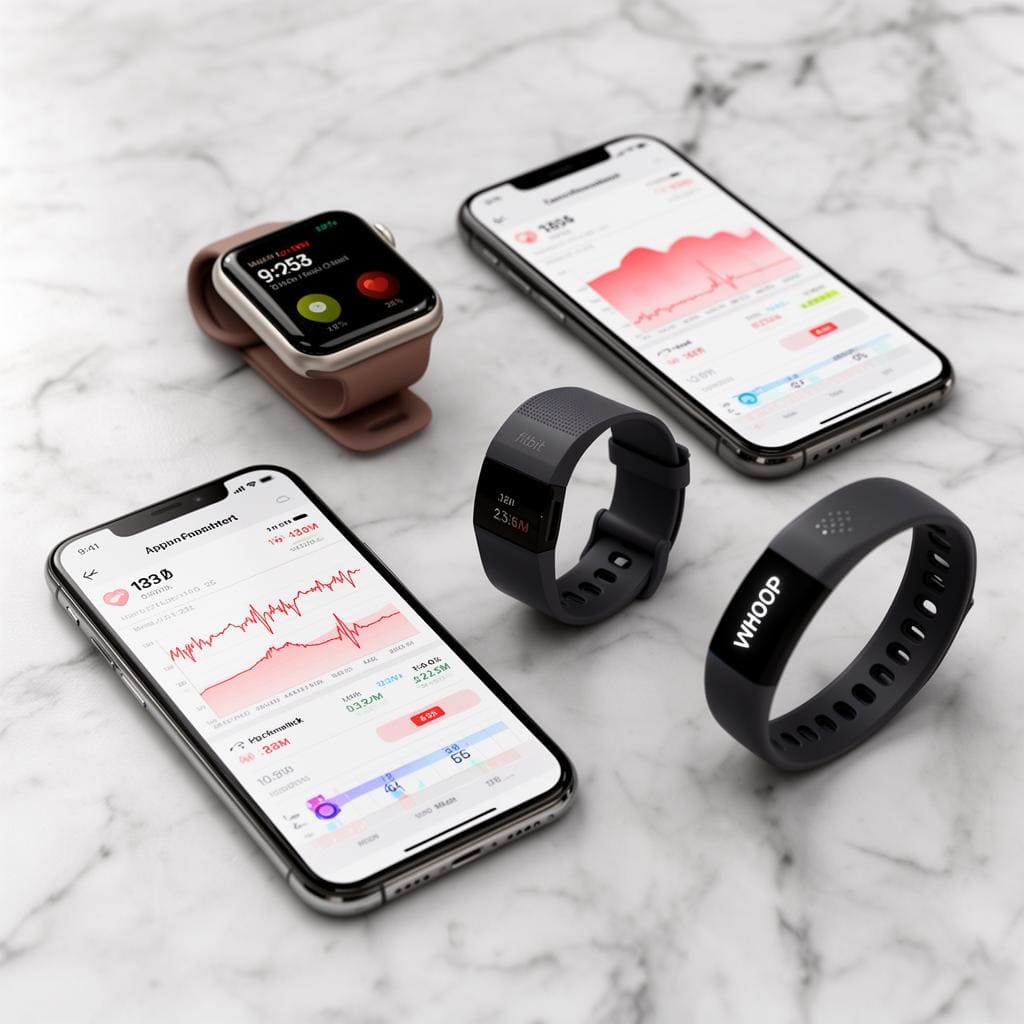
Wearable integration in 2026 demands direct SDK access to Apple Watch, Fitbit, Garmin, and WHOOP, not just Apple Health passthrough.
Wearables have led the American College of Sports Medicine (ACSM) fitness trends survey for six consecutive years, and nearly half of US adults now own a fitness tracker or smartwatch. In 2026, a fitness app without wearable integration is invisible to a substantial portion of the market.
Modern wearable integration goes far beyond pulling step counts. The data available from devices like Apple Watch, Garmin, WHOOP, and Fitbit includes:
- Continuous heart rate monitoring: Including resting heart rate trends for cardiovascular fitness tracking
- Heart rate variability (HRV): The gold standard for recovery assessment and training readiness
- Sleep stage analysis: Deep, light, REM, and awake phases for sleep quality optimization
- Blood oxygen saturation (SpO2): Altitude adaptation and respiratory health monitoring
- Skin temperature variations: Early illness detection and menstrual cycle tracking
- Stress level estimation: Based on HRV patterns and physiological markers
- GPS tracking with elevation data: Route mapping, pace analytics, and elevation gain for outdoor activities
- Activity-specific metrics: Swimming strokes, cycling power, running cadence for sport-specific analytics
The technical challenge is making this data integration seamless and battery-efficient. Users notice and abandon apps that drain their phone or watch battery, delay data sync, or display inconsistent readings between devices. React Native handles wearable integration through native modules that access Apple HealthKit, Google Health Connect, Fitbit Web API, and Garmin Connect IQ, enabling a single codebase to serve users across the wearable ecosystem.
The Holistic Wellness Shift
The biggest category evolution in 2026 is the shift from "fitness tracking" to "wellness ecosystem." Users no longer compartmentalize their health. They want one platform that understands how their sleep affects their workout performance, how their nutrition influences their recovery, and how their stress levels impact their training capacity.
The market identified 25 holistic features integrating workouts, nutrition, sleep, and mindset, compared to only 13 mind-focused and 12 recovery-specific features. This confirms the market direction: users want integrated experiences, not separate apps for each wellness dimension.
2026 Digital Fitness Ecosystem Report
Building a holistic wellness platform requires broader technical capability than a single-function fitness tracker. It demands:
- Nutrition database integration: AI-powered meal analysis with barcode scanning and camera-based food recognition
- Sleep tracking through wearable data: Sleep hygiene recommendations based on sleep stage analysis and circadian rhythm patterns
- Recovery scoring: Synthesizing multiple biometric indicators (HRV, resting HR, sleep quality, training load) into actionable readiness scores
- Mental wellness features: Guided meditation, breathing exercises, journaling, and stress management integrated with physical training data
- Unified dashboard: Showing how all wellness dimensions interact, giving users insight into their complete health picture
For health-conscious applications that approach clinical-grade monitoring, additional compliance considerations apply. Frenchy Digital navigates this spectrum (from consumer wellness features to healthcare-adjacent capabilities) with the regulatory awareness that prevents compliance problems as your app's health features become more sophisticated.
Computer Vision: Your Phone as Personal Trainer
2026 is the year smartphone cameras become real-time form coaches. Computer vision technology analyzes movements (joints, angles, posture, asymmetries) and provides immediate corrective feedback during exercises. This technology makes every home workout safer and more effective by catching form errors that lead to injuries.
Current applications deliver capabilities that were science fiction just two years ago:
- Automatic repetition counting: Eliminating manual logging and ensuring accurate workout records
- Postural deviation detection: Identifying form errors during squats, deadlifts, and push-ups in real time
- Voice prompts for form correction: Audio cues that guide users without requiring them to look at the screen mid-exercise
- Movement quality assessment over time: Tracking improvements in technique and identifying persistent movement patterns that increase injury risk
The technical requirements are significant: sophisticated machine learning models for pose estimation, performance-optimized processing for real-time feedback on mobile devices, and careful UX design that delivers corrections without interrupting workout flow. TensorFlow Lite and Apple's Vision framework power these capabilities through on-device inference, meaning the processing happens locally for privacy and low latency.
Technology Stack for Fitness Apps
Building a competitive fitness app in 2026 requires a carefully selected technology stack that balances performance, scalability, and development efficiency. The following table maps the recommended stack for modern fitness platforms.
| Layer | Technology | Purpose |
|---|---|---|
| Mobile Frontend | React Native + TypeScript | Cross-platform iOS/Android with native wearable modules |
| Wearable Integration | Apple HealthKit, Google Health Connect, Fitbit SDK, BLE | Biometric data sync, real-time heart rate, sleep data |
| Backend API | Node.js + Express | Workout logic, user profiles, AI pipeline, social features |
| Database | PostgreSQL + Redis | User data, workout history, time-series biometrics, caching |
| AI/ML | OpenAI GPT-4, Claude AI, TensorFlow Lite | Adaptive coaching, NLP chat, on-device pose estimation |
| Cloud | AWS / Firebase | Hosting, push notifications, analytics, media storage |
| Video | CloudFront CDN + HLS streaming | Exercise demo videos, live class streaming |
| Analytics | Firebase Analytics + Mixpanel | Engagement tracking, retention analysis, feature usage |
The choice of React Native as the mobile framework is particularly important for fitness apps. Native modules provide direct access to Apple HealthKit and Google Health Connect, while the cross-platform architecture saves 40-50% in development costs by maintaining a single codebase for both iOS and Android.
For cloud infrastructure, AWS provides the scalability required for fitness apps that may experience rapid user growth during New Year's resolution season or viral marketing moments. Firebase offers excellent push notification capabilities, which are critical for fitness app engagement and workout reminders.
Fitness App Development Costs
Fitness app development costs vary dramatically based on feature complexity, AI sophistication, and wearable integration depth. The following table provides realistic cost ranges for the Los Angeles development market in 2026.
| App Type | Features | Cost Range (LA Market) | Timeline |
|---|---|---|---|
| Basic Workout Tracker | Exercise library, logging, basic plans, progress charts | $40,000: $70,000 | 3-4 months |
| AI-Powered Training App | Adaptive plans, wearable sync, nutrition, AI coaching | $80,000: $160,000 | 5-7 months |
| Social Fitness Platform | Challenges, leaderboards, community, trainer marketplace | $100,000: $200,000 | 5-8 months |
| Comprehensive Wellness Ecosystem | Workouts + nutrition + sleep + recovery + mental health + AI + social | $180,000: $350,000+ | 7-12 months |
| Corporate Wellness Platform | B2B features, team challenges, admin dashboards, health analytics | $120,000: $250,000 | 6-9 months |
Frenchy Digital's phased approach makes fitness app development accessible and risk-managed:
Research Phase: $5,000
We analyze your target fitness niche, competitive landscape, wearable integration requirements, and feature prioritization. You receive a comprehensive strategy document and accurate cost projection. This two-week phase ensures you invest development dollars in features that matter.
Prototype Phase: $13,000
Interactive prototype demonstrating core workout flows, wearable data display, and user experience. Real fitness enthusiasts test the prototype to validate design decisions before committing to full development. This 3-4 week phase prevents expensive pivots during development.
Development: Starting at $80,000
Full React Native build with AI coaching, wearable integration, and deployment to Apple App Store and Google Play Store. Review our complete pricing guide for detailed breakdowns by feature and platform.
Maintenance: Starting at $11,000/year
Ongoing maintenance and support including OS updates, wearable SDK updates, AI model optimization, and feature iterations. Fitness apps require more frequent updates than most categories due to constantly evolving wearable APIs and health data regulations.
Monetization Models
The dominant fitness app business model is freemium with premium subscription, but several monetization strategies can be combined for maximum revenue:
Subscription (Dominant Model)
Free tier with basic features, premium subscription ($9.99-$29.99/month) unlocking AI coaching, advanced analytics, personalized nutrition, and exclusive content. This model generates the highest lifetime value and is strongly preferred by investors and acquirers. Annual plans at 40-50% discount drive upfront cash flow and reduce churn.
In-App Purchases
Individual workout programs, specialty challenges, or nutrition plans sold as one-time purchases within a free or basic app. Lower commitment than subscriptions, useful for converting hesitant users who want to test premium content before committing to recurring payments.
Corporate B2B Licensing
White-label or enterprise licensing to companies for employee wellness programs. Per-employee-per-month pricing ($3-$15/employee/month) creates predictable recurring revenue. Frenchy Digital has experience building corporate wellness platforms that serve this model, including the SnapFit corporate wellness app built for Snapchat.
Trainer Marketplace Commission
Connecting users with personal trainers and taking a percentage of session fees (typically 15-25%). This creates a two-sided marketplace that increases user value and trainer income simultaneously, while generating commission revenue for the platform.
Branded Content and Partnerships
Supplement brands, sportswear companies, and fitness equipment manufacturers pay for placement, sponsored challenges, or integrated shopping experiences. The high-intent fitness audience is extremely valuable to these advertisers, making fitness apps attractive ad inventory.
Ad-Supported Free Tier
Display or video ads for free users, with the subscription upgrade removing ads. This model works best for high-volume apps where advertising revenue compensates for non-paying users. The key is implementing ads in a way that doesn't disrupt workout flow.
Why LA Is the Fitness App Capital

Los Angeles combines unmatched fitness culture with tech innovation, making it the ideal home for fitness app development.
Los Angeles is not just a tech hub: it is the wellness capital of the United States. The city's fitness culture runs deeper than any other American city, from outdoor training at Runyon Canyon and Muscle Beach to the boutique studio revolution born in Santa Monica and West Hollywood to the wellness brand ecosystem concentrated in Venice and Silver Lake.
For fitness app developers, this culture translates into tangible advantages:
- Intuitive UX understanding: LA-based development teams understand fitness user experience because they live it daily: from morning hikes to evening yoga classes
- Influencer proximity: Many of the top fitness content creators are LA-based, creating natural marketing partnerships and beta testing opportunities
- Brand ecosystem: Concentration of wellness brands, supplement companies, and fitness equipment manufacturers provides partnership and integration opportunities
- Entertainment industry connection: The entertainment industry's emphasis on health and appearance drives demand for premium, visually stunning fitness experiences
- Diverse fitness culture: From CrossFit boxes to boutique Pilates studios to outdoor bodyweight training, LA encompasses every fitness modality
Frenchy Digital's presence in Beverly Hills and Brentwood places us at the intersection of LA's fitness culture and tech ecosystem. Our team builds fitness apps in Los Angeles informed by the market we personally participate in: understanding what motivates LA's health-conscious consumers, what design standards they expect, and what features keep them opening the app day after day.
Frenchy Digital's Fitness App Approach
Our fitness app development methodology combines technical expertise with domain understanding. Here's how we approach every fitness project:
AI-First Architecture
We design the data pipeline and AI infrastructure from the beginning, not as features added later. This means wearable data feeds directly into AI models, workout recommendations adapt in real time, and every user interaction improves personalization. We integrate advanced language models for conversational coaching and TensorFlow Lite for on-device biometric analysis.
Wearable-Native Integration
Apple HealthKit, Google Health Connect, Fitbit SDK, and BLE device support are built into the core architecture. Our React Native native modules handle background sync, battery-efficient data collection, and real-time heart rate display during workouts.
Holistic Design
Our design team creates unified experiences that integrate workout, nutrition, recovery, and mental wellness, not isolated tabs with disconnected features. The dashboard shows how these dimensions interact, giving users insight into their complete wellness picture.
Engagement Engineering
Social features, gamification, push notification strategy, and onboarding flows are designed with retention psychology in mind. We build the engagement mechanics that turn first-time users into daily active users, drawing on behavioral science and our experience across 100+ launched applications.
Cross-Platform Efficiency
React Native delivers both iOS and Android from one codebase, saving 40-50% in development and ongoing maintenance costs. This is particularly valuable for fitness apps where ongoing updates (new exercises, seasonal challenges, AI model improvements) are a constant investment.
Ready to build? Schedule your free fitness app discovery call with Frenchy Digital and start creating the wellness platform your users deserve.
Conclusion: Build for the Body, Design for the Mind
The fitness app market in 2026 rewards platforms that understand a fundamental truth: people do not want a workout tracker: they want to become healthier, stronger, and more confident versions of themselves. The apps that succeed are the ones that connect biometric data to intelligent coaching, nutrition guidance to training outcomes, and community support to individual motivation.
Building this kind of platform requires fitness app developers who combine AI engineering, wearable integration, health domain knowledge, and the design sophistication to make complex technology feel effortless. It requires understanding not just how to build the technology but why users will open the app tomorrow, next week, and next year.
Frenchy Digital builds fitness apps from Los Angeles the city where fitness culture and technology intersect daily. Our transparent pricing, AI-first development approach, and 5.0-star Clutch rating deliver wellness platforms that users love and businesses profit from.
Frenchy Digital is a Black-owned mobile app development company based in Los Angeles with offices in Beverly Hills, Brentwood, Paris, and Évian-les-Bains, France. We specialize in AI-powered fitness apps, wearable device integration, React Native cross-platform development, and HIPAA-compliant health solutions. 100+ launched applications. Transparent pricing. 5.0-star Clutch rating.
Ready to Build Your Fitness App?
Partner with Frenchy Digital for fitness app development that users actually use, not just download and forget. AI coaching, wearable integration, and transparent pricing from $5,000.
1517 S Bentley Ave Suite 204, Los Angeles CA 90025
Frequently Asked Questions
Sources & References
Related Articles You May Find Helpful
- Fitness & Wellness App Development in LA 2026
- Fitness App Developers: Complete 2026 Guide
- Healthcare App Development 2026
- AI-Powered App Development 2026
- Fitness App Development Los Angeles 2026
- Mobile App Development Cost Guide
- Wearable App Development 2026
- Social Media App Development 2026
- Top 10 Fitness App Features Users Want in 2026

Social Features and Gamification
Social features are among the strongest retention drivers in fitness apps. Strava's community model proves that competition and connection keep users engaged far longer than individual tracking alone. Gamification transforms exercise from a chore into a game with rewards, milestones, and social validation.
Professional design services that understand fitness psychology create social features that retain users rather than driving them away. The best social fitness features feel like a supportive gym community, not a hostile competition.