








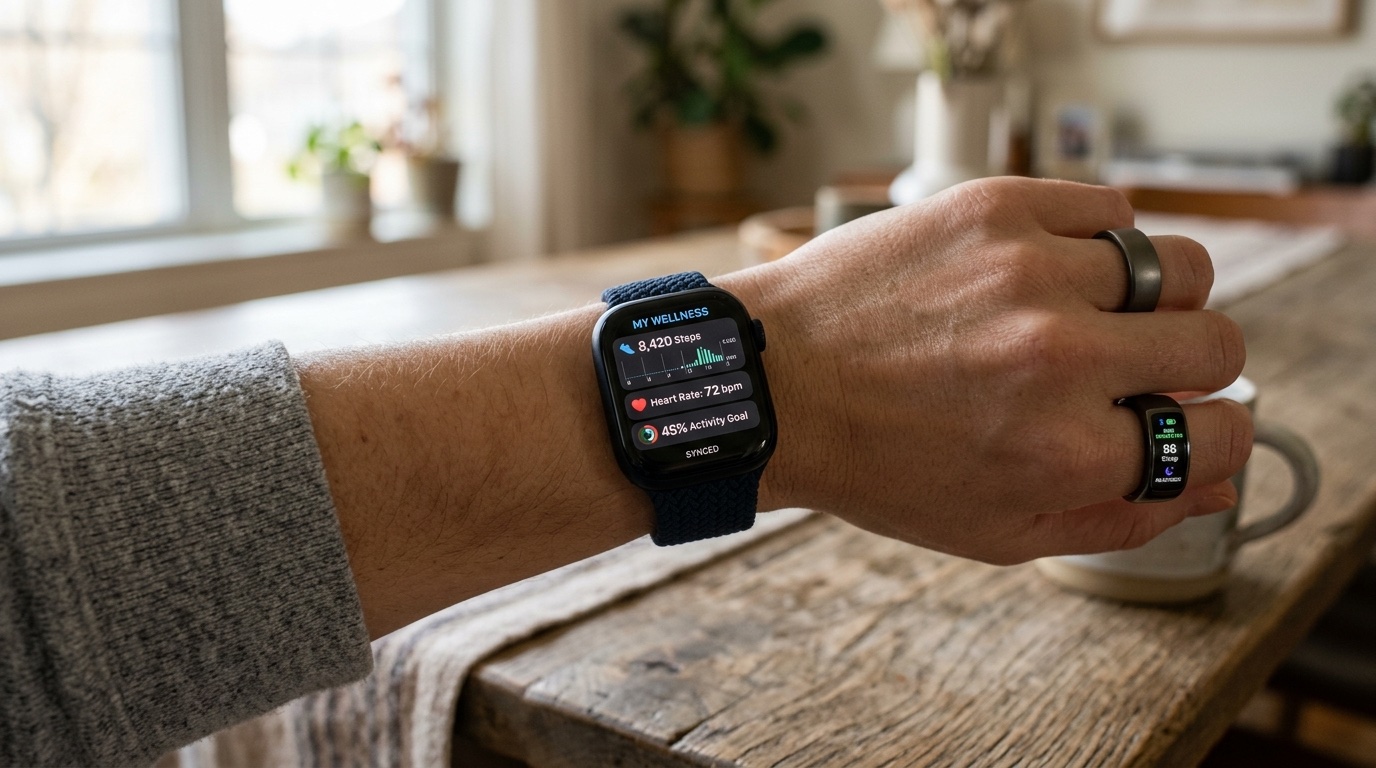
The screen on your wrist knows more about your health than your doctor sees in an annual checkup. It tracks your heart rate continuously, analyzes your sleep architecture down to the minute, monitors blood oxygen through the night, detects irregular heart rhythms, estimates your stress levels from heart rate variability, and counts every step, stair, and workout rep throughout the day. And in 2026, it does not just track. It thinks. AI algorithms transform raw biometric data into predictions, recommendations, and alerts that actively protect your health and optimize your performance.
The wearable app development market is enormous and accelerating. The wearable technology market is valued at $265 billion in 2026, with over 402 million smartwatches projected to be in active use. Approximately 60% of US households now own at least one wearable device. Smartwatches hold a 43% share of the wearable market, followed by fitness bands, hearables (smart earbuds), smart rings, and specialized medical wearables.
For businesses building health, fitness, productivity, or connected device applications, wearable integration is no longer optional. It is the expected baseline. Users want their phone apps to sync seamlessly with their wrist devices, displaying richer insights on the phone while delivering glanceable information and quick actions from the watch. This guide covers everything you need to know about building for wearables in 2026: device types, platforms, health data, AI integration, design patterns, costs, and how Frenchy Digital connects wearable data to the mobile applications where the real user experience lives, from our headquarters in Los Angeles.
The Wearable Market in 2026
The wearable ecosystem has expanded far beyond the early days of basic step counting. In 2026, wearables are intelligent health platforms that generate continuous biometric data streams, connected controllers for smart homes and IoT devices, productivity tools that keep knowledge workers focused without phone distractions, and increasingly, standalone computing devices that operate independently from smartphones.
Market by the Numbers
Over 1 billion connected wearable devices are in active use globally. The market is growing at an 18% CAGR. Approximately 29% of global consumers own at least one wearable device. 42% of US wearable owners are willing to share health data with third parties for personalized services. Apple Watch leads the premium segment while Wear OS has rapidly closed the gap thanks to Samsung Galaxy Watch and Google Pixel Watch.
The market shift from 2025 to 2026 is defined by three trends. First, standalone apps are becoming the standard applications that function fully from the watch, even without a phone connection. Users can install apps directly from the wrist-worn app store. Second, AI health intelligence is moving from a premium feature to a baseline expectation. Users want their wearable app to predict, not just report. Third, the smart ring category is emerging as a serious wearable platform, with Oura, Samsung Galaxy Ring, and rumored Apple and Meta entries creating demand for companion app development that serves these minimal, always-on form factors.
Wearable Device Types and Development Opportunities
Wearable Device Categories 2026
| Device Type | Key Devices (2026) | Sensors Available | App Opportunity |
|---|---|---|---|
| Smartwatches | Apple Watch 11/Ultra 3, Samsung Galaxy Watch 7, Google Pixel Watch 3 | HR, HRV, SpO2, ECG, temp, GPS, accelerometer, gyroscope, barometer | Standalone apps, health platforms, productivity, payments, smart home |
| Fitness Bands | Fitbit Charge, Xiaomi Band, Garmin Vivosmart | HR, steps, sleep, SpO2, GPS (some models) | Companion apps via health data APIs, fitness tracking |
| Smart Rings | Oura Ring 4, Samsung Galaxy Ring, RingConn | HR, HRV, temp, sleep, SpO2, activity | Companion mobile apps, sleep optimization, wellness tracking |
| Hearables | AirPods Pro, Galaxy Buds, Jabra Elite | Motion, hearing health, HR (some), ambient sound | Audio fitness coaching, hearing health, spatial audio experiences |
| Smart Glasses | Meta Ray-Ban, XREAL Air, Apple Vision Pro (spatial) | Camera, GPS, microphone, head tracking | AR navigation, photo/video, real-time translation, field service |
| Medical Wearables | Dexcom CGM, Abbott Libre, Biobeat patches | Glucose, blood pressure, continuous vitals | Clinical companion apps, remote patient monitoring, EHR integration |
Each device category presents different development challenges and opportunities. Smartwatches offer the richest app platform with full standalone capability. Fitness bands and smart rings communicate with companion phone apps through Bluetooth, making them natural extensions of mobile app development. Medical wearables require HIPAA-compliant companion applications and often FDA regulatory consideration.
Development Platforms: watchOS vs. Wear OS
watchOS vs. Wear OS Platform Comparison
| Factor | watchOS (Apple ) | Wear OS (Google ) |
|---|---|---|
| Market Share | ~55% of smartwatches | ~35% of smartwatches |
| Language | Swift / SwiftUI | Kotlin / Jetpack Compose |
| IDE | Xcode | Android Studio |
| Health Data API | HealthKit | Health Services / Health Connect |
| Key Devices | Apple Watch Series, Ultra | Samsung Galaxy Watch, Pixel Watch, Fossil |
| Standalone Capability | Full (with cellular models) | Full (with cellular models) |
| User Demographics | Premium consumers, higher spending | Broader market, more hardware diversity |
| App Development Cost | $20,000-$90,000+ standalone | $20,000-$90,000+ standalone |
Both platforms now support standalone applications that work independently from a phone, direct app store installation from the watch, rich health sensor access through dedicated APIs, and background processing for continuous health monitoring. The development environments are platform-specific: watchOS requires Swift/SwiftUI and a Mac, while Wear OS uses Kotlin/Compose and Android Studio.
For companion apps that sync wearable data to your mobile application, cross-platform frameworks like React Native can access both Apple HealthKit and Google Health Connect through native modules, enabling a single mobile codebase to receive and display data from both watch ecosystems. This is the approach Frenchy Digital uses for most wearable-connected projects from our Los Angeles headquarters, delivering iOS and Android companion apps that integrate with the full spectrum of wearable devices.
Connect Your App to the Wrist
Frenchy Digital builds mobile apps with deep wearable integration: Apple HealthKit, Google Health Connect, Fitbit SDK, and BLE. AI-powered health analytics. Transparent pricing from $5,000. Based in Los Angeles with offices in Beverly Hills and Geneva.
Companion vs. Standalone vs. Hybrid Apps
The architecture of your wearable app determines its capabilities, complexity, and cost:
Companion Apps
Run on the phone and receive wearable data through health data APIs (HealthKit, Health Connect) or direct Bluetooth connections. The watch does not run your app. It runs the manufacturer's own tracking, and your phone app reads the resulting data. This is the simplest and most cost-effective approach, ideal for fitness apps, wellness platforms, and health dashboards that need wearable data without requiring a wrist interface.
Standalone Apps
Run directly on the watch with full sensor access, offline capability, and independent user interface. Users interact with your app on their wrist: tracking workouts, receiving notifications, making payments, or controlling smart home devices. Standalone apps require platform-specific development (Swift for watchOS, Kotlin for Wear OS) and significantly more testing across device variants.
Hybrid Apps (Most Common in 2026)
A standalone watch app provides glanceable information and quick actions on the wrist, while a richer companion mobile app offers detailed analytics, historical charts, settings management, and AI-powered insights. The two apps sync data bidirectionally. This is the architecture that most successful wearable products use in 2026: the watch handles the real-time, the phone handles the deep dive.
Health Data: The Gold Mine on Your Wrist
Modern wearables generate an extraordinary volume of health data. Here is what your app can access (with user permission) through Apple HealthKit and Google Health Connect :
Continuous Metrics
Heart rate (real-time and resting), heart rate variability (HRV) for recovery and stress assessment, blood oxygen saturation (SpO2), step count and distance, calories burned (active and resting), skin temperature variations, and respiratory rate estimation.
Activity Data
Workout detection and classification (running, cycling, swimming, strength training), exercise duration and intensity, GPS route tracking, elevation gain, and cadence/pace metrics.
Sleep Data
Sleep stages (deep, light, REM, awake), sleep duration and consistency, sleep quality scoring, snoring detection (some devices), and sleep environment factors.
Clinical Metrics (Select Devices)
ECG readings (Apple Watch, Samsung), irregular rhythm notifications, blood pressure estimation (Samsung), fall detection, crash detection, and menstrual cycle tracking with ovulation estimation and temperature-based predictions.
Privacy and Compliance
This data is subject to strict privacy regulations. Apple HealthKit and Google Health Connect encrypt health data on device. Apps must request specific data type permissions from users. Healthcare applications handling this data in clinical contexts must comply with HIPAA. European deployments require GDPR compliance for biometric data processing. Frenchy Digital builds health data compliance into the architecture from our research phase, whether deploying from Los Angeles, Paris, or Geneva.
AI-Powered Wearable Experiences
AI is the bridge between raw biometric data and actionable intelligence. Without AI, a wearable app shows you that your resting heart rate was 62 last night. With AI, it tells you that your recovery score is 85%, your HRV trend indicates low stress, and today is optimal for a high-intensity workout, or that your three-day downward HRV trend suggests you should take a rest day despite feeling fine.
Predictive Health Alerts
Machine learning models trained on individual biometric baselines detect anomalies before they become problems: an unusual heart rate pattern during sleep, a sudden change in HRV that precedes illness, or an overtraining trajectory that risks injury. These predictions transform wearable apps from rearview mirrors to windshields.
Adaptive Fitness Coaching
AI analyzes workout data, recovery metrics, sleep quality, and training load to generate personalized exercise recommendations that adjust daily. Poor sleep last night? The AI scales back intensity. HRV fully recovered? Time for a progression workout. This level of personalization was previously available only through expensive personal trainers, now accessible to anyone with a wearable and a well-built companion app.
Natural Language Health Insights
Integration with OpenAI GPT-4 or Claude AI enables conversational health guidance within the companion app. Users ask "why is my sleep score low this week?" and receive explanations grounded in their actual data: late bedtimes, elevated resting heart rate from alcohol consumption, or inconsistent sleep schedule.
On-Device Inference
TensorFlow Lite and CoreML enable AI processing directly on the watch or phone without sending data to the cloud. This preserves privacy for sensitive health data while enabling real-time predictions with no network latency. Frenchy Digital implements on-device AI for health features where privacy and responsiveness are critical.
Designing for the Wrist: UX That Works
Wearable UX is fundamentally different from mobile UX. The screen is small (38-49mm), interactions are brief (2-5 seconds average), and users typically glance rather than stare. Design principles that work on phone screens fail on the wrist.
Glanceability
Users check their watch for information, not exploration. The most important data must be visible immediately without scrolling or tapping. Complications (watch face widgets) are the primary interface for many wearable apps: a single glanceable data point that represents your app's value.
Minimal Interaction
Each tap on a watch is harder than on a phone. Reduce interactions to the absolute minimum. The best wearable apps require zero taps for their primary function: information is displayed; the user glances and moves on.
Haptic Communication
Wearables vibrate on the wrist: a direct, personal notification channel. Haptic patterns communicate different events (workout milestone, high heart rate alert, timer completion) without requiring the user to look at the screen. Well-designed haptics make wearable apps feel responsive and alive.
Voice and Gesture Input
Dictation and voice commands compensate for the tiny keyboard. Gesture controls (wrist rotations, double-tap) provide input without touching the screen. In 2026, these alternative input methods are standard, not experimental.
Battery-Conscious Design
Every animation, refresh, and sensor poll costs battery life. Design that respects battery creates apps users keep installed. Design that drains batteries gets deleted within days regardless of how useful the features are.
The Unique Challenges of Wearable Development
Battery Optimization
Battery optimization is the paramount challenge. Continuous heart rate monitoring, GPS tracking, and frequent screen refreshes can drain a smartwatch battery in hours. Developers must use efficient background processing patterns, batch sensor readings rather than continuous polling, and minimize display wake-ups. Apple and Google provide specific APIs for power-efficient health monitoring, but using them correctly requires expertise.
Cross-Device Testing
Cross-device testing is significantly more complex than mobile testing. Different watch models have different sensors, screen sizes, processors, and battery capacities. An app that works perfectly on Apple Watch Ultra may struggle on the smaller Apple Watch SE. A Wear OS app must handle the differences between Samsung Galaxy Watch, Pixel Watch, and budget Wear OS devices.
Sensor Accuracy
Sensor accuracy varies between devices and between users. Wrist-based heart rate sensors produce noisy signals during movement. SpO2 readings are affected by skin tone and fit. Developers must implement algorithms that filter noise, detect unreliable readings, and present data with appropriate confidence levels rather than false precision.
Data Synchronization
Data synchronization between watch and phone must be reliable across connectivity interruptions. When Bluetooth drops or the watch is out of phone range, data must be queued locally and synced seamlessly when connection is restored. Users should never lose health data due to connectivity gaps.
Health Data Privacy
Health data privacy adds regulatory compliance requirements that standard mobile apps do not face. Both Apple and Google enforce strict guidelines on health data usage. Apps serving EU users must comply with GDPR's enhanced protections for biometric data. And clinical-grade applications must meet HIPAA standards that govern how protected health information is stored, transmitted, and accessed.
Smart Rings: The New Frontier
Smart rings are 2026's fastest-growing wearable category. The Oura Ring pioneered the space, and Samsung's Galaxy Ring brought mainstream attention. Rumored Apple and Meta smart rings could dramatically expand the market. These devices track health metrics (heart rate, HRV, temperature, sleep, activity) in a form factor that is discreet, comfortable, and socially unobtrusive, solving the "I do not want to wear a computer on my wrist" objection that limits smartwatch adoption.
For app developers, smart rings present a distinct opportunity. Ring users do not interact with the ring directly. There is no screen. All interaction happens through the companion phone app. This makes smart ring development fundamentally a mobile app development challenge: building the companion app that receives ring data via Bluetooth, processes it with AI, and presents actionable insights through the phone interface.
Frenchy Digital's Smart Ring Expertise
This is squarely in Frenchy Digital's expertise. Our React Native mobile apps integrate with wearable devices through BLE (Bluetooth Low Energy) protocols and health data APIs, handling the real-time data synchronization, AI-powered analytics, and engaging user experience that make raw ring sensor data genuinely useful. As the smart ring ecosystem expands, every ring needs a great companion app, and great companion apps are what we build from our Los Angeles studio.
Wearable App Development Costs
Wearable Development Cost Breakdown 2026
| Project Type | What It Includes | Cost Range | Timeline |
|---|---|---|---|
| Companion App Only | Mobile app with HealthKit/Health Connect integration, data display, basic analytics | $5,000-$30,000 | 1-3 months |
| Standalone Watch App | watchOS or Wear OS native app with sensors, notifications, offline capability | $20,000-$90,000 | 3-5 months |
| Hybrid (Watch + Phone) | Standalone watch app + companion mobile app with sync, analytics, AI | $60,000-$180,000 | 4-7 months |
| Multi-Device Platform | Watch + phone + multiple device integrations + AI analytics + admin dashboard | $120,000-$300,000+ | 6-10 months |
| Medical-Grade Wearable App | Clinical data handling, HIPAA compliance, EHR integration, regulatory preparation | $150,000-$350,000+ | 7-12 months |
Frenchy Digital's phased approach manages wearable project investment: our $5,000 research phase validates your wearable concept, maps device compatibility requirements, and defines the integration architecture before development begins. The $13,000 prototype phase tests the mobile companion experience with real wearable data. Development starts at $80,000 for the full mobile application with wearable integration, AI analytics, and app store deployment.
Transparent Pricing from Los Angeles
Frenchy Digital provides itemized proposals that break down every cost component: no hidden fees, no surprise invoices. Our LA-based team works with the same transparent pricing model whether you are a startup in Santa Monica or an enterprise in Beverly Hills. See our full cost guide for detailed breakdowns.
From Wrist Data to Intelligent Mobile Experiences
Frenchy Digital builds the mobile apps that make wearable data actionable: Apple HealthKit, Google Health Connect, BLE device sync, and AI-powered health analytics. 50+ apps launched. 5.0-star Clutch rating. Los Angeles headquarters with presence in Paris and \u00c9vian-les-Bains.
Frenchy Digital's Wearable App Approach
Frenchy Digital approaches wearable development through the lens of the mobile companion experience, because that is where users spend 95% of their time with wearable data. The watch collects; the phone interprets, visualizes, and guides.
Deep Health Data Integration
Our React Native native modules connect to Apple HealthKit, Google Health Connect, Fitbit Web API, and BLE protocols for direct device communication. We handle background synchronization, data normalization across device types, and battery-efficient collection patterns.
AI-Powered Analytics
We integrate OpenAI GPT-4 and Claude AI for conversational health insights, and TensorFlow Lite for on-device biometric analysis. Recovery scoring, training load optimization, sleep quality analysis, and anomaly detection turn raw sensor data into intelligence users act on.
Cross-Device Support
A single React Native companion app serves users across the Apple and Android wearable ecosystems. Users with Apple Watch and users with Samsung Galaxy Watch both get a first-class experience from the same codebase, at 40-50% lower cost than building separate native apps. Our maintenance services keep wearable integrations current as watch OS versions and health APIs evolve.
Compliance-Ready
For healthcare wearable applications, we build HIPAA-compliant data handling from the architecture phase: encrypted biometric data storage, audit logging, and secure transmission to clinical systems. For fitness applications, we ensure compliance with Apple and Google health data policies.
LA-Based Wellness Expertise
Our Los Angeles base puts us at the center of America's wellness culture, building wearable-connected apps informed by the fitness-forward market we live in. Our 5.0-star Clutch rating across 100+ launched applications includes fitness and health platforms with real-time wearable integration.
Conclusion: The Future Is Worn, Not Carried
Wearable technology has crossed the threshold from gadget to essential health infrastructure. With 60% of US households owning a wearable and AI transforming raw biometric data into intelligent health guidance, the applications built on this data are becoming as important as the devices themselves. The watch collects the signal. The app creates the meaning.
Wearable app development in 2026 is a multi-device, multi-platform, privacy-sensitive, AI-powered discipline that demands expertise in mobile development, health data integration, real-time synchronization, and intelligent analytics. The apps that succeed are the ones that make complex biometric data feel simple, personal, and actionable, turning your wrist into a window on your wellbeing.
Frenchy Digital builds the mobile applications that complete the wearable experience. Our React Native expertise delivers cross-platform companion apps that integrate with Apple Watch, Samsung Galaxy Watch, Fitbit, Oura Ring, and custom BLE devices. Our AI integration powers the intelligent features that keep users engaged. And our transparent pricing ensures you invest wisely in technology that users wear (and rely on) every day.
Ready to build for the wrist? Schedule your free wearable app discovery call with Frenchy Digital and connect your mobile app to the most personal computing platform ever created.
Frenchy Digital is a Black-owned mobile app development company based in Los Angeles with offices in Beverly Hills, Brentwood, Paris, and \u00c9vian-les-Bains, France. We specialize in wearable-connected mobile apps, AI health analytics, React Native cross-platform development, and HIPAA-compliant healthcare solutions. 100+ launched applications. Transparent pricing. 5.0-star Clutch rating. Explore our blog for more resources on mobile app development.
Frequently Asked Questions
Ready to Build Your Wearable App?
Frenchy Digital specializes in wearable-connected mobile app development with expertise in Apple HealthKit, Google Health Connect, AI health analytics, and BLE integration. From smart ring companion apps to comprehensive health platforms: we build from Los Angeles with offices in Beverly Hills, Paris, and Geneva.