












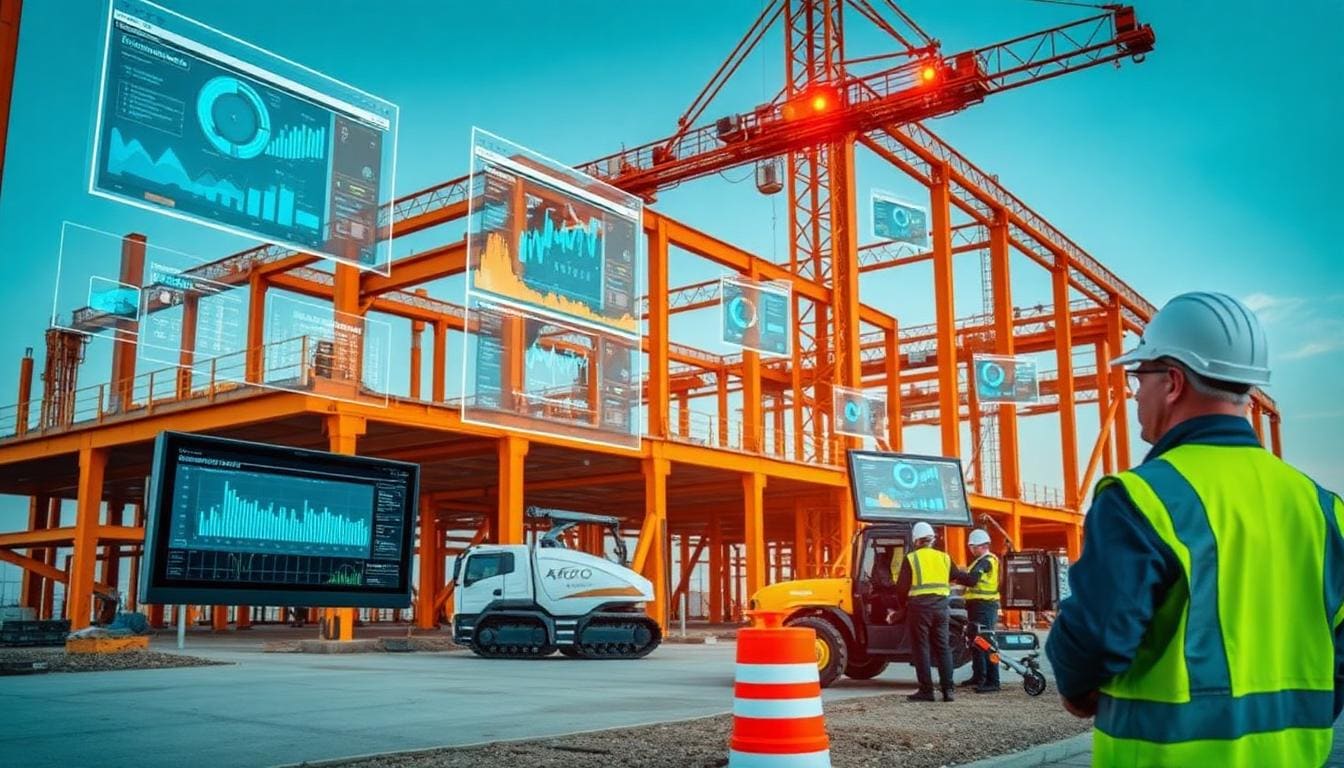
The Construction Crisis AI Agents Are Built to Solve
Artificial intelligence is no longer confined to experimental pilots in the construction industry. It is moving into the operational core of how projects are planned, monitored, and executed, driven by labor shortages, safety pressures, and rising project complexity that traditional methods cannot address. What is emerging across the global construction industry is not a single "AI tool" but an ecosystem of autonomous agents, predictive systems, and intelligent applications that are reshaping the economics and risk profile of building.
Construction companies implementing AI report fewer project delays, improved productivity, and fewer safety incidents. McKinsey estimates that US construction companies using AI and automation achieve up to 20% cost reductions and 30% faster project delivery. And the construction AI market itself is projected to keep growing in the years ahead.
Yet the construction industry remains one of the least digitized sectors in the economy. Productivity growth has lagged behind manufacturing and virtually every other industry for two decades. The reason is not that the technology does not exist: it is that the technology has not been built specifically for how construction companies actually work. Generic AI tools do not understand RFIs, submittals, change orders, trade coordination, or the reality that your data lives in ten different systems that do not talk to each other.
This is where custom AI agents, built for your workflows, integrated with your existing tools, and designed around your specific operational challenges, create the competitive advantage that off-the-shelf solutions cannot. And this is exactly what Frenchy Digital builds.
- Labor shortage at crisis level: US construction needs more workers in 2026. Contractors struggle to fill positions. Workforce retirements are adding pressure before 2031.
- Safety remains dangerous: Construction is one of the most dangerous US industries. AI safety tools help reduce incidents.
- Cost and margin pressure: Material costs elevated from tariffs and supply volatility. Every inefficiency erodes profit directly.
- Complexity and fragmentation: Data scattered across schedules, drawings, submittals, change orders, emails, and disconnected software platforms.
What AI Agents Actually Do on a Construction Site
An AI agent is not a chatbot. It is not a dashboard. It is an autonomous software system that observes data from construction workflows, reasons about what it sees, makes decisions, and takes action, without waiting for a human to tell it what to do at every step. Think of AI agents as a digital project coordinator that never sleeps, never gets tired, and can process data from every system simultaneously.
Traditional construction software stores data and waits for humans to analyze and act on it. Procore stores your RFIs. PlanGrid stores your drawings. CMiC stores your financials. AI agents sit on top of these existing tools, connecting data across platforms and acting autonomously. An AI agent reads new RFIs, classifies them by urgency and trade, routes them to the correct team member, tracks response deadlines, and escalates overdue items, all without human intervention for routine cases.
The critical distinction is reactive versus proactive. Software waits for commands. Agents observe patterns and act. In 2026, Trimble predicts that networks of AI agents will operate across design, engineering, and construction in connected ecosystems: streamlining design processes, orchestrating schedules, resolving conflicts, tracking progress, managing resources, and more. These are not isolated pilots. They are moving into production workflows at the firms that lead the industry.
Seven AI Agent Use Cases Transforming Construction
| Use Case | What the AI Agent Does | Measured Impact |
|---|---|---|
| Estimating & Bidding | Automates quantity takeoffs from drawings, drafts bid proposals, benchmarks pricing against historical data, predicts win probability | Faster takeoffs, more accurate bids |
| Project Management | Dynamically adjusts schedules in real time, forecasts labor shortfalls, simulates what-if scenarios, generates progress reports | Fewer delays, 30% faster delivery |
| Safety Monitoring | Computer vision analyzes site cameras for PPE compliance and unsafe behavior, predicts high-risk activities, sends real-time alerts | Fewer safety incidents |
| Document Processing | Reads and classifies RFIs, submittals, invoices, and contracts. Extracts key data, routes to correct teams, tracks deadlines | Faster document processing |
| Supply Chain & Procurement | Forecasts material demand, optimizes ordering, tracks deliveries, identifies supply risks, matches invoices to purchase orders | Fewer supply chain delays |
| Cost Management | Monitors real-time spending, predicts budget overruns, processes change orders, compares actuals to estimates | Real-time financial visibility |
| Quality & Inspection | Analyzes progress photos against BIM models, detects defects, tracks completion percentages, generates punch lists automatically | Reduced rework costs |
Each of these use cases represents a specific AI agent, or a network of agents working together. The most advanced construction companies are deploying multiple agents that share data: the scheduling agent knows what the estimating agent priced, the safety agent informs the scheduling agent about high-risk task sequences, and the cost agent tracks the financial impact of every change. This connected ecosystem is what Trimble calls "networks of AI agents", and it is the direction the industry is heading.
The AI Construction Market in 2026
- The construction AI market is projected to keep growing in the years ahead.
- Companies implementing AI report fewer project delays, productivity gains, and fewer safety incidents.
- 20% cost reduction (McKinsey). 30% faster delivery.
- Faster client and contractor communication. Fewer supply chain delays.
The investment flowing into construction AI is accelerating. Bedrock Robotics raised new funding to scale autonomous construction equipment. AI-powered platforms like SmartPM, Trunk Tools, Document Crunch, and Boon are moving from early-stage pilots to production deployment at major contractors. Gartner lists physical AI, AI that interacts with the physical world through sensors, cameras, and autonomous machines, as one of its top technology trends in 2026, with construction identified as a primary application domain.
The critical insight for construction company owners and executives is that AI is not a future consideration. The firms that launched AI pilots in 2024-2025 are now integrating the technology into core operations. Those that start in 2026 can still close the gap. Those that wait until 2027 or later face a compounding disadvantage as AI-leading competitors accumulate proprietary data, optimized workflows, and operational efficiency that late adopters cannot easily replicate.
AI Agents and the 500,000 Worker Shortage
The framing matters: AI agents in construction are not worker replacements. They are force multipliers for a workforce that is shrinking, aging, and stretched thin. When your industry cannot find the additional workers it needs, the only alternative is to make the workers you have significantly more productive.
Three Ways AI Multiplies Workforce Capacity
- Automate administrative burden: Document processing, report generation, schedule updates, compliance tracking, invoice matching, tasks that eat into project managers' time.
- Scale institutional knowledge: When a veteran superintendent retires, AI agents trained on your company's project data preserve and distribute that knowledge to every team member.
- Optimize deployment: AI scheduling agents analyze labor availability, trade sequences, weather forecasts, and equipment locations to ensure the right workers are in the right place at the right time.
The surge in data center, energy storage, and semiconductor construction is drawing a disproportionate share of electricians, welders, and HVAC technicians, further straining the labor pool for residential and commercial contractors. AI does not add workers to the pool. It ensures the workers you have spend their hours on skilled work rather than administrative coordination.
The Widening Gap Between AI Leaders and Followers
Deloitte's 2026 Engineering and Construction Industry Outlook identifies a widening gap between AI leaders and followers. Companies that launched AI pilots in previous years are now fully integrating the technology into operations. The impact is most pronounced in back-office functions: financial forecasting, contract management, compliance checking, and project scheduling. But firms are not stopping there. Agentic AI, autonomous agents that make decisions independently with human-in-the-loop oversight, is the next wave.
The competitive dynamics are asymmetric. Large enterprises benefit from scaling digital capabilities across operations. Mid-market firms thrive through agility and strategic partnerships, adopting AI faster than large competitors burdened by legacy systems and organizational inertia. But those slow to adapt, regardless of size, risk rising costs, shrinking margins, and strategic irrelevance. The data feedback loops that AI creates, where AI performance improves as more project data accumulates, mean that early adopters gain compounding advantages over time.
Building Custom AI Agents for Your Construction Company
Off-the-shelf AI construction tools like SmartPM, Document Crunch, and Boon solve specific problems well. But they are generic: designed for the average construction company, not for your specific workflows, your specific tool stack, and your specific competitive challenges. Custom AI agents built for your company integrate with your exact combination of Procore, PlanGrid, CMiC, or other platforms. They understand your company's data structure, your project types, your subcontractor relationships, and your operational priorities.
Frenchy Digital builds custom AI agent applications for construction companies using GPT-4 and Claude AI for natural language processing (reading documents, answering questions, generating reports), TensorFlow and PyTorch for predictive analytics (cost forecasting, risk prediction, schedule optimization), computer vision for site monitoring (safety compliance, progress tracking, quality inspection), and React Native for mobile delivery (field teams access AI agents from phones and tablets on the job site).
The development process follows our product-led approach: the $5,000 research phase maps your construction workflows, identifies the highest-impact AI opportunities, audits your data readiness, and defines the KPIs the AI agent must deliver. The $13,000 prototype validates the core AI functionality with real project data. Full development at $80,000+ builds the production system with integrations, mobile access, and ongoing learning.
Custom AI Agent Development Costs
| Project Type | What It Includes | Cost Range | Timeline |
|---|---|---|---|
| Single-Function AI Agent | One workflow: estimating assistant, safety monitor, or document processor with integration to one platform | $40,000-$80,000 | 2-4 months |
| Multi-Function AI System | 2-3 construction workflows, integrations to Procore/PlanGrid/CMiC, mobile access, dashboard | $80,000-$200,000 | 4-7 months |
| AI Agent Platform | Connected agents across estimating, scheduling, safety, quality, and cost management. Portfolio-level analytics | $200,000-$500,000+ | 8-14 months |
| AI-Powered Mobile Field App | Mobile app for field teams: AI document scanning, voice-to-report, photo-based progress tracking, safety alerts | $60,000-$150,000 | 3-6 months |
| AI Chatbot / Knowledge Assistant | GPT-4/Claude-powered assistant trained on company data: specs, procedures, safety protocols, project history | $30,000-$70,000 | 2-3 months |
The ROI calculation for construction AI is straightforward. Preventing a single 2-week delay on a $2 million project saves more than the cost of most AI implementations. Reducing rework by even 5% on a $10 million project recovers $500,000. Catching one safety incident before it becomes a lost-time injury avoids $50,000-$200,000 in direct and indirect costs. The $11,000+/year maintenance that keeps your AI agent current and learning from new project data is a rounding error against these returns.
Why Construction Companies Choose Frenchy Digital
Frenchy Digital builds AI agent applications for construction and renovation companies with the same product discipline, technical rigor, and transparent pricing that has earned a 5.0-star Clutch rating across 100+ launched applications.
Frenchy Digital Construction AI Capabilities
- AI that integrates with your existing tools: Procore, PlanGrid, CMiC, Bluebeam. No rip-and-replace.
- Mobile-first for field teams: React Native apps deliver AI capabilities directly to field teams on the job site.
- AI expertise proven across industries: healthcare, fintech, wellness, and enterprise applications.
- Transparent pricing, phased approach: $5,000 research, $13,000 prototype, $80,000+ development, $11,000+/year maintenance.
- Los Angeles-based, construction-market aware: Deep understanding of LA's regulatory environment, labor dynamics, and project complexity.
Ready to explore AI for your construction company? Schedule your free AI assessment and start with the question that matters: where in your operation would preventing one delay, catching one defect, or automating one workflow deliver the highest return?
Ready to Build Your App?
Schedule a free strategy consultation with our team to discuss your project.
1517 S Bentley Ave Suite 204, Los Angeles CA 90025
Frequently Asked Questions
Sources & References
Related Articles You May Find Helpful
- Claude AI Agents for Black-Owned Tutoring and EdTech Companies in Los Angeles 2026
- Claude AI Agents for Black-Owned Construction and Trades Businesses in Los Angeles 2026
- AI Agents for Construction Estimating
- AI Agents for Construction Project Management
- AI Agents for Construction Safety
- AI Agents for Home Renovation
- AI Agents for General Contractors