











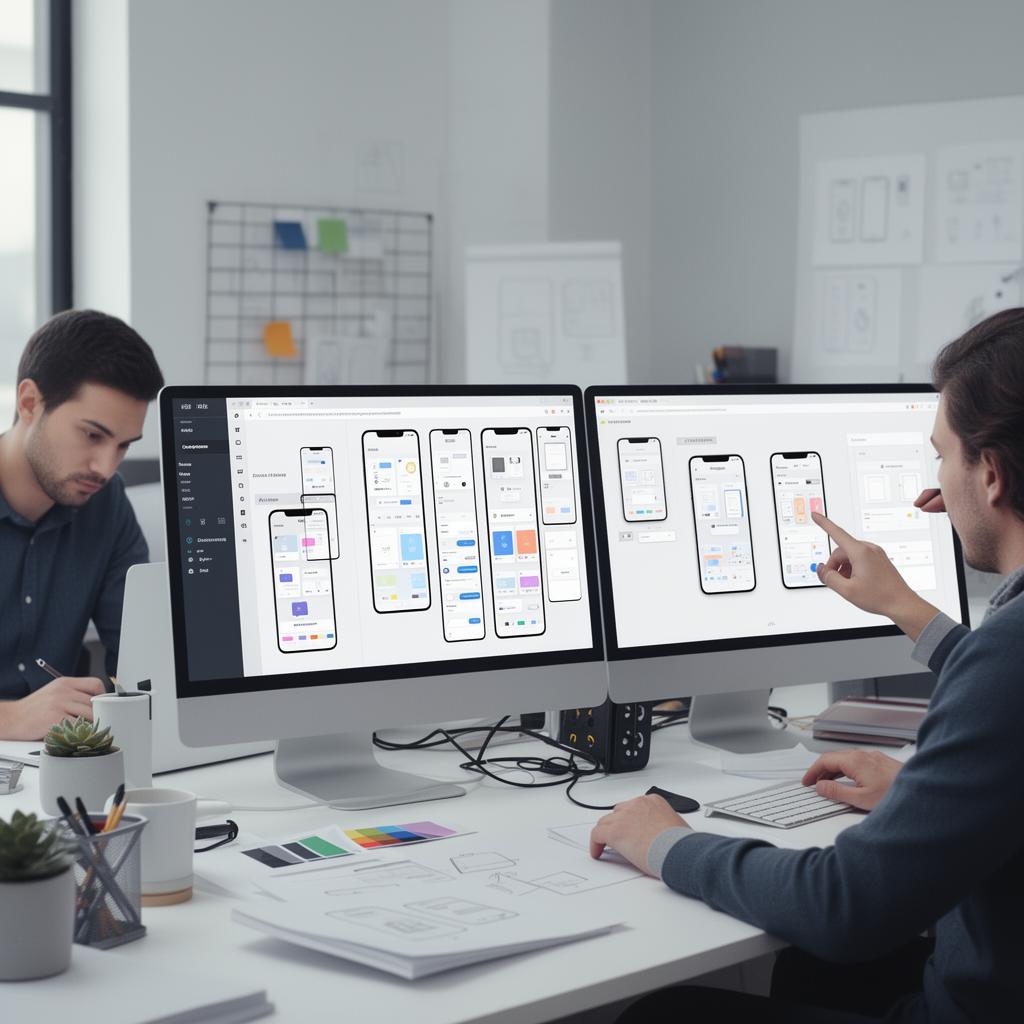
What Is a UX Design and App Development Firm?
A UX design and app development firm is a partner that combines user experience research, interaction design, visual design, and full-stack engineering under a single accountability structure. This is fundamentally different from the market's two dominant but flawed models: design-only studios that deliver Figma files and walk away, and development-only shops that take requirements and produce code without ever speaking to a user.
The integrated model exists because the boundary between "design" and "development" is artificial. A button's placement is a design decision with engineering implications. A database query's response time is an engineering decision with user experience consequences. When the same team owns both, tradeoffs are visible and optimizable. When separate vendors own each, tradeoffs become conflicts, and users pay the price.
According to McKinsey's Design Value Index, companies that integrate design and engineering into cross-functional teams outperform industry peers by 32% in revenue growth and 56% in total returns to shareholders. The integration is not a workflow preference: it is a competitive advantage.
The Three Models Compared
| Model | What You Get | Typical Cost | Hidden Cost | Best For |
|---|---|---|---|---|
| Design-Only Studio | Figma files, style guide | $25K-$100K | Handoff translation, dev rework, misaligned constraints | Companies with mature internal engineering teams |
| Dev-Only Shop | Code, working app | $100K-$500K | No user research, poor UX, high post-launch churn | Internal tools, B2B dashboards with captive users |
| Integrated Firm | Research, design system, code, outcomes | $125K-$2M | Higher upfront investment, but 15-25% lower total cost of ownership | Consumer apps, startups, products where UX drives revenue |
Why Integrated UX + Development Wins
The case for integration is not theoretical. It is measurable across time, cost, and product quality. When UX researchers, interaction designers, and engineers share sprint boards, standups, and retrospectives, three things happen that do not happen in siloed organizations.
First, constraints are discovered early, not at handoff. An engineer can flag a proposed animation as performance-prohibitive on low-end Android devices while the designer is still exploring concepts, not after the design is "final." A designer can identify that a database schema limits real-time updates before engineering commits to the architecture. These early discoveries save 25-40% of total project time that would otherwise be spent in revision cycles.
Second, design systems emerge organically rather than being imposed. In integrated teams, the design system is not a deliverable from design to engineering: it is a shared codebase where components are designed in Figma and implemented in React Native or Swift simultaneously. The components are battle-tested because they are built by the same people who designed them. This cuts component-level rework by 50-70% compared to handoff models.
Third, outcomes are owned, not tickets. In a dev shop, an engineer's success metric is tickets closed. In an integrated firm, the metric is user retention, task completion rate, or revenue per user. This shifts every micro-decision, from error message copy to loading state behavior, toward business impact rather than spec compliance.
"The most successful product teams we have studied do not have a design phase followed by a development phase. They have a continuous loop of research, design, build, and validate, with the same people participating at every stage."
Jakob Nielsen, Nielsen Norman Group
Integrated vs. Siloed: The Numbers
| Metric | Siloed Vendors | Integrated Firm | Source |
|---|---|---|---|
| Average Time-to-Market | 9-14 months | 6-10 months | McKinsey |
| Design Revision Cycles | 8-15 rounds | 3-6 rounds | Industry benchmarks |
| Post-Launch UX Issues | 40-60 per release | 10-20 per release | DORA research |
| Total Cost of Ownership (3-year) | Baseline | 15-25% lower | Forrester |
| User Retention at 90 Days | 25-35% | 45-60% | Product analytics benchmarks |
Top 12 Firms for UX Design and App Development 2026
The following firms were evaluated across six dimensions: (1) verified integrated delivery (not subcontracted handoffs), (2) demonstrated user research practice, (3) living design systems in production, (4) senior-level engineering talent, (5) measurable business outcomes for clients, and (6) post-launch accountability. Each was cross-referenced against Clutch, GoodFirms, and direct client references.
| Firm | HQ | Specialty | Verified Range | Notable Clients |
|---|---|---|---|---|
| IDEO | Palo Alto, CA | Human-centered design + prototyping | $500K-$5M | Fortune 100 healthcare, fintech |
| Frog Design | San Francisco, CA | Enterprise UX + digital transformation | $1M-$10M | Global telecom, automotive |
| Frenchy Digital | Los Angeles, CA / Geneva, CH | Integrated UX research, design systems, React Native/native | $125K-$900K | ScoreBiz 360, Pergola Cave, Fairfax Training |
| R/GA | New York, NY | Brand-driven product innovation | $750K-$5M | Nike, Samsung, Google |
| Work & Co | Brooklyn, NY | Product design + engineering | $500K-$3M | Apple, Facebook, Spotify |
| ustwo | London, UK / New York | Game-inspired UX + mobile apps | $300K-$2M | Monument Valley, Adidas |
| Devbridge | Chicago, IL / London | Enterprise UX + custom software | $400K-$3M | S&P Global, Grainger |
| Crema | Kansas City, MO | Product design + web/mobile dev | $150K-$1M | Startups to mid-market |
| Netguru | Poznan, PL | Product design + React Native | $100K-$800K | European startups, SaaS |
| Thoughtbot | Boston, MA / London | Lean UX + Ruby/Elixir | $150K-$1M | Startups, healthcare, education |
| Clay | San Francisco, CA | UX/UI design + mobile development | $200K-$1.5M | Slack, Coinbase, Stripe |
| Appnovation | Vancouver, CA | Digital experience + open-source | $300K-$2M | Fortune 500, government |
How to read this table: Verified range reflects publicly confirmed project sizes from Clutch reviews, direct client references, and case studies. Firms are not ranked 1-12 because the right partner depends on your product complexity, budget, industry, and geographic preference. A $150K consumer app startup will have a different optimal partner than a $2M enterprise platform.
Frenchy Digital's position: We specialize in integrated engagements where UX research, design systems, and senior engineering (React Native, Swift, Kotlin) are delivered by the same pod. Our verified range ($125K-$900K) reflects 100+ shipped apps across fintech, healthtech, proptech, and consumer, with an average Clutch rating of 5.0 and 80% of clients returning for additional products.
The UX Process for App Development
The UX process in an integrated firm is not a pre-development phase: it is the first loop of a continuous cycle that runs parallel to engineering. Each phase produces artifacts that engineers can consume immediately, not at a mythical "handoff" milestone.
- Phase 1: Discovery (Weeks 1-3): Stakeholder interviews, competitive audit, heuristic evaluation of existing products, user journey mapping, and preliminary persona development. Output: Research report with prioritized opportunity areas.
- Phase 2: Strategy (Weeks 3-5): Information architecture, detailed user flows, feature prioritization via RICE or Kano modeling, and content inventory. Output: Sitemap, user flow diagrams, and prioritized feature backlog.
- Phase 3: Design (Weeks 5-10): Low-fidelity wireframes, high-fidelity mockups, interactive prototypes, and initial design system (typography, color, spacing, components). Output: Clickable prototype, design system v1, and annotated wireframes.
- Phase 4: Validation (Weeks 8-12, overlapping): Usability testing with 5-8 participants per round, A/B testing of critical flows, accessibility review (WCAG 2.1 AA), and analytics instrumentation planning. Output: Usability report, prioritized fix list, and validated design system.
- Phase 5: Handoff (Continuous, Weeks 10-14): Annotated specs in Figma dev mode or Zeplin, component library in Storybook, motion specification for animations, and API contract documentation for data-driven UI. Output: Developer-ready package with zero ambiguity.
The critical difference in integrated firms is that Phase 5 does not exist as a discrete event. Engineers begin consuming wireframes in Phase 3, building foundational components while designers refine high-fidelity details. By the time "handoff" would traditionally occur, 40-60% of the codebase is already implemented and tested.
Parallel vs. Sequential Delivery
| Week | Sequential Model | Integrated Parallel Model |
|---|---|---|
| 1-3 | Research only | Research + architecture spike |
| 4-6 | Strategy only | Strategy + component scaffolding |
| 7-10 | Design only | Design + feature implementation |
| 11-14 | Handoff + dev start | Testing + refinement + launch prep |
| 15-18 | Development | Already live in beta |
| 19-22 | Testing and launch | Public launch + iteration |
Design Systems: The ROI Multiplier
A design system is not a style guide. It is a living product: a single source of truth containing reusable UI components, typography scales, color tokens in semantic naming (not hex values), interaction patterns, animation specifications, and usage documentation. In integrated firms, the design system is maintained in Figma and implemented in code simultaneously.
The business case for design systems is overwhelming. According to Smashing Magazine's longitudinal study, teams with mature design systems ship features 30-50% faster, reduce design debt by 60%, and cut onboarding time for new designers and engineers by 70%. For a team of 10, that translates to $200K-$400K in annual productivity gains.
What a real design system includes in 2026:
- Foundation layer: Color tokens (primary, secondary, semantic states), typography scale (heading, body, caption, label with exact sizes and weights), spacing system (4px base grid with named increments), and elevation/shadow tokens.
- Component layer: Buttons (primary, secondary, ghost, with loading, disabled, and active states), inputs (text, password, search, with validation states), cards, modals, navigation (tab bars, sidebars, breadcrumbs), lists, and form layouts.
- Pattern layer: Empty states, error states, loading skeletons, search flows, filter/sort interactions, and onboarding sequences.
- Motion layer: Transition durations, easing curves, micro-interaction specifications (button press, toggle switch, swipe actions), and page transition patterns.
- Documentation: Usage guidelines, do/don't examples, accessibility annotations, and contribution workflow for adding new components.
"A design system is the official story of how your organization designs and builds digital products. Without one, every product is a snowflake, every team is inventing from scratch, and every launch takes longer than the last."
Brad Frost, Author of Atomic Design
When evaluating a firm, ask to see their design system in action, not screenshots, but a live Storybook or Figma library you can interact with. Ask how many components it contains, how often it is updated, and whether it spans mobile and web. A firm with 20 components updated quarterly is at a different maturity level than one with 200+ components updated continuously.
User Research & Validation
User research is the foundation of every decision in an integrated firm. Without it, designers are guessing, product managers are prioritizing by opinion, and engineers are building features no one needs. Firms that skip research produce beautiful apps that fail, because failure in product development is not aesthetic, it is functional.
Research methods that matter in 2026:
- Generative interviews: 45-minute 1:1 sessions with target users to understand mental models, pain points, and existing workarounds. Minimum 5-8 participants per user segment.
- Competitive heuristic evaluation: Expert review of 3-5 competitor apps against Nielsen's 10 usability heuristics, producing a scored gap analysis.
- Journey mapping: Visual mapping of the user's end-to-end experience, identifying emotional highs, lows, and opportunity points.
- Usability testing: Task-based observation of users interacting with prototypes, measuring success rate, time-on-task, and error rate. Minimum 5 participants per round, 2-3 rounds per major flow.
- A/B testing: Controlled comparison of two design variants with real users, requiring statistical significance (typically 95% confidence) before declaring a winner.
- Analytics instrumentation: Event tracking, funnel analysis, and cohort retention measurement starting from beta launch.
The firms in our top 12 all demonstrate at least four of these methods in their case studies. The best demonstrate all six with published metrics. When a firm cannot show you a usability test report with real participant quotes, they do not do research. They do assumption.
Research Investment by Product Stage
| Stage | Research Focus | Typical Investment | Expected Impact |
|---|---|---|---|
| Pre-Launch | Generative interviews, competitive audit, journey mapping | $15K-$40K | Prevents building the wrong product |
| MVP | Usability testing, prototype validation, analytics setup | $10K-$25K | Reduces post-launch churn by 30-50% |
| Growth | A/B testing, cohort analysis, feature prioritization | $15K-$40K/month | Increases conversion 15-25% per experiment |
| Scale | Accessibility audit, internationalization research, advanced analytics | $25K-$60K | Opens new markets, reduces legal risk |
Designer-to-Developer Handoff
In traditional models, handoff is a crisis point. Designers export static images. Developers interpret them differently. Animations are described in Slack messages. Edge cases are discovered during QA. The result is a product that looks like the design but does not feel like it, and users notice the difference.
Integrated firms solve this by eliminating handoff as an event. But when handoff does occur, for external engineering teams or client handbacks, the best firms deliver a comprehensive package that removes all ambiguity.
- Figma dev mode: Developers inspect components with CSS values, spacing measurements, and asset exports directly from the design file. No more measuring screenshots.
- Annotated specifications: Every screen includes notes on behavior, animation timing, error states, loading states, and empty states, not just the happy path.
- Component library in Storybook: Interactive, documented components that match Figma exactly. Developers copy code, not recreate from images.
- Motion specification: Animation duration, easing curves, and gesture thresholds defined with code-ready values (e.g., cubic-bezier, spring physics).
- API contract documentation: Data structures, response formats, and error codes that drive the UI, documented alongside the screens that consume them.
- Accessibility annotations: Screen reader labels, focus order, keyboard navigation paths, and color contrast ratios for every interactive element.
The firms that do this well have a single shared repository where Figma files, Storybook components, and engineering code live together. When a designer updates a button color, the design token propagates to the component library and the app automatically. This is not futuristic: it is standard practice at the firms in our top 12.
Pricing & Engagement Models
Pricing for integrated UX design and app development follows a tiered structure that reflects the scope of research, the complexity of the design system, and the engineering effort required. The ranges below reflect verified 2026 market rates from Clutch, direct vendor quotes, and client reference checks.
| Tier | Scope | Design | Development | Total Range | Timeline |
|---|---|---|---|---|---|
| Essential | Single platform, core features, basic UX, minimal research | $25K-$50K | $100K-$200K | $125K-$250K | 4-6 months |
| Professional | Multi-platform, design system, full research, integrations | $50K-$100K | $200K-$400K | $250K-$500K | 6-9 months |
| Enterprise | Complex platform, advanced UX, custom design system, compliance | $100K-$150K | $400K-$800K | $500K-$950K | 8-12 months |
| Transformation | Digital transformation, multiple products, dedicated team | $150K-$300K | $800K-$1.7M | $950K-$2M | 12-18 months |
Engagement models:
- Fixed-price phases: Discovery and design as fixed-price deliverables; development as milestone-based sprints. Reduces risk for both parties while preserving flexibility.
- Monthly retainer: Dedicated design + engineering pod at a fixed monthly rate ($40K-$120K/month depending on team size). Best for ongoing products with continuous iteration.
- Equity hybrid: Reduced cash rate in exchange for equity stake. Rare and only appropriate for pre-seed startups with strong founder-market fit and clear path to Series A.
- Outcome-based: Payment tied to measurable business outcomes (user acquisition, retention, revenue). Structurally complex but aligns incentives perfectly. Only a few firms offer this.
The most common and successful model in 2026 is fixed-price discovery + design, followed by milestone-based development sprints. This gives clients budget certainty in the research phase (where scope is most uncertain) while preserving engineering flexibility (where learning changes priorities).
30-Point Vetting Checklist
Use this checklist to evaluate any firm claiming integrated UX design and app development capabilities. A firm should score "yes" on at least 24 of 30 to be considered a true integrated partner. Score anything below 20 as a high-risk engagement.
- UX RESEARCH (1-6): (1) Do they conduct generative user interviews before design begins? (2) Can they show you a research report from a past engagement? (3) Do they usability-test prototypes with real participants? (4) Is research included in the base price, or is it an add-on? (5) Do they have a dedicated researcher, or do designers do research part-time? (6) Can they articulate how research findings changed the final product?
- DESIGN CAPABILITY (7-12): (7) Do they have a live design system you can inspect? (8) Are their designs accessible (WCAG 2.1 AA minimum)? (9) Do they design for iOS, Android, and web simultaneously, or treat each as separate? (10) Can they show you motion/animation specifications, not just static screens? (11) Do they conduct design critiques with engineers present? (12) Is visual design driven by brand strategy or purely aesthetic preference?
- ENGINEERING DEPTH (13-18): (13) Do engineers participate in design reviews from week one? (14) Can you speak directly with the tech lead before signing? (15) Do they have code samples or open-source work to review? (16) Do they practice test-driven development or automated testing? (17) Is DevOps/infrastructure included, or treated as separate? (18) Do they deliver infrastructure-as-code in your cloud account?
- INTEGRATION QUALITY (19-24): (19) Do designers and engineers share sprint boards? (20) Is there a single point of accountability for outcomes, not just deliverables? (21) Do they measure success by business metrics or ticket completion? (22) Can they show you a product they designed and built that is still in production 2+ years later? (23) Do they have a documented handoff process for client teams? (24) Is post-launch iteration included in the engagement model?
- BUSINESS PRACTICE (25-30): (25) Do they transfer full IP ownership on final payment? (26) Is pricing transparent with no hidden fees for standard scope changes? (27) Do they provide weekly demos, not just monthly reports? (28) Can they provide 3+ references from similar-sized clients in your industry? (29) Do they have professional liability insurance? (30) Is their contract written in plain English, not legalese designed to obscure risk?
Essential Tools & Tech Stack 2026
The tool stack of an integrated firm reveals its maturity. Firms using outdated tools produce outdated products. The following stack represents the 2026 standard for integrated UX design and app development.
| Layer | Primary Tools | Mature Alternative | Red Flag |
|---|---|---|---|
| Design | Figma (dev mode, variables, auto-layout) | Sketch + Abstract | Photoshop, Illustrator for UI |
| Prototyping | Figma prototypes, Principle | ProtoPie, Framer | InVision (discontinued), static PDFs |
| Research | Maze, UserTesting, Lookback | Hotjar, FullStory | No research tools, informal feedback only |
| Handoff | Figma dev mode, Storybook | Zeplin, Zeroheight | PNG screenshots, email attachments |
| Design System | Storybook + Figma | Zeroheight + Sketch | PDF style guide, no interactive components |
| Mobile Engineering | React Native, Swift, Kotlin | Flutter, Ionic | PhoneGap, Cordova, WebView wrappers |
| Web Engineering | Next.js, React, TypeScript | Vue, Svelte | jQuery, Bootstrap-only sites |
| Backend | Supabase, Node.js, PostgreSQL | Firebase, AWS | Custom untested frameworks |
| DevOps | GitHub Actions, Vercel, Docker | GitLab CI, AWS ECS | Manual deploys, no CI/CD |
| Analytics | Amplitude, Mixpanel, PostHog | Google Analytics 4 | No analytics, no event tracking |
When a firm mentions tools not on this list, ask why. There are legitimate reasons to deviate: a game studio may use Unity, an AR product may use VisionOS. But if the deviation is due to inertia rather than intentional choice, it signals technical debt in the firm's own practice.
Accessibility & Inclusive Design
Accessibility is not a feature. It is a legal requirement, a moral obligation, and a business opportunity. In the United States, the Americans with Disabilities Act (ADA) has been applied to digital products since 2019, with settlements ranging from $10K to $250K. In the European Union, the European Accessibility Act (EAA) mandates WCAG 2.1 AA compliance for all digital products by June 2025.
Beyond compliance, accessible design reaches more users. According to the World Health Organization, over 1 billion people worldwide live with some form of disability. Products designed with accessibility from the start do not exclude 15% of the addressable market.
- Perceivable: Text alternatives for images, captions for video, sufficient color contrast (4.5:1 for normal text, 3:1 for large text), and resize text up to 200% without loss of content.
- Operable: All functions available via keyboard, no time limits without user control, clear focus indicators, and skip navigation links.
- Understandable: Readable text (avoid jargon), predictable navigation, error prevention and recovery, and input assistance.
- Robust: Compatible with assistive technologies (screen readers, voice control), valid markup, and name/role/value exposed to accessibility APIs.
Firms in our top 12 all have documented accessibility practices. Ask for an accessibility audit report from a past project. If they cannot produce one, they are not building accessible products, regardless of what their marketing claims.
10 Red Flags to Avoid
These warning signs predict failed engagements with high confidence. If you observe more than two during evaluation, consider it a strong signal to look elsewhere.
- No user research phase: Design begins with mockups, not interviews. The firm assumes they know your users.
- Portfolios showing only final screens: Process transparency matters. If you cannot see research, wireframes, and iterations, the work may not be real.
- Designers who have never worked with engineers: Ask the designer and engineer on a past project to describe their collaboration. If they have never met, you have two vendors, not one firm.
- No design system or component library: Every project starts from scratch. Expect 20-30% budget overhead for reinvented buttons and forms.
- Inaccessible designs: No WCAG consideration, no screen reader labels, no keyboard navigation planning. This is a lawsuit waiting to happen.
- Fixed-price quotes before discovery: A firm that can quote a fixed price without understanding your users, market, or technical constraints is either guessing or planning to change-order you later.
- Offshore design teams with no direct access: If you cannot talk to the person designing your product, you cannot give feedback. Time zone delays compound into missed deadlines.
- Cannot explain how they measure design success: Metrics like task completion rate, System Usability Scale (SUS), Net Promoter Score (NPS), and conversion lift are standard. Vague claims like 'we focus on user delight' are not.
- No usability testing in their process: Designs go straight to development without validation. The first real users see the product after launch.
- Treats design as a one-time deliverable: 'We will deliver the designs and you can have your developers build it.' This is not integrated delivery. This is a handoff vendor.
Frequently Asked Questions
The following questions represent the most common concerns from executives and product leaders evaluating integrated UX design and app development partners. Each answer reflects 2026 market conditions and verified industry data.
Choosing Your Integrated Partner
The firms that lead in 2026 share one characteristic: they treat UX design and app development as a single continuous practice, not sequential phases owned by separate teams. They invest in research before pixels, build design systems before screens, and measure outcomes before deliverables.
The vetting framework in this guide (the 30-point checklist, the red flags, the tool stack audit) gives you the structure to evaluate any firm claiming integrated capabilities. Use it ruthlessly. The cost of choosing the wrong partner is not just budget overrun; it is months of lost market opportunity, degraded user trust, and technical debt that compounds for years.
The right partner will welcome your scrutiny. They will show you research reports, open their design systems, introduce you to their engineers, and connect you with references whose products are still thriving. They will be transparent about what they know, honest about what they do not, and structured in how they learn.
At Frenchy Digital, we have built our practice on this integration. Our UX researchers, interaction designers, and senior engineers work in shared sprints with overlapping timelines. Every engagement includes structured discovery, tested prototypes, a living design system, and full IP transfer. If you are building a product where user experience and engineering quality both matter, book a free 30-minute discovery call. We will give you an honest assessment of scope, budget, and timeline. And if we are not the right fit, we will tell you who is.
Building an app that needs great UX and solid engineering?
Book a free 30-minute discovery call with Frenchy Digital. We will walk through your user research needs, design system requirements, and engineering stack, and give you an honest integrated budget and timeline, whether or not you work with us.
1517 S Bentley Ave Suite 204, Los Angeles CA 90025
Frequently Asked Questions
Sources & References
- 1Forrester: The ROI of UX Design↗
- 2Nielsen Norman Group: UX Research Methods↗
- 3McKinsey: The Business Value of Design↗
- 4Clutch: Top UX Design Companies↗
- 5WCAG 2.1: Web Content Accessibility Guidelines↗
- 6Figma: Design Systems Best Practices↗
- 7DORA: State of DevOps Report↗
- 8Apple: Human Interface Guidelines↗
- 9Material Design: Google Design System↗
- 10Smashing Magazine: Design Systems↗
Related Articles You May Find Helpful
- Best Mobile App Design and Maintenance Service Providers in Zurich 2026
- Best Firms for Mobile App Maintenance and Updates in Paris 2026
- Agencies That Design, Develop & Maintain Mobile Apps 2026
- Best Partners for End-to-End Digital Products 2026
- Digital Product Studios for Startup Launches 2026
- Best Agencies for Custom Software Builds 2026
- App Development Cost Calculator