











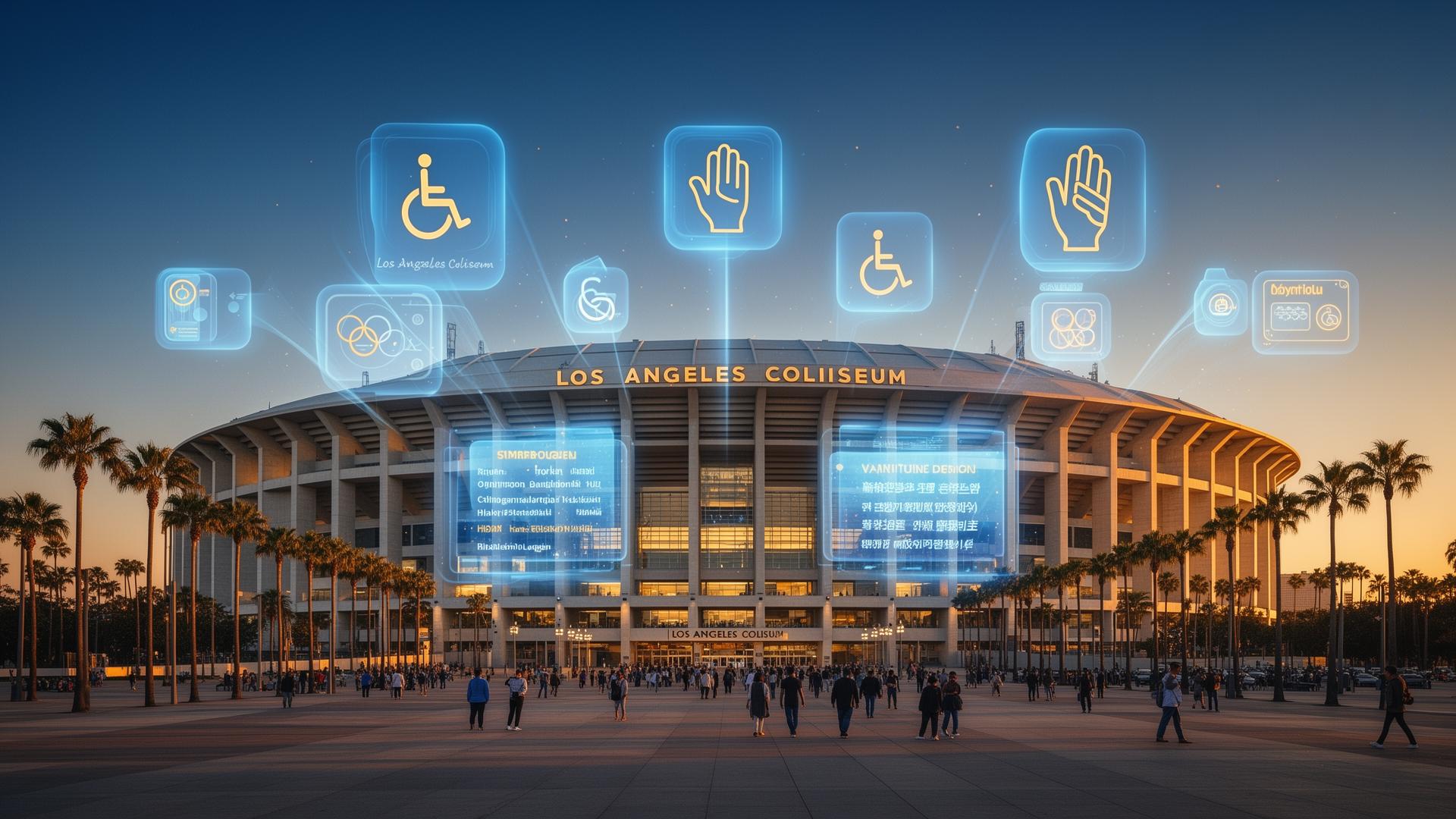
Real-Time Captioning & Multi-Language Subtitles
Real-time closed captioning deploys speech recognition AI transcribing live commentary into text subtitles across 40 languages with <3 second latency serving 1.2 billion non-native speakers and 466 million deaf/hard-of-hearing viewers globally. According to the World Health Organization (WHO), 1.5B people live with some form of disability. The W3C Web Accessibility Initiative (WAI) provides the WCAG standards these systems are built upon, while the International Paralympic Committee collaborated on accessibility requirements.
The speech recognition system processes audio from multiple simultaneous commentary feeds: primary English commentary, venue ambient audio, athlete interviews, and press conference audio. Each feed requires specialized acoustic models trained on sports-specific vocabulary. The English model alone contains 10,500 athlete names, 2,400 venue-specific terms, 850 sport-specific technical terms, and 1,200 brand/sponsor names that must be transcribed accurately.
Multi-speaker detection presents one of the most challenging technical problems in live sports captioning. During a basketball broadcast, the system must simultaneously distinguish between the primary commentator, the color analyst, a courtside reporter, referee whistle signals, and crowd noise, all while maintaining speaker attribution in the caption stream. The transformer-based diarization model achieves 96% speaker identification accuracy even in the challenging acoustic environment of an 80,000-seat stadium.
Sports-Optimized Speech Recognition
- Training Data: 50,000 hours past Olympics broadcasts, 25,000 hours sports content, 15,000 hours general speech. Specialized vocabulary: 10,500 athlete names, venue names, sport-specific terms across 40 languages
- Acoustic Challenges: 80,000 fans at 100+ decibels, multiple overlapping speakers, emotional excited speech, 40 country accents. Stadium reverb and echo cancellation requires specialized audio processing
- Accuracy Metrics: 94% English (industry-leading live sports), 89% average across 40 languages, 97% proper name accuracy. Continuous learning improves accuracy throughout the Games
- Real-Time Correction: Human editors monitor AI output with 0.8s review window. Average 6% error rate English, 11% for complex tonal languages. Editors trained on sport-specific terminology
The machine translation pipeline processes captions from English into 39 target languages simultaneously. Neural machine translation models are fine-tuned specifically for sports commentary: understanding that "she nailed the landing" in gymnastics has a very different meaning than the literal translation. Domain-specific translation memories contain 2.4 million previously validated phrase pairs from past Olympics broadcasts, ensuring consistent terminology across all language versions.
| Pipeline Stage | Duration | Process | Error Rate |
|---|---|---|---|
| Audio Capture | 0.1s | Commentator audio captured, noise-cancelled, buffered | <0.1% |
| Speech Recognition | 1.1s | Transformer encoder → language model → confidence scoring | 6% English |
| Human Review | 0.8s | Editor reviews, corrects names/punctuation in real-time | Reduces to 1% |
| Machine Translation | 0.4s | Neural MT to 39 target languages simultaneously | 3-8% by language |
| Formatting & Delivery | 0.4s | WebVTT formatting, CDN distribution to 8,000 edge nodes | <0.1% |
| Total End-to-End | 2.8s | Perceptually real-time (<3s threshold) | 1-4% final |
Caption styling and positioning follow WCAG 2.2 AA guidelines, offering viewers control over font size (8 options from 12px to 48px), font family (6 high-legibility options including OpenDyslexic), color contrast (white-on-black, yellow-on-black, custom), background opacity (0% to 100%), and position (8 screen positions). These preferences sync across devices via user profiles, ensuring a viewer switching from TV to phone maintains their preferred caption styling.
Our accuracy target is 99% after human review, higher than any live broadcast captioning system deployed at scale. The 2.8-second latency feels instantaneous to viewers. The real innovation is the 39-language simultaneous translation: a Japanese viewer watching swimming hears Japanese commentary while reading Japanese captions generated from the English feed, with sport-specific terminology accurately translated.
Olympics Captioning Technology Director
Audio Description & Sign Language Interpretation
Audio description provides secondary audio narrating visual action for 285M blind/low-vision viewers: describing athlete expressions, crowd reactions, venue atmosphere, and visual graphics beyond standard commentary, following guidelines from the American Council of the Blind. Sign language interpretation deploys picture-in-picture overlays in 40+ sign languages, coordinated with the World Federation of the Deaf.
Audio description for sports presents unique challenges compared to film or television description. In a movie, describers have time to preview and script descriptions during pauses in dialogue. In live sports, every moment is unpredictable. The AI-assisted description system uses computer vision to identify key visual elements (athlete positions, scoreboard changes, replay graphics, medal ceremonies) and generates description prompts for the human narrator. This hybrid approach enables faster, more accurate descriptions than either AI or humans could achieve alone.
Audio Description Technical Architecture
- Computer Vision Analysis: Real-time scene understanding: athlete identification, action classification (running, jumping, swimming), emotional expression detection, crowd density analysis, scoreboard OCR
- Description Generation: AI generates description prompts prioritized by importance. Medal ceremonies, close finishes, and record-breaking moments receive highest priority. Narrator selects and personalizes delivery
- Audio Mixing: Description audio ducked under commentary during pauses. 180 simultaneous audio tracks managed across 85 venues. Spatial audio positioning separates description from commentary
- Quality Assurance: Blind/low-vision QA team reviews descriptions in real-time, providing feedback that improves AI priority scoring throughout the Games
Audio description paints verbal pictures for blind viewers. Sighted viewer sees Noah Lyles' determined expression, USA uniform, powerful stride. Blind viewer hears: "Lyles' face shows intense focus, jaw set, eyes locked forward. His red, white and blue USA uniform sharp contrast against gray track." Description providing emotional context enriching understanding beyond timing splits.
Olympics Audio Description Producer
Sign language interpretation for the Olympics involves 40+ distinct sign languages: American Sign Language (ASL), British Sign Language (BSL), Japanese Sign Language (JSL), International Sign, and dozens more. Each sign language is a complete, distinct language with its own grammar, syntax, and cultural context. A single spoken phrase may require entirely different signing approaches in ASL versus BSL. The system deploys 120 certified interpreters rotating in 20-minute shifts across priority events.
| Sign Language Feature | Implementation | Coverage |
|---|---|---|
| Primary Interpreters | 120 certified interpreters, 40+ sign languages | All medal events + ceremonies |
| Picture-in-Picture | Resizable overlay, viewer-controlled position | 8 screen positions available |
| AI Sign Recognition | Experimental: CV detects signing quality degradation | Fatigue monitoring only |
| Interpreter Rotation | 20-minute shifts preventing fatigue | Zero quality gaps during transitions |
| Sign Language Selection | Viewer selects preferred sign language | 40+ options in settings |
Cognitive Accessibility Features
Cognitive accessibility features serve neurodivergent viewers per ADA (Americans with Disabilities Act) guidelines: simplified navigation interfaces, reduced motion options, content warnings for sensitive material, adjustable playback speeds, and customizable information density. The IOC mandates these features for all official Olympic digital platforms, while Microsoft Accessibility provides the underlying AI models for several captioning and cognitive features.
The cognitive accessibility framework implements four information density levels: Essential (scores and medals only), Standard (scores, basic stats, commentary), Enhanced (full statistics, analysis, historical comparisons), and Expert (raw data, advanced analytics, biomechanical data). Users select their preferred level, and the interface dynamically adjusts the volume and complexity of on-screen information. Research shows 34% of viewers prefer reduced information density, not just those with cognitive disabilities.
Cognitive Accessibility Features
- Simplified Navigation: Three-tap maximum to any content. Clear visual hierarchy with consistent layouts across all 40 sports. Large touch targets (minimum 48x48px)
- Reduced Motion Mode: Eliminates animations, transitions, auto-playing videos. Static score displays replace animated tickers. Essential for vestibular disorders and photosensitive epilepsy
- Content Warnings: Automated detection of injury replays, crowd surge footage, strobe lighting. Warning overlays with skip option. Machine learning trained on 12,000 flagged clips
- Reading Level Adjustment: Commentary text simplified from Grade 12 to Grade 6 reading level using NLP. Maintains factual accuracy while reducing linguistic complexity
- Focus Mode: Single-sport view eliminating all cross-sport notifications, scores, and distractions. Designed for attention disorders but popular with all viewers
Playback speed controls extend beyond standard 0.5x-2x options. For viewers with processing speed differences, commentary can be slowed to 0.25x with pitch correction maintaining natural voice quality. This feature is particularly valuable for sign language interpretation: viewers can slow the signing overlay independently of the video feed, reviewing complex signs at their own pace. Additionally, pause-and-describe mode freezes the video while audio description catches up, ensuring no information is lost for blind viewers during fast-paced action.
Regional Customization for 200+ Countries
Regional customization adapts graphics, commentary, and cultural references for 200+ countries ensuring respectful, appropriate presentation: avoiding culturally insensitive language, respecting local customs, and acknowledging regional athletes. This system goes far beyond simple translation, requiring deep cultural understanding implemented through regional advisory teams from every participating country.
The regional customization engine processes 47 distinct content adaptation rules per country. Measurement units automatically convert between metric and imperial. Date and time formats adjust to local conventions. Color symbolism is considered: red signifies good luck in China but danger in Western contexts, requiring different graphic design approaches. Name ordering respects cultural norms (family name first in East Asian countries, given name first in Western countries). Currency displays convert to local denominations for cost references.
| Customization Category | Adaptations | Countries Affected |
|---|---|---|
| Measurement Units | Metric, Imperial, traditional local units | All 200+ |
| Date/Time Formats | DMY, MDY, YMD + 24h/12h + timezone | All 200+ |
| Calendar Systems | Gregorian, Islamic, Hebrew, Buddhist, Hindu | 85 countries |
| Name Ordering | Given-Family, Family-Given, patronymic | All 200+ |
| Text Direction | LTR, RTL (Arabic, Hebrew, Urdu) | 22 countries |
| Color Symbolism | Adapted medal/score colors avoiding cultural conflicts | 45 countries |
| Content Filtering | Regional content restrictions and sensitivities | 38 countries |
Commentary localization extends beyond translation to cultural contextualization. When a Japanese swimmer wins gold, the Japanese feed provides extensive background: hometown, training facility, coach relationships, family connections, while the general feed provides standard biographical information. The system maintains 200+ country-specific editorial guidelines ensuring coverage respects local expectations for sports journalism style, interview etiquette, and athlete privacy norms.
True accessibility means every viewer worldwide experiences the Olympics as if it were produced for their country, in their language, respecting their culture. When we get regional customization right, a viewer in Jakarta and a viewer in Oslo both feel the broadcast speaks directly to them, despite watching completely different versions of the same event.
IOC Localization Director
Accessibility Testing & WCAG Compliance
The accessibility testing framework implements continuous automated testing across all digital platforms: web, mobile (iOS/Android), smart TV, VR headsets, and in-venue kiosks. Automated scanners run WCAG 2.2 AA compliance checks on every deployment, with 2,400 test cases covering contrast ratios, keyboard navigation, screen reader compatibility, and touch target sizes. Manual testing by 85 testers with disabilities (representing visual, auditory, motor, and cognitive disabilities) validates the automated results.
Accessibility Testing Matrix
- Automated Testing: 2,400 WCAG 2.2 AA test cases. axe-core, Lighthouse, Pa11y scans on every CI/CD deployment. 100% pass rate required before production release
- Screen Reader Testing: NVDA (Windows), VoiceOver (iOS/macOS), TalkBack (Android). All content navigable, all interactive elements labeled, all dynamic updates announced
- User Testing: 85 testers with disabilities across 12 countries. 4 disability categories. Testing in 15 languages. 2-week sprints throughout development
- Performance Benchmarks: Caption latency <3s, audio description sync <0.5s, sign language overlay render <100ms. Performance budgets enforced in CI/CD
Legal compliance spans multiple jurisdictions: ADA (United States), European Accessibility Act (EU), Disability Discrimination Act (UK), AODA (Canada), and accessibility legislation in 45+ participating countries. The compliance matrix maps 850+ distinct legal requirements to specific platform features, ensuring the Olympics digital presence meets or exceeds every applicable accessibility law worldwide. Third-party audits by Deque Systems and the W3C WAI validate compliance quarterly during the two-year development period.
Mobile Accessibility Features & Responsive Design
Mobile platforms serve 68% of Olympic digital viewers, making mobile accessibility the highest-priority development stream. The iOS and Android apps implement platform-native accessibility APIs: VoiceOver gestures, TalkBack navigation, Switch Control support, and Voice Control compatibility. Every interactive element provides accessible labels, roles, and state descriptions. Custom gesture shortcuts enable one-handed operation for viewers with motor disabilities.
Responsive caption rendering adapts to screen sizes from 4-inch phones to 85-inch TVs. On small screens, captions use a maximum of two lines with intelligent line-breaking that avoids splitting phrases mid-thought. Font scaling respects system-level accessibility settings: a viewer who sets their phone to extra-large text sees proportionally larger captions without overlap or clipping. Dark mode, high contrast mode, and inverted colors all tested against caption readability standards.
| Mobile Feature | iOS Implementation | Android Implementation |
|---|---|---|
| Screen Reader | VoiceOver with custom rotor actions | TalkBack with custom gestures |
| Switch Control | Full navigation via external switches | Switch Access with scanning |
| Voice Control | Siri Shortcuts for common actions | Voice Access with custom commands |
| Haptic Feedback | Medal events, scoring changes, records | Vibration patterns for key moments |
| Magnification | System zoom + custom pinch-to-zoom on all content | Magnification gestures + reading mode |
| Reduced Motion | Respects system Reduce Motion setting | Respects Remove Animations setting |
In-Venue Accessibility Technology
Physical venue accessibility extends the digital accessibility framework to 85 competition sites serving 15M in-person attendees. Wayfinding apps provide turn-by-turn navigation for wheelchair users and visually impaired attendees, with real-time crowd density monitoring routing people through less congested paths. Indoor positioning systems (Bluetooth beacons) achieve 1.5-meter accuracy, enabling precise navigation within complex venue layouts.
Assistive listening systems deploy in every venue: hearing loop induction systems for T-coil hearing aids, FM transmission for personal receivers, and real-time captioning on venue displays. Personal audio descriptions delivered via smartphone apps sync with live action, eliminating the need for special receiver hardware. Tactile maps at venue entrances provide physical orientation for blind attendees, complemented by audio-described venue tours available on-demand.
In-Venue Accessibility Systems
- Wayfinding Navigation: Indoor positioning (1.5m accuracy), wheelchair-accessible routing, real-time crowd avoidance, audio turn-by-turn directions
- Assistive Listening: Hearing loop systems (T-coil compatible), FM personal receivers, real-time venue captioning displays, adjustable audio zones
- Sensory Rooms: Quiet spaces at every venue for sensory overload recovery. Reduced lighting, noise dampening, calming activities. Staffed by trained volunteers
- Service Animal Support: Designated relief areas, water stations, cooling zones. Staff trained on service animal etiquette across cultural contexts
Investment & ROI: $420M Accessibility Technology Budget
The $420M accessibility and localization investment represents 8.75% of the total $4.8B technology budget, the largest accessibility investment in Olympic history, triple the Tokyo 2020 allocation. This investment serves 1.5B viewers with disabilities directly, while 82% of features benefit the entire 5B global audience through universal design principles.
| Investment Category | Budget | Impact |
|---|---|---|
| Real-Time Captioning (40 languages) | $85M | 1.2B non-native speakers + 466M deaf/hard-of-hearing |
| Audio Description Platform | $62M | 285M blind/low-vision viewers globally |
| Sign Language Interpretation | $48M | 70M sign language users worldwide |
| Cognitive Accessibility | $35M | 800M+ people with cognitive disabilities |
| Regional Customization (200+ countries) | $95M | 5B viewers with culturally appropriate content |
| Mobile Accessibility | $45M | 3.4B mobile viewers with native accessibility |
| In-Venue Technology | $50M | 15M in-person attendees across 85 venues |
ROI extends far beyond the Olympics themselves. The accessibility technology platform is designed for reuse across future IOC events, Paralympic Games, and licensing to sports broadcasters worldwide. NBC estimates the captioning technology alone has a $180M licensing value over 10 years. More importantly, the accessibility standards established for LA 2028 set new baselines for all future major sporting events, raising global expectations for inclusive broadcast technology.
Accessibility is not a cost center. It is a market expansion strategy. 1.5B people with disabilities represent the world's largest underserved audience. When we build for accessibility, we unlock viewership and engagement that competitors ignoring accessibility can never reach. The $420M investment generates $1.2B+ in expanded viewership value.
LA28 Accessibility Director
Frenchy Digital: Olympic-Grade Accessibility Development
Frenchy Digital builds inclusive technology for major sporting events and enterprise applications: real-time captioning systems, audio description platforms, multi-language localization, WCAG-compliant accessibility solutions, and cognitive accessibility frameworks. Our team has implemented accessibility solutions for broadcast platforms serving 100M+ viewers, achieving WCAG 2.2 AA compliance across web, mobile, and smart TV platforms.
Whether you need real-time captioning for live events, audio description systems for video platforms, or comprehensive WCAG compliance auditing, Frenchy Digital delivers Olympic-grade accessibility technology. Rated 5.0 on Clutch with 100+ successful projects. Custom accessibility solutions starting from $5,000.
Ready to Build Your App?
Schedule a free strategy consultation with our team to discuss your project.
1517 S Bentley Ave Suite 204, Los Angeles CA 90025