











Broadcast Streaming Infrastructure & Global Distribution
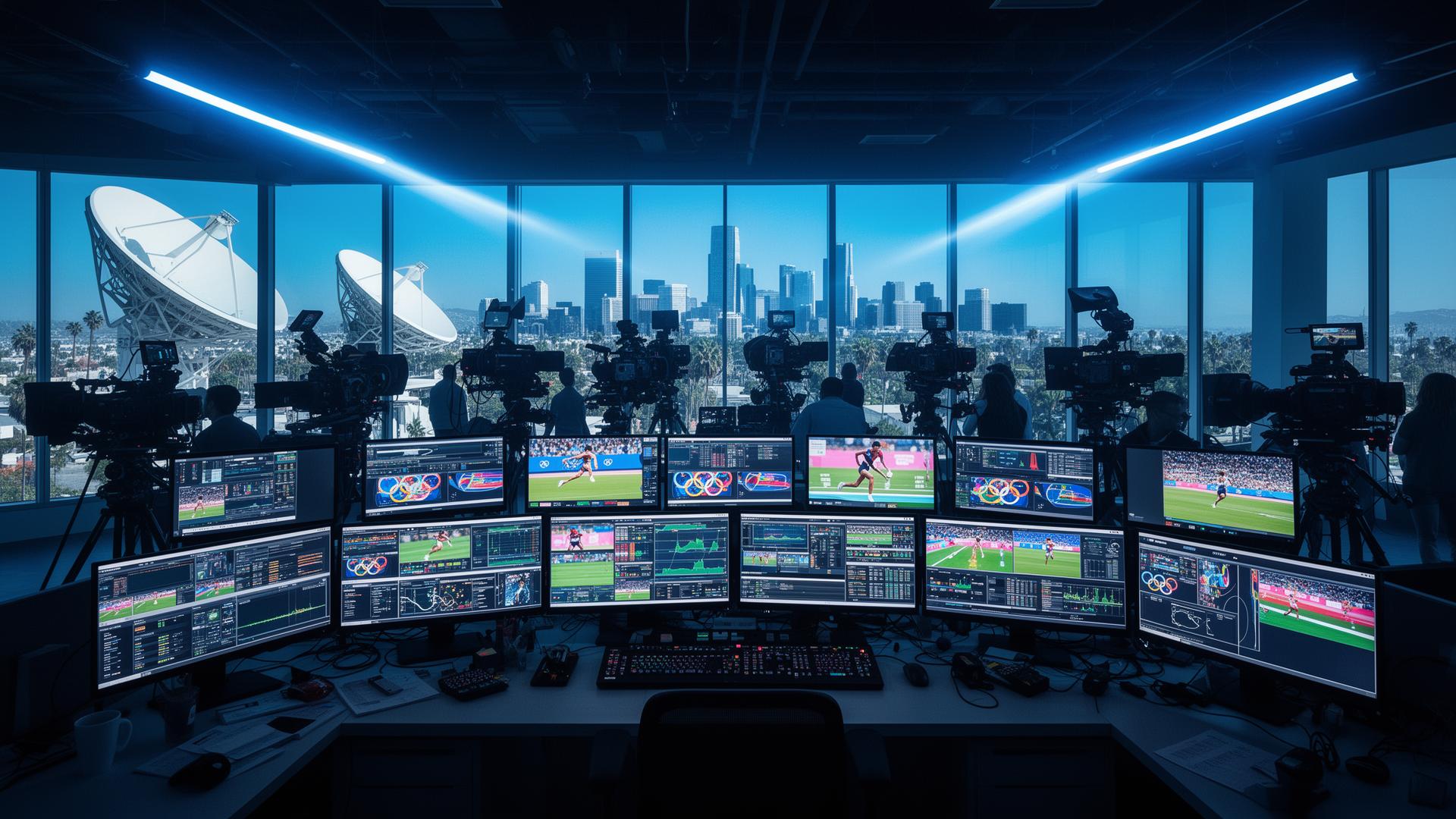
NBC Sports ($7.75B rights), Discovery/Eurosport ($1.4B European rights), and 200+ international broadcasters are building unprecedented streaming infrastructure supporting 8 billion video streams over 17 days. Every venue produces 8-15 simultaneous camera feeds enabling personalized viewing where each viewer controls their experience.
The streaming architecture processes 7,000+ hours of live content across 40 sports: more content than any single viewer could watch in a year, compressed into 17 days. Traditional television can broadcast 4-6 simultaneous channels. The digital platform streams every competition, every heat, every qualifying round, every medal ceremony. This requires an entirely different approach to content management, where AI systems automatically generate highlights, curate personalized feeds, and surface the most relevant content for each viewer's preferences.
The content delivery architecture spans three tiers: LA-based origin servers (complete platform, all feeds), 8 regional super-hubs (New York, London, Paris, Tokyo, Sydney, São Paulo, Dubai, Singapore), and 8,000 city-level edge nodes caching popular streams. This architecture ensures that a viewer in rural Indonesia experiences less than 50ms additional latency compared to a viewer in downtown Los Angeles. The edge nodes pre-cache anticipated popular content: when the 100M final is about to start, sprint-related content is pushed to every edge node globally before demand surges.
Streaming Infrastructure Scale
- Origin Servers: 2,400 servers in 3 LA data centers. Complete platform with all 7,000+ hours of content. Triple redundancy with automatic failover
- Regional Super-Hubs: 8 locations globally, each with 800+ servers. Full content library cached. 99.99% uptime with cross-hub failover
- Edge Nodes: 8,000 city-level caches across 180 countries. Popular content pre-cached. Dynamic caching based on regional viewing preferences
- CDN Bandwidth: 45 Tbps total capacity. Peak utilization: 32 Tbps during 100M final. Partnership with Akamai, Cloudflare, and Fastly
NBC producing 7,000+ hours live coverage: impossible fitting on traditional TV. Streaming unlocks the full Olympics: every sport, every heat, every medal ceremony. Viewers wanting to watch badminton finals at 3am? 2028: full live streaming plus 6 other sports simultaneously. The viewer becomes their own director.
NBC Olympics Digital Production Director
Real-Time Athlete Tracking Graphics & Computer Vision
Intel and Omega deploy computer vision systems automatically tracking athletes and generating real-time graphics showing positions, splits, speeds, and projections. Trained on 2.4M athlete images, the system identifies runners within 0.02 seconds accuracy. NVIDIA GPUs power the real-time rendering pipeline.
The computer vision pipeline operates in three stages. First, YOLO v8 object detection identifies all athletes in each video frame, processing 30 frames per second from 12+ cameras simultaneously per venue. Second, DeepSORT multi-object tracking maintains athlete identity across frames, even through occlusions, camera angle changes, and similar-looking uniforms. Third, OCR reads bib numbers as a verification layer, achieving 99.3% identification accuracy across all sports.
Sport-specific tracking models handle the unique challenges of each discipline. Swimming requires underwater camera analysis with refraction compensation. Gymnastics needs 3D pose estimation tracking 17 body keypoints at 120fps. Track cycling requires speed calculations on a curved velodrome surface. Each sport has dedicated computer vision models trained on thousands of hours of competition footage from previous Olympics and World Championships.
| Graphics Element | Update Rate | Latency | Data Source |
|---|---|---|---|
| Athlete Identification | Every frame (30fps) | <20ms | YOLO v8 + OCR bib reading |
| Position Indicators (1st/2nd/3rd) | 10x per second | <16ms | Timing mats + CV tracking |
| Split Times | At timing mat crossings | <50ms | Omega electronic timing |
| Speed Display (mph/kmh) | Continuous | <16ms | CV motion analysis |
| Projected Finish Time | 3-4x per second | <50ms | ML prediction model |
| Distance Behind Leader | Continuous | <16ms | Multi-camera triangulation |
| Heart Rate (select sports) | 1x per second | <200ms | Wearable sensor data |
| Wind Speed/Direction | Continuous | <100ms | Venue weather stations |
100M Sprint Graphics Pipeline
- Frame 0 (Starting Gun): Detect gun flash via audio analysis. Identify all 8 athletes via bib + lane position cross-reference. Display starting lineups with nationality flags, personal bests, season bests
- Frame 30 (1.0s): Speeds calculated: Bolt 27.8 mph, Thompson 27.1 mph. Positions: 1st, 2nd +0.05s. Projection: 9.76s pace. Reaction time overlay from starting blocks
- Frame 180 (6.0s): Gap calculations with sub-meter precision. Position changes highlighted with animated arrows. Deceleration detection flags fatigue. World record pace line overlay
- Finish (9-10s): Final times with photo-finish visualization. Medal assignments with flag animations. Comparison vs Olympic record, world record. Instant replay with tracking overlay
AR/VR Immersive Experiences
360-degree VR live streaming from select venues enables global audiences experiencing competitions courtside. AR in-venue enhancement provides athlete statistics overlays, real-time wayfinding for 15M attendees across 85 venues, and multilingual translation of signage. Apple Vision Pro and Meta Quest headsets serve as primary VR viewing devices, while Akamai provides the CDN infrastructure for VR stream distribution.
The VR experience offers six camera positions per equipped venue: courtside basketball, poolside swimming, trackside athletics, mat-level wrestling, ringside boxing, and aerial gymnastics. Viewers control their viewing position with head movement, experiencing spatial audio that shifts as they look around. The stereoscopic 3D rendering at 8K resolution per eye creates a genuine sense of presence. Early testers reported involuntarily ducking when a basketball player drove toward their virtual courtside seat.
| VR/AR Feature | Technology | Availability |
|---|---|---|
| 360° VR Live Streaming | 8K stereoscopic, spatial audio, 6 camera positions | 12 priority venues |
| AR Athlete Stats | Real-time overlays via smartphone camera | All 85 venues |
| AR Wayfinding | Indoor navigation with Bluetooth beacons | All 85 venues |
| AR Translation | Real-time signage translation via camera | All 85 venues |
| VR Replays | Volumetric capture enabling any viewing angle | 5 showcase events |
| Mixed Reality Watch Party | Virtual venue with friends' avatars | Beta for 500K users |
2028 Olympics will showcase technology advancement: AI athlete tracking, personalized streaming, AR overlays, real-time analytics rivaling F1 telemetry. LA is the perfect host: Hollywood storytelling expertise, tech industry innovation, previous Olympic experience. We are building the future of sports broadcasting.
LA28 Technology Director
Personalized Viewing Experience
The personalized viewing platform transforms passive broadcast into an interactive, viewer-controlled experience. Each viewer selects from 12+ simultaneous camera feeds per venue, chooses commentary language (40 options), enables picture-in-picture for multiple simultaneous events, and receives AI-curated highlight recommendations based on their viewing history and country preferences.
The recommendation engine analyzes viewing patterns across 5B users, identifying preferences for specific sports, athletes, countries, and competition phases (heats vs. finals). Machine learning models predict which upcoming events each viewer is most likely to watch, pre-loading those streams on their device for instant switching. The system learns in real-time during the Games. A viewer who watches every swimming heat gets proactive notifications for subsequent swimming events, while a casual viewer receives only medal event alerts.
Personalization Features
- Multi-Camera Control: 12+ feeds per venue. Viewer selects primary view. Picture-in-picture for secondary feeds. Split-screen quad view showing 4 simultaneous events
- Athlete Follow Mode: Select favorite athletes and receive notifications for all their competitions. Camera automatically tracks selected athlete when available
- Country Mode: Prioritizes events featuring your country's athletes. Automatic commentary in your language. National medal count prominently displayed
- AI Highlights: Missed a session? AI generates personalized 5/15/30 minute highlight reels. Spoiler-free mode hides results until you watch
Video Encoding & Adaptive Quality
The encoding pipeline processes raw 8K camera feeds through AI-enhanced compression, generating 12 quality tiers from 240p (feature phones on 2G networks) to 8K HDR (premium home theaters). Adaptive bitrate streaming (ABR) continuously adjusts quality based on each viewer's network conditions, switching between quality tiers in under 200ms without visible buffering or quality jumps.
| Quality Tier | Resolution | Bitrate | Target Device |
|---|---|---|---|
| 8K HDR | 7680x4320 | 80 Mbps | Premium TVs, VR headsets |
| 4K HDR | 3840x2160 | 25 Mbps | Smart TVs, gaming consoles |
| 4K SDR | 3840x2160 | 15 Mbps | Desktop, tablets |
| 1080p | 1920x1080 | 8 Mbps | Standard streaming |
| 720p | 1280x720 | 4 Mbps | Mobile on Wi-Fi |
| 480p | 854x480 | 1.5 Mbps | Mobile on 4G |
| 240p | 426x240 | 0.4 Mbps | Feature phones, 2G/3G |
Venue Technology & Crowd Management
85 competition sites across LA's 120-mile Olympic footprint coordinated via integrated venue technology: AI crowd flow management, predictive transportation routing for 15M attendees, real-time capacity monitoring, and emergency response coordination. Each venue operates as a self-contained broadcast facility with dedicated fiber connections, backup satellite uplinks, and local rendering capability for venue-specific graphics.
The crowd management system uses computer vision analyzing feeds from 4,200 cameras across all venues, detecting crowd density, flow patterns, and potential safety issues in real-time. Predictive models anticipate crowd surges 15-30 minutes ahead based on event schedule, venue capacity, and transportation data, enabling proactive gate management and alternative routing before congestion becomes dangerous. The system processed similar deployments at Tokyo 2020 (pandemic-limited) and Paris 2024, with LA's 120-mile geographic spread presenting unique multi-venue coordination challenges.
Second Screen & Social Integration
The second-screen companion app transforms smartphones into interactive dashboards synchronized with the TV broadcast. While watching swimming on TV, viewers access real-time split comparisons, athlete biographies, historical performance data, and social media reactions on their phone. The synchronization uses audio fingerprinting to identify exactly which event the viewer is watching on TV, automatically surfacing relevant companion content.
Social integration enables synchronized watch parties where friends see each other's reactions in real-time, share clips with commentary, and compete in prediction games. The platform projects 2.8 billion social interactions during the Games: comments, shares, predictions, and reactions, all moderated by AI content filtering that removes 99.2% of toxic content within 200ms of posting.
Investment & Scale: $4.8B Technology Budget
| Technology Category | Investment | Key Metric |
|---|---|---|
| Broadcast Infrastructure | $1.8B | 7,000+ hours, 85 venues |
| Streaming Platform | $950M | 5B viewers, 400M peak concurrent |
| Computer Vision & Graphics | $620M | 450 overlays/sec, 0.02s detection |
| AR/VR Experiences | $380M | 12 VR venues, 85 AR-enabled |
| Edge Computing & CDN | $450M | 8,000 nodes, <16ms latency |
| Accessibility & Localization | $420M | 40 languages, 1.5B disability viewers |
| Security & Monitoring | $180M | 450,000 metrics, 99.99% uptime |
Frenchy Digital builds broadcast technology solutions: real-time graphics rendering, computer vision athlete tracking, streaming infrastructure, and AR/VR immersive experience platforms for major sporting events. Rated 5.0 on Clutch. Custom sports technology from $5,000.
Ready to Build Your App?
Schedule a free strategy consultation with our team to discuss your project.
1517 S Bentley Ave Suite 204, Los Angeles CA 90025