











Athlete Performance Tracking & Coaching Analytics
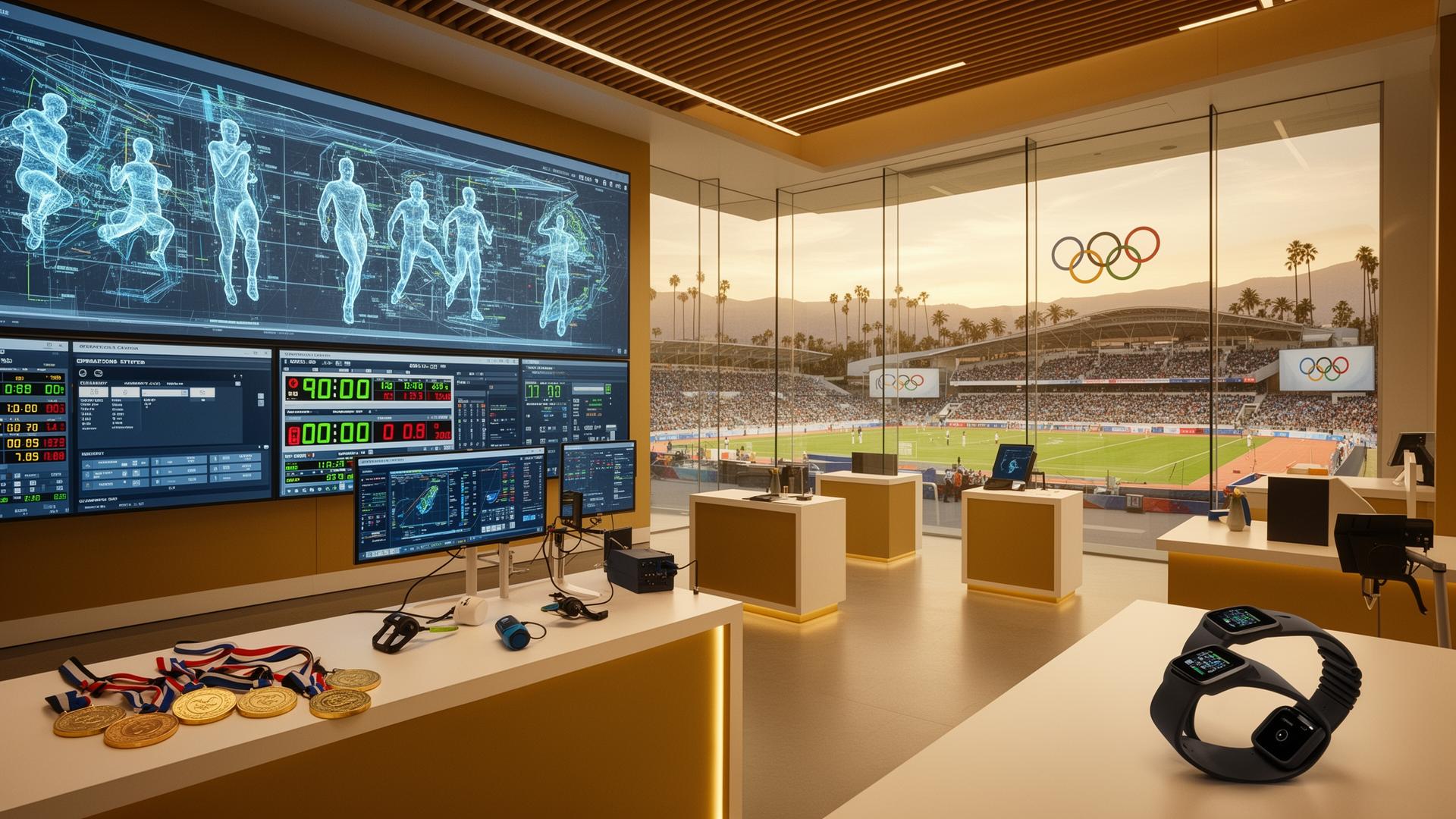
Performance tracking provides 10,500 competitors and 2,800 coaches real-time biomechanical data (stride length, ground contact time, joint angles, power output, fatigue indicators), collected via wearable sensors, timing mats, and computer vision. Omega Timing (official timekeeper since 1932) provides the foundational timing infrastructure, while Intel computer vision systems enable real-time athlete identification.
The wearable sensor platform deploys three form factors: chest-mounted inertial measurement units (IMUs) for torso dynamics and breathing patterns, shoe-mounted force plates for ground reaction forces and stride analysis, and wrist-mounted optical sensors for heart rate and blood oxygen saturation. Each sensor samples at 1,000 Hz, transmitting compressed data packets via Bluetooth 5.3 to venue-mounted receivers with <5ms latency. The total sensor deployment across all sports generates 4,000 data events per second during peak competition periods.
Sport-Specific Tracking Systems
- Track & Field Timing Mats: Embedded sensors at 10M intervals: reaction time (0.142s = excellent), split intervals, stride analysis (4.8 strides/sec, 2.4M stride length = elite), deceleration detection in final 30M
- Swimming Stroke Analysis: Underwater cameras + CV: stroke rate (48-52/50M elite freestyle), stroke efficiency (distance per stroke), turn analysis (5-7s optimal 15M underwater), breathing pattern impact on velocity
- Gymnastics Pose Estimation: 17-keypoint body tracking at 120fps: joint angles measured to 0.5° precision, deduction prediction based on form deviations, real-time difficulty score calculation
- Coach Dashboards: iPad-based real-time interface: split comparisons vs personal best, fatigue indicators (stride length decrease = deceleration phase), tactical positioning data, historical trend analysis
- Recovery Monitoring: Post-competition: heart rate recovery curves, sleep quality via wearable (voluntary), training load management, injury risk scoring based on biomechanical asymmetries
Coaches historically watched races with a stopwatch, guessing splits. Performance tracking provides objective data: stride length decreased 8cm final 30 meters = fatigue setting in earlier than training. Concrete insights informing training focus: technology replacing guesswork with data-driven coaching. We can now quantify what we previously felt intuitively.
Olympic Track Coach, 40+ years experience
The coaching analytics platform processes raw sensor data into actionable insights through sport-specific machine learning models. A sprinter's acceleration curve is compared against their historical best performances and against competitors' profiles (anonymized), identifying specific phases where performance can be improved. A swimmer's stroke analysis detects subtle efficiency losses: a 2% decrease in distance-per-stroke in the final 25 meters indicates a specific endurance issue that can be targeted in training. These insights are delivered within 30 seconds of competition ending, while the athlete's memory of the performance is still fresh.
| Sport | Key Metrics Tracked | Sensor Types | Data Rate |
|---|---|---|---|
| Track & Field | Reaction time, splits, stride length, speed, deceleration | Timing mats, IMUs, CV cameras | 8,000 events/sec |
| Swimming | Stroke rate, turn time, underwater distance, splits | Touchpads, underwater cameras, wearables | 4,200 events/sec |
| Gymnastics | Joint angles, rotation speed, landing force, execution score | CV cameras (120fps), force plates | 6,800 events/sec |
| Cycling | Power output, cadence, speed, aerodynamic position | Power meters, GPS, wind tunnel data | 2,400 events/sec |
| Rowing | Stroke rate, force curve, boat speed, synchronization | Oar sensors, GPS, accelerometers | 3,600 events/sec |
Results Processing: 850 Events, Zero Error Tolerance
Omega (official timekeeper since 1932) deploys timing systems across 40 sports, each with unique requirements. Track uses electronic timing, gymnastics uses judge panels, basketball uses scoreboards. All integrate into a unified results system broadcasting globally via the IOC's official Olympic platform.
The unified results engine normalizes data from 40 fundamentally different scoring systems into a consistent format. Electronic timing produces millisecond-precision finish times. Gymnastics judging produces averaged difficulty and execution scores. Boxing uses computerized punch scoring. Diving calculates weighted scores across multiple judges with difficulty multipliers. Each sport has a dedicated results processor that validates, normalizes, and publishes results through a common API, ensuring consistent data format regardless of the underlying scoring methodology.
| Sport | Timing System | Data Format | Processing Time | Redundancy |
|---|---|---|---|---|
| Track & Field | Omega electronic timing + photo-finish | Split times to 0.001s | <0.8s | Triple (3 independent systems) |
| Swimming | Touchpads + underwater cameras | Finish times to 0.01s | <0.5s | Triple + backup photo finish |
| Gymnastics | Judge panels (D+E scores) | Averaged difficulty + execution | 8-12s | Double (primary + backup panel) |
| Basketball | Scoreboard + clock | Real-time score + stats | Real-time | Double + manual backup |
| Boxing | Electronic scoring + judges | Computerized punch scoring | Per round | Double + video review |
| Diving | Judge panels + difficulty table | Weighted scores × difficulty | 4-8s | Double + automated calculation check |
| Fencing | Electronic scoring equipment | Touch detection to 0.04s | <0.3s | Triple + video replay |
Photo-finish technology captures 10,000 frames per second using a slit-scan camera aligned precisely with the finish line. The resulting composite image shows every athlete's torso crossing the finish line with temporal resolution of 0.0001 seconds. When finishes are separated by less than 0.01 seconds, the photo-finish image becomes the official determining factor. The system has resolved finishes as close as 0.001 seconds, approximately 1 centimeter difference at sprinting speed.
The margin between gold and silver can be one thousandth of a second, 10 centimeters at full sprint. Our triple-redundant timing must be absolutely precise. Three independent systems measuring the same event must agree within 0.001 seconds. If they don't agree, the race result is held pending manual review. Zero tolerance for error. Zero.
Omega Chief Timekeeper
Graphics Rendering: 450 Overlays/Second at <16ms
280 NVIDIA A100 GPUs process 4K video at 120fps. Computer vision (YOLO v8 detection, DeepSORT tracking, OCR bib reading) identifies athletes, while Unreal Engine 5 renders name overlays, split times, speed indicators, and projected finishes, all composited into broadcast feeds within 16ms. Blackmagic Design capture cards handle 4K signal acquisition from venue cameras.
The rendering pipeline implements a priority queue system ensuring the most important graphics are rendered first. Medal-deciding finishes receive maximum GPU allocation. Qualifying heat graphics are rendered with lower priority. When GPU utilization exceeds 85%, the system gracefully degrades: reducing overlay complexity for lower-priority events rather than introducing latency for high-priority ones. This priority-based approach ensures that the most-watched moments always receive the highest-quality graphics treatment.
GPU Architecture (Per Venue)
- GPU Cluster: 280 A100 GPUs across 35 servers (8/server). InfiniBand 400 Gbps networking. NVLink 600 GB/s GPU-to-GPU communication. Total: 21.8 PFLOPS compute capacity
- Video Processing: 12 BlackMagic 4K capture cards per venue. Hardware H.265 encoders. Frame synchronization across multi-camera feeds. Color correction and white balance normalization
- Storage: 1.2 PB flash storage for replay and analysis. 40 TB RAM caching for instant data access. Redis clusters for microsecond lookup of athlete data and statistics
- Computer Vision Pipeline: YOLO v8 (detection) + DeepSORT (tracking) + pose estimation + OCR. Trained on 8.2M images across 40 sports: 99.3% identification accuracy. Sport-specific models for unique requirements
- Rendering Engine: Unreal Engine 5 with custom sports overlay plugins. Template library: 2,400 overlay designs across 40 sports. Dynamic data binding refreshes at 60fps
| Pipeline Stage | GPU Allocation | Latency | Output |
|---|---|---|---|
| Video Ingestion | 12 capture cards | 1ms | Raw 4K frames at 120fps |
| Object Detection (YOLO v8) | 40 GPUs | 3ms | Bounding boxes for all athletes |
| Multi-Object Tracking (DeepSORT) | 20 GPUs | 2ms | Persistent athlete IDs across frames |
| OCR & Identification | 10 GPUs | 2ms | Bib numbers → athlete profiles |
| Overlay Rendering (UE5) | 120 GPUs | 4ms | 4K graphics with transparency |
| Compositing | 40 GPUs | 2ms | Overlays merged with live feed |
| Encoding & Output | 50 GPUs | 2ms | H.265 encoded for CDN distribution |
Media Workflow: 18,000 Journalists Served
18,000 credentialed journalists access results within seconds of competition ending, auto-transcribed athlete quotes, photos uploaded seconds after capture, and video clips on-demand, eliminating delays between competition and publication. SMPTE standards govern the media workflow interoperability, while Broadcasting & Cable reports this represents the most advanced media distribution system ever deployed for a sporting event.
The AI-powered media workflow includes automatic highlight detection: identifying the most dramatic moments (close finishes, world records, unexpected results) and generating broadcast-ready clips within 30 seconds. Natural language generation produces initial result summaries in 8 languages, providing journalists with factual foundations they can enhance with analysis and commentary. Photo selection AI identifies the most impactful images from thousands of frames captured per event, presenting editors with a curated selection ranked by visual impact, athlete expression, and compositional quality.
Media Platform Features
- Real-Time Results API: Results published within 0.8 seconds of official confirmation. RESTful API + WebSocket push. 18,000 concurrent journalist connections supported
- AI Transcription: Athlete interviews transcribed in real-time with 96% accuracy across 40 languages. Speaker identification, sentiment tagging, quote extraction
- Photo Distribution: Photos from 500+ accredited photographers available within 8 seconds of capture. AI-powered selection, automated cropping, metadata tagging
- Video Clips: AI-generated highlight clips available within 30 seconds. 8 standard durations (15s to 5min). Automatic rights management and embargo enforcement
Accreditation & Security Systems
The accreditation system manages 250,000 credentials across athletes, coaches, officials, media, volunteers, sponsors, and VIPs, each with specific access rights to venues, zones within venues, and time-restricted areas. Biometric verification (facial recognition + badge NFC) processes 1,200 entries per minute at major venues. Access violations trigger real-time security alerts with response times under 30 seconds.
The multi-layer identity verification system prevents credential sharing and unauthorized access. Level 1: NFC badge scan (500ms). Level 2: Facial recognition comparison against credential photo (800ms, 99.7% accuracy). Level 3: Biometric fingerprint for highest-security zones (1.2s). Anti-tailgating sensors at venue entrances detect multiple people using a single credential, automatically alerting security staff.
Volunteer Coordination & Transportation
50,000 volunteers managed across 85 venues via coordination apps (shift scheduling, task assignments, credentials). Transportation systems route 15M attendees using real-time traffic, venue capacity, and event schedules across LA's 120-mile Olympic footprint. The volunteer app includes real-time task assignment, multilingual communication (40 languages), and GPS-based positioning for deployment optimization.
The transportation optimization engine coordinates 2,800 buses, 450 dedicated Olympic lanes, 12 temporary transit stations, and integration with LA Metro rail. Predictive models analyze event schedules to pre-position transportation assets: when a sold-out 80,000-seat track and field session ends, 420 buses are already positioned at the venue. Real-time traffic management adjusts Olympic lane access based on demand, ensuring VIP and athlete transportation maintains priority while minimizing impact on general LA traffic.
| Transportation Mode | Capacity | Coverage | Technology |
|---|---|---|---|
| Olympic Bus Fleet | 2,800 buses | All 85 venues | GPS tracking, real-time dispatch |
| LA Metro Integration | 12 rail lines | 45 venues within 1 mile | Real-time capacity monitoring |
| Dedicated Olympic Lanes | 450 lane-miles | Major venue corridors | Dynamic access control |
| Ride-Share Partnership | 25,000 drivers | Last-mile connectivity | Integrated booking, surge pricing cap |
| Pedestrian Flow | 15M attendees | Venue perimeters | CV crowd analysis, dynamic signage |
Medical Operations Technology
Medical operations technology supports 4,500 medical staff across 85 venues with electronic health records, real-time athlete medical alerts, doping control chain-of-custody tracking, and emergency response coordination. The medical platform integrates with athlete wearable data (with consent) to detect potential medical emergencies: heat stress indicators, abnormal heart rate patterns, and impact events, alerting medical staff before the athlete may even recognize symptoms.
Heat safety monitoring is critical for LA's summer climate. 2,400 environmental sensors across all venues track temperature, humidity, wet bulb globe temperature (WBGT), and UV index. When WBGT exceeds sport-specific thresholds, the system automatically recommends schedule modifications, additional cooling stations, or competition delays. The medical AI analyzed 12 years of heat-related incidents at major sporting events, creating sport-specific risk models that predict heat illness probability based on environmental conditions, competition duration, and athlete acclimatization status.
Sustainability Monitoring & Carbon Tracking
LA 2028 commits to climate-positive operations. Real-time sustainability dashboards track carbon emissions across transportation, venues, catering, and technology infrastructure. IoT sensors monitor energy consumption, water usage, and waste generation across all 85 venues, providing minute-by-minute data against sustainability targets. The carbon tracking system calculates scope 1, 2, and 3 emissions with venue-level granularity, enabling real-time optimization: shifting computation to renewable-powered data centers during high-carbon-intensity grid periods.
Technical Deep Dive: GPU Rendering Pipeline
The GPU rendering pipeline processes a single video frame through 7 stages in 16ms total. Stage 1 (1ms): Raw frame captured via BlackMagic 4K card. Stage 2 (3ms): YOLO v8 runs on frame, detecting all human figures with bounding boxes. Stage 3 (2ms): DeepSORT associates detections with tracked identities using appearance features + Kalman filter prediction. Stage 4 (2ms): OCR reads bib numbers within detected bounding boxes for verification. Stage 5 (4ms): Unreal Engine 5 renders overlay graphics with athlete data bound to template slots. Stage 6 (2ms): Compositor layers overlay onto original frame with alpha blending. Stage 7 (2ms): Hardware encoder compresses composited frame for CDN distribution.
Frenchy Digital: Operational Technology Solutions
| Operational System | Investment | Key Deliverable |
|---|---|---|
| Athlete Tracking | $380M | 10,500 athletes, real-time biomechanics |
| Results Processing | $250M | 850 events, zero-error tolerance |
| Graphics Rendering | $620M | 450 overlays/sec, <16ms latency |
| Media Workflow | $180M | 18,000 journalists served in real-time |
| Accreditation & Security | $340M | 250,000 credentials, biometric verification |
| Volunteer & Transportation | $280M | 50,000 volunteers, 15M attendee routing |
| Medical Operations | $150M | 4,500 medical staff, heat safety monitoring |
| Total Operational Tech | $3.2B | Most advanced ops platform in sports history |
Frenchy Digital builds operational technology platforms: real-time tracking systems, results processing, graphics rendering pipelines, and media workflow platforms for high-stakes events requiring zero-downtime and millisecond accuracy. Rated 5.0 on Clutch. Custom operational technology from $5,000.
Ready to Build Your App?
Schedule a free strategy consultation with our team to discuss your project.
1517 S Bentley Ave Suite 204, Los Angeles CA 90025