












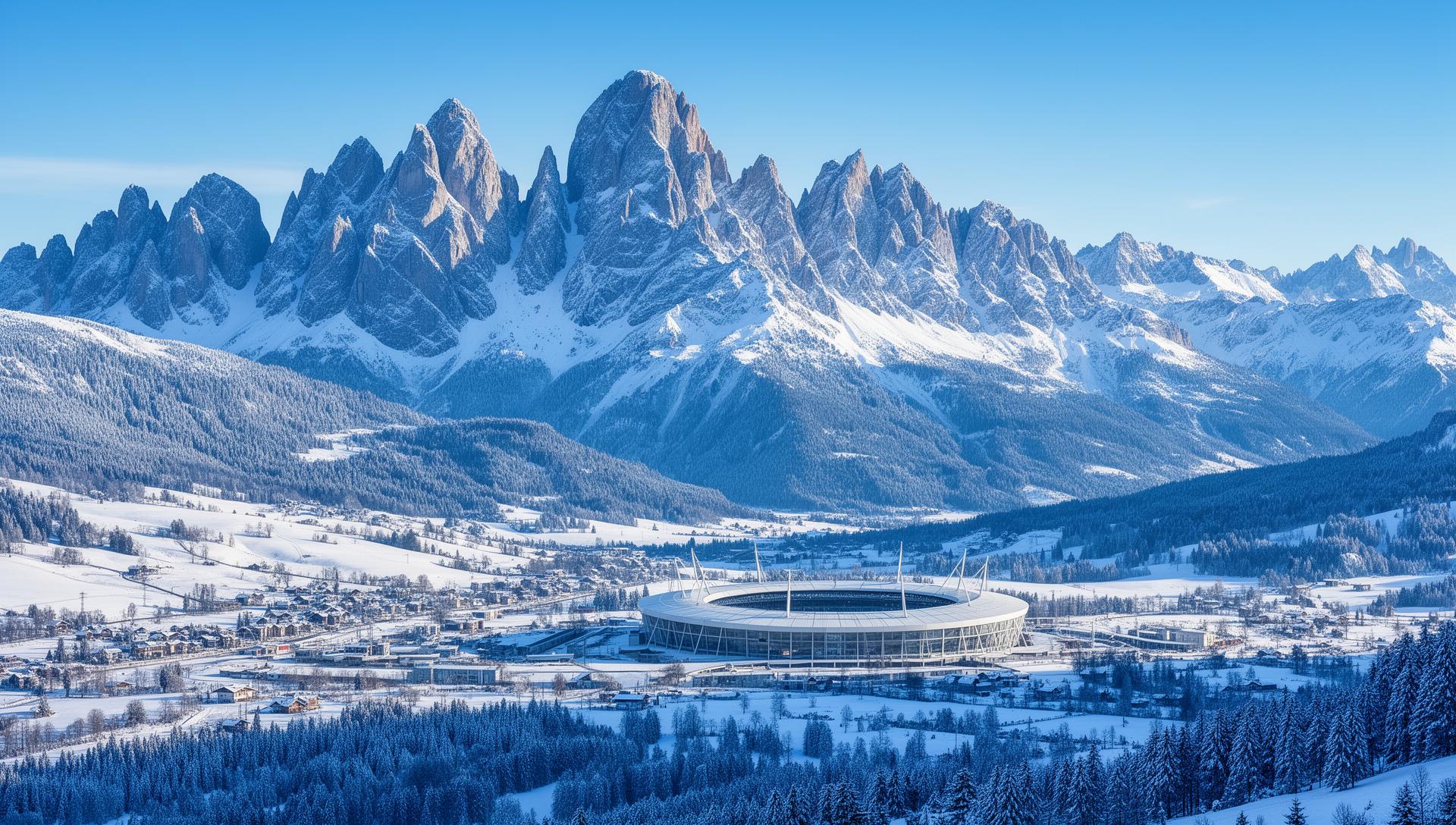
Milano Cortina 2026: The Digital Vision
Milano Cortina 2026 represents the next evolution of Olympic digital experiences, building on the groundbreaking innovations of Paris 2024 while confronting the unique challenges of a winter, multi-venue, alpine Games. With venues spanning 22,000 km² across four distinct clusters (urban Milan, alpine Cortina, mountain Livigno, and scenic Valtellina), the digital platform must be the most versatile Olympic app ever built.
The International Olympic Committee (IOC) digital strategy centers on three pillars: "Always Connected," "Always Personal," and "Always Sustainable." The Swiss Timing partnership ensures sub-second results delivery, while AWS and Google Cloud provide hybrid infrastructure for 10M+ concurrent users.
..."We're building on what Paris showed the world: that Olympic technology can be transformative, not just functional. But we face challenges Paris never had: our venues span from sea-level Milan to 2,000m Dolomites peaks."
Andrea Varnier, CEO
The €16M+ estimated investment reflects multi-venue complexity. The UNESCO World Heritage Dolomites present unique connectivity challenges, while Trenitalia integration is critical for inter-cluster transportation. Apple CoreLocation and multi-constellation GPS ensure accurate tracking even in mountain terrain.
Dolomites: Unique Technical Challenges
The Dolomites, a UNESCO World Heritage site and one of Earth's most dramatic mountain landscapes, present technical challenges that urban Olympic developers have never encountered. Building reliable mobile experiences at 2,000m altitude in sub-zero temperatures with inconsistent connectivity requires a fundamentally different approach.
Alpine Technical Challenges Matrix
| Challenge | Technical Impact | Severity | Solution Approach |
|---|---|---|---|
| Cellular Coverage | 3G/4G only above 1,500m | Critical | Offline-first + WiFi mesh |
| GPS Accuracy | Mountain multipath errors | High | Multi-constellation + differential |
| Battery Drain | -30-50% at -10°C to -20°C | Critical | Aggressive power management |
| Screen Readability | Snow glare, bright conditions | Medium | High contrast + auto-brightness |
| Touch Input | Gloved fingers | High | 56px targets + voice control |
| Device Temperature | Shutdown below -20°C | Medium | Warm phone advisories |
| Infrastructure Access | Helicopter-only sites | High | Edge computing units |
The offline-first approach requires more than simple caching. The app must function as a fully capable event companion without any network connection, including venue maps, event schedules, digital tickets, and emergency information. When connectivity returns, it must intelligently sync, prioritizing critical data (results, alerts) over background updates.
Offline-First Architecture
- Vector tile maps for all venues: zoomable without data usage, 50MB total download
- Event schedule database with 7-day pre-cache and delta sync when connected
- Digital tickets with local cryptographic validation: no server roundtrip needed
- Athlete profiles including photos cached at WiFi-available locations
- Results queue with priority sync: medal events first, then followed athletes
- Emergency information always cached: evacuation routes, medical facilities, contacts
WiFi mesh networks at each venue provide a connectivity bridge. Deployed using ruggedized outdoor access points rated to -30°C, these networks offer reliable connectivity within venue perimeters, even when cellular coverage is unavailable. The app automatically switches between cellular and WiFi mesh without user intervention.
Connectivity Strategy by Venue Type
| Venue Type | Primary | Secondary | Emergency | Offline Capability |
|---|---|---|---|---|
| Urban (Milan) | 5G | WiFi mesh | 4G fallback | Basic (connectivity reliable) |
| Alpine (Cortina) | 4G (limited) | WiFi mesh | Satellite | Full offline required |
| Mountain (Livigno) | 3G/4G | WiFi mesh | Satellite | Full offline required |
| Nordic (Valtellina) | 4G | WiFi mesh | 4G fallback | Extended offline |
| Ceremony (Verona) | 5G | WiFi mesh | 4G fallback | Basic |
AI-Powered Fan Experience Platform
Building on Paris 2024's demonstration that AI personalization drives 3x more engagement, Milano Cortina's fan platform makes AI a core architectural component rather than an add-on feature. Every interaction is personalized: content feeds, notifications, transportation recommendations, and even in-venue services.
AI Feature Set
- Smart Feed: ML-ranked content combining followed athletes, sports, and serendipitous discovery
- Predictive Alerts: Notifications triggered by ML models predicting events the user will care about
- Journey Intelligence: AI-optimized transportation routing accounting for weather, crowds, and preferences
- Auto-Highlights: Daily personalized video packages combining moments from followed athletes
- Language AI: Real-time commentary summaries in 10+ languages using NLG models
- Crowd Prediction: ML models forecasting venue capacity to help fans plan venue visits
The personalization engine operates on three layers: explicit preferences (athletes, sports, countries the user follows), implicit signals (content dwell time, interaction patterns, session timing), and contextual factors (current location, upcoming events, weather conditions). This multi-signal approach creates experiences that feel intuitively tailored.
Personalization Architecture
| Signal Type | Data Source | Processing | Application |
|---|---|---|---|
| Explicit | User selections | Real-time | Feed filtering, notifications |
| Implicit | Engagement patterns | Batch ML | Content ranking, discovery |
| Contextual | Location, time, weather | Real-time | Venue features, transport |
| Social | Friend activity | Real-time | Social recommendations |
| Predictive | Historical patterns | Batch ML | Proactive suggestions |
| Collaborative | Similar user behavior | Batch ML | Sport/athlete discovery |
On-device ML models enable personalization even when offline. Core ranking models are downloaded during setup and updated periodically, allowing the app to provide personalized content ordering and notification filtering without server communication, critical for mountain venues with limited connectivity.
Multi-Venue Transportation System
Transportation is the make-or-break feature for Milano Cortina 2026. With venues spanning from Milan (sea level) to Cortina d'Ampezzo (1,224m) to Livigno (1,816m), fans face 150+ km journeys between venue clusters via train, shuttle, cable car, and mountain road. The app must coordinate all modes seamlessly.
Transportation Integration Map
| Mode | Integration | Coverage | Real-Time Data |
|---|---|---|---|
| Trenitalia Rail | API integration | Milan-Verona-Alpine stations | Delays, platform changes |
| Olympic Shuttles | GPS tracking | All venue clusters | Position, ETA, capacity |
| Cable Cars | Schedule integration | Alpine venues | Wait times, weather status |
| Park & Ride | Availability API | All clusters | Space count, shuttle ETA |
| Local Bus | GTFS feed | Within clusters | Real-time position |
| Private Transfer | Booking integration | Point-to-point | Availability, pricing |
The journey planning algorithm considers factors unique to winter alpine travel: road conditions (snow, ice, chain requirements), visibility and weather warnings, cable car wind limits, and venue-specific security screening times. It recommends departure times that account for all variables, not just travel time.
Smart Journey Planning Features
- Weather-aware routing: automatically suggesting alternative transport when alpine roads are affected
- Security time estimation: accounting for venue-specific screening wait times based on crowd predictions
- Multi-modal optimization: combining train, shuttle, and cable car for fastest inter-cluster journeys
- Group coordination: synchronized journey planning for friends and families attending together
- Accessibility routing: wheelchair-accessible paths including lift-equipped vehicles and accessible stations
- Carbon comparison: showing environmental impact of transport choices (train vs. car vs. shuttle)
Inter-Cluster Journey Options
| Route | Distance | Best Option | Time | Weather Risk |
|---|---|---|---|---|
| Milan → Cortina | 150 km | Train + shuttle | 3-4 hrs | Medium (mountain pass) |
| Milan → Livigno | 190 km | Train + bus | 3.5-4 hrs | High (Bernina pass) |
| Cortina → Livigno | 170 km | Shuttle | 3-3.5 hrs | High (alpine roads) |
| Milan → Bormio | 200 km | Train + shuttle | 3.5-4 hrs | Medium |
| Milan → Verona | 160 km | High-speed rail | 1.5 hrs | Low (valley route) |
| Cortina → Bormio | 120 km | Olympic shuttle | 2.5-3 hrs | High |
Alpine Athlete Tracking & Results
Tracking athletes in alpine environments pushes GPS and timing technology to its limits. Ski courses descend 800-1,000 vertical meters through mountain terrain that creates GPS multipath errors, while extreme cold affects transponder batteries and sensor accuracy. The results pipeline must deliver reliable data despite these challenges.
Alpine Tracking Technology
- Multi-GNSS Receivers: GPS + GLONASS + Galileo + BeiDou for maximum satellite visibility in valleys
- Differential Correction: Base stations near courses providing real-time differential GPS correction
- Timing Gate Integration: Photoelectric sensors at intermediate points providing ground-truth timing
- Speed Radar: Doppler radar at key course sections for accurate speed measurement
- Course Overlay: Pre-mapped 3D course models with real-time athlete position overlay
- Finish Detection: Redundant finish line systems: photoelectric, pad sensor, and camera
Real-Time Results for Alpine Skiing
- Intermediate times at every timing gate (typically 5-8 per run) displayed within 500ms
- Speed measurements at key sections (typically top speed, final schuss)
- Gap to leader calculated and updated at each timing point
- Projected finish time based on current pace and remaining course profile
- Course map overlay showing athlete's current position and trail
- Historical comparison: same athlete's previous runs, course record overlay
Verona Arena: Opening Ceremony Technology
The Opening Ceremony at Verona's ancient Arena, a 2,000-year-old Roman amphitheater, presents a unique blend of heritage conservation and cutting-edge technology. Building on Paris 2024's Seine Ceremony innovation, Milano Cortina will use the Arena's spectacular setting while integrating modern digital experiences for both in-venue and remote audiences.
Verona Arena Digital Features
| Feature | Technology | Audience | Complexity |
|---|---|---|---|
| AR Heritage Overlay | ARKit/ARCore | In-venue | Historical arena visualization |
| Multi-Angle Streaming | 150+ cameras | Remote viewers | User-selectable feeds |
| Drone Light Show | 600+ synchronized drones | All | Alpine backdrop formations |
| Delegation Tracker | Real-time identification | App users | Country entry notifications |
| Second Screen | Audio sync | TV viewers | Companion content |
| Social Moments | AI-powered | All | Shareable branded moments |
Heritage Venue Technology Integration
- Non-invasive sensor mounting respecting 2,000-year-old stone architecture
- WiFi mesh deployment using temporary structures within heritage guidelines
- AR experiences revealing the Arena's gladiatorial past alongside Olympic present
- Drone light shows over the Arena with Dolomites backdrop: weather contingency essential
- Acoustic optimization for open-air amphitheater using directional speaker arrays
- 4K HDR capture maximizing the Arena's dramatic nighttime lighting
Applying Paris 2024 Lessons
Paris 2024 provided an invaluable blueprint. With 15M+ downloads and dramatically improved engagement, it demonstrated that AI personalization, city integration, and sustainability transparency aren't optional. They're expected. Milano Cortina must meet or exceed this standard while solving winter-specific challenges.
Paris 2024 → Milano Cortina 2026 Technology Transfer
| Paris Innovation | Result | Milano Cortina Adaptation |
|---|---|---|
| AI content personalization | 3x downloads vs Tokyo | On-device ML for offline personalization |
| City transit integration | 78% public transport use | Multi-mode alpine transport hub |
| 450M cyberattacks blocked | Zero disruptions | Distributed security per venue cluster |
| Sustainability dashboard | Fan behavior change | Winter-specific carbon tracking |
| 5G instant replays | Fan favorite feature | WiFi mesh-delivered at mountain venues |
| AI highlight generation | 10M+ daily packages | Athlete-focused winter sport recaps |
| Seine multi-angle ceremony | 1.5B viewers | Verona Arena heritage + modern tech |
| Digital-only ticketing | 10M+ processed | Cold-weather offline validation |
Critical Differences: Summer vs Winter
- Paris had reliable urban 5G; Milano Cortina needs offline-first for 60% of venues
- Paris venues were concentrated; Milano Cortina spans 22,000 km² requiring transport coordination
- Paris spectators had normal phone battery; cold reduces battery by 30-50%
- Paris had RATP integration; Milano Cortina needs Trenitalia + shuttles + cable cars
- Paris cybersecurity was centralized; distributed venues need autonomous security nodes
- Paris Opening was on the Seine; Verona Arena is a 2,000-year-old heritage site with restrictions
Sustainability & Environmental Platform
Milano Cortina 2026 has committed to being the most sustainable Winter Olympics ever, with environmental responsibility embedded in every aspect of the digital platform. The Dolomites UNESCO World Heritage setting demands particular care: technology must minimize environmental impact while maximizing spectator awareness.
Sustainability Technology Features
- Transport Carbon Tracker: Real-time CO2 comparison for journey choices (train: 14g/km vs car: 120g/km)
- Venue Energy Dashboard: Live energy consumption and renewable percentage for each venue
- Ski Lift Efficiency: Real-time ski lift energy usage with optimization recommendations
- Waste Monitoring: IoT-enabled waste bin fill levels with recycling rate tracking
- Food Impact: Menu carbon footprint labels with local sourcing indicators
- Snow Management: Natural vs artificial snow ratio with water usage transparency
Environmental Impact Targets
| Category | Target | Technology Enabler | Paris Benchmark |
|---|---|---|---|
| Carbon Footprint | -60% vs 2018 | IoT + AI optimization | -55% (Paris 2024) |
| Renewable Energy | 100% venues | Smart grid management | 100% (achieved) |
| Public Transport | 80%+ spectators | Integrated journey planner | 78% (Paris) |
| Paper Elimination | 99% digital | Digital tickets/programs | 98% (Paris) |
| Food Waste | -40% | Predictive ordering AI | -35% (Paris) |
| Water Conservation | -30% | IoT sensor networks | -24% (Paris) |
Investment Analysis & ROI
Milano Cortina 2026's distributed venue model drives development costs 30-50% above concentrated Games. The €16M+ estimated app investment reflects the complexity of building a platform that works seamlessly across urban Milan and alpine Dolomites, essentially two different environments in one app.
Detailed Cost Breakdown
| Component | Estimated Cost | Complexity Driver |
|---|---|---|
| Architecture & Planning | €1.5M | Multi-venue, offline-first design |
| Core App (iOS + Android) | €4M | Dual-environment UX |
| Results & Tracking | €2M | Alpine tracking challenges |
| Navigation & Maps | €1.5M | Offline maps, AR wayfinding |
| Transportation Hub | €1M | Multi-mode, weather-aware |
| Ticketing Integration | €1.5M | Cold-weather offline validation |
| Media & Video | €2M | Multi-angle, AI highlights |
| Infrastructure & Ops | €3M | Global scaling, edge computing |
| Security & Testing | €1M | Distributed security, venue testing |
| TOTAL | €17.5M+ | 30-50% premium over urban Games |
ROI Projections
- Direct revenue: €5M+ from in-app commerce, premium features, and sponsor activations
- Operational savings: €8M+ from digital ticketing, automated information services, and AI operations
- Sponsor value: €15M+ in digital activation opportunities exceeding traditional signage
- Legacy platform: €3M+/year ongoing revenue from Dolomites/Lombardy tourism platform
- Brand equity: Measurable improvement in Olympic brand perception through digital excellence
- Data assets: Audience insights informing future event planning and media rights negotiations
Post-Olympics Legacy Platform
The most compelling long-term ROI comes from transforming the Olympic app into a permanent digital asset for the Dolomites and Lombardy regions. Rather than decommissioning a €17.5M platform after 17 days, the legacy plan converts it into a year-round tourism, sports, and events companion.
Legacy Platform Transformation
| Olympic Feature | Legacy Transformation | Revenue Model |
|---|---|---|
| Venue Navigation | Ski resort & tourism maps | Venue partnership fees |
| Event Results | Historical Olympics archive | Content licensing |
| Transportation | Alpine travel planner | Booking commissions |
| Athlete Profiles | Winter sports hall of fame | Advertising, sponsorship |
| Ticketing | Regional event tickets | Transaction fees |
| Sustainability | Eco-tourism guides | Green certification |
| AI Personalization | Tourism recommendations | Hotel/restaurant partnerships |
| Social Features | Mountain sports community | Premium subscriptions |
The legacy vision extends beyond tourism. The platform can support regional winter sports development, hosting club competition results, training schedules, and youth development programs. The Olympic brand association provides lasting credibility that attracts users and partners for years after the Games conclude.
5-Year Legacy Revenue Projection
- Year 1 (Post-Games): €3M, Olympic nostalgia, venue tourism launch
- Year 2: €4M, Full tourism platform with booking integration
- Year 3: €5M, Expanded to all Dolomites resorts and Lombardy attractions
- Year 4: €4.5M, Steady state with winter/summer seasonal patterns
- Year 5: €4M, Platform maturity with stable partnership revenue
- 5-Year Total: €20.5M, Exceeding original €17.5M development investment
"The smartest Olympic digital investment isn't one that serves 17 days. It's one that serves 17 years. Milano Cortina's legacy platform can become the definitive digital companion for Alpine Italy, generating returns that dwarf the original development cost."
Chris Machetto, Sports Tech Lead
Ready to Build Your Olympic-Scale Platform?
Whether you're developing for the Winter Olympics, World Championships, or major alpine events, our team combines large-scale event expertise with cutting-edge mobile development.
1517 S Bentley Ave Suite 204, Los Angeles CA 90025