












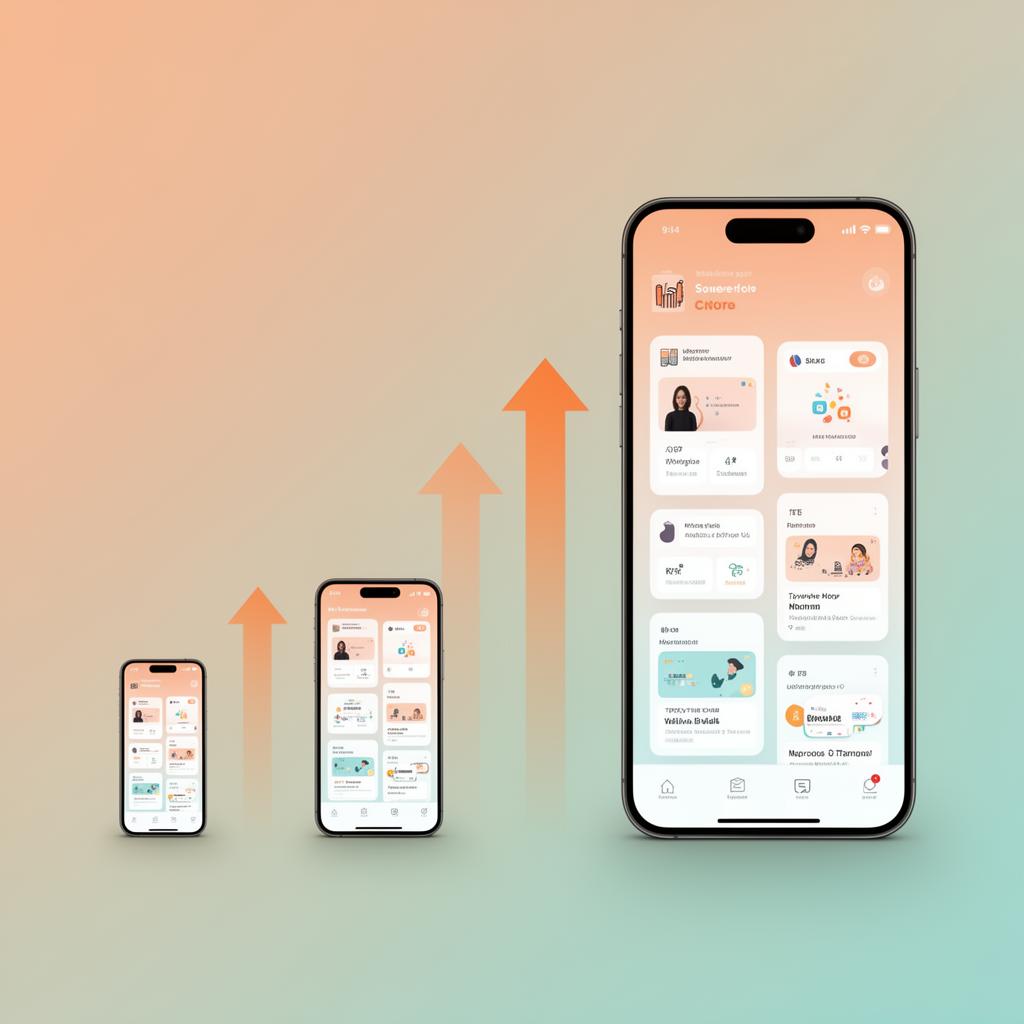
What Is a Validate-Design-Scale Agency?
Most app development agencies fall into one of three categories: validation-only consultancies that research and recommend but do not build; design-only studios that create beautiful interfaces but hand off engineering; and build-only shops that write code against your spec without questioning whether the spec is right. A validate-design-scale agency does all three, and more importantly, integrates them into a continuous loop.
The integration matters because each phase informs the others. Validation findings reshape design priorities. Design prototypes reveal validation assumptions that need testing. Scale architecture constraints influence design decisions (e.g., real-time features require different UX patterns than batch-processed ones). And post-launch usage data feeds back into validation, starting the cycle again.
Companies that integrate design, research, and engineering into continuous teams tend to outperform companies that keep them siloed. The validate-design-scale model is not a service offering. It is an organizational capability that produces compounding returns.
The Three Agency Archetypes Compared
| Archetype | Validation | Design | Engineering | Scale | Best For |
|---|---|---|---|---|---|
| Research Consultancy | Deep | None | None | Strategic only | Enterprise due diligence, investor prep |
| Design Studio | Light | Deep | None / subcontracted | None | Companies with internal engineering teams |
| Dev Shop | None | Light / your files | Deep | Limited | Well-defined products with proven demand |
| Validate-Design-Scale | Deep | Deep | Deep | Engineered from day one | Startups, new products, growth-stage companies |
Phase 1: Validation: Prove Before Building
Validation is the process of proving that your app idea solves a real problem for real users who are willing to pay, switch, or change behavior. It is not market research in the abstract. It is direct, empirical testing of the riskiest assumptions before committing engineering resources.
The four assumptions every app must validate:
- Problem validation: Do users actually have this problem? (Not 'Wouldn't it be nice if...' but 'This is painful every day.')
- Solution validation: Does your proposed solution solve the problem better than current workarounds? (Not 'This is cool' but 'I would use this instead of what I do now.')
- Willingness to pay: Will users pay money, spend time, or change habits to use your solution? (Not 'I might try it' but 'I would pay $X per month.')
- Market viability: Is the addressable market large enough to support a business? (Not 'Everyone could use this' but 'There are 100,000+ people with this problem who meet our target criteria.')
Validation methods that professional agencies use:
| Method | What It Tests | Cost | Timeline | Confidence Level |
|---|---|---|---|---|
| Generative Interviews | Problem existence and intensity | $3K-$8K | 1-2 weeks | Medium |
| Competitive Teardown | Market gaps and positioning | $2K-$5K | 1 week | Medium |
| Landing Page Test | Demand and willingness to engage | $1K-$5K | 1-2 weeks | Medium-High |
| Concierge MVP | Solution fit with real delivery | $5K-$15K | 2-4 weeks | High |
| Wizard of Oz | User behavior with manual backend | $5K-$12K | 2-3 weeks | High |
| Smoke Test (Paid Ads) | Conversion rate at target CAC | $3K-$10K | 1-2 weeks | High |
| Quantitative Survey | Problem frequency and demographics | $2K-$6K | 1-2 weeks | Medium |
The best agencies do not use one method. They triangulate. If interviews say the problem is real, a landing page test confirms demand, and a concierge MVP proves users will engage with the solution, you have high confidence. If interviews are positive but the landing page converts at 0.1%, something is wrong with your messaging, pricing, or target audience, and you have saved $200K in unnecessary development.
The core validation principle is simple: learn whether the idea works before the money runs out.
Phase 2: Design: Build for Users, Not Assumptions
Design in a validate-design-scale agency is not decoration. It is the translation of validated insights into interactive experiences. Every design decision is traceable to a research finding, a user quote, or a behavioral observation. This prevents the common failure mode where designers create interfaces that win awards but fail to solve the validated problem.
Design for scale means three things:
- Component-based design systems: Reusable UI components that can be deployed across iOS, Android, and web without redesigning for each platform. Accelerates feature delivery.
- State-driven UX: Designing for loading, error, empty, and success states, not just the happy path. Scaled products encounter edge cases that MVPs rarely see.
- Progressive disclosure: Showing users what they need when they need it. Critical for complex products where overwhelming new users with every feature kills adoption rates.
Design deliverables in a scale-ready engagement:
| Deliverable | Purpose | Scale Impact |
|---|---|---|
| User Flow Diagrams | Map every path through the product | Identifies bottlenecks before engineering |
| Wireframes | Validate layout and hierarchy | Prevents expensive visual redesigns |
| High-Fidelity Mockups | Final visual design with brand system | Creates consistent experience across platforms |
| Interactive Prototype | Test with real users before engineering | Catches UX issues before they become post-launch fixes |
| Design System | Reusable components and tokens | Enables faster feature development |
| Accessibility Audit | WCAG 2.1 AA compliance | Opens product to more users, reduces legal risk |
At Frenchy Digital, every design phase includes usability testing with 5-8 participants from the validated target audience. We do not proceed to engineering until core tasks are completable without confusion. This practice, borrowed from Nielsen Norman Group research, prevents post-launch UX issues from reaching users.
Phase 3: Scale: Engineer for Growth
Scale is where most agencies fail. They build an app that works for 100 users, celebrate launch, and discover six months later that the database locks under concurrent load, the API latency spikes to 5 seconds, and the app crashes on low-end Android devices. Scale is not an afterthought. It is an architectural discipline that starts with the first line of code.
The five dimensions of app scale:
- User scale: Handling 10×, 100×, or 1000× more concurrent users. Requires horizontal scaling, load balancing, caching layers, and database optimization.
- Feature scale: Adding new capabilities without breaking existing ones. Requires modular architecture, feature flags, and comprehensive test coverage.
- Geographic scale: Launching in new markets with localization, compliance, and infrastructure proximity. Requires multi-region deployment and i18n architecture.
- Team scale: Growing from 2 engineers to 10+ without productivity collapse. Requires clear code ownership, documented APIs, and established CI/CD practices.
- Data scale: Processing and analyzing exponentially growing datasets. Requires data pipelines, warehouse architecture, and efficient query patterns.
Scale-ready architecture decisions that validate-design-scale agencies make from day one:
| Decision | MVP-Only Approach | Scale-Ready Approach | Impact at 100K Users |
|---|---|---|---|
| Database | Single PostgreSQL instance | Read replicas, connection pooling, eventual sharding plan | Prevents slow query times |
| API Design | REST with minimal pagination | GraphQL or REST with cursor pagination, rate limiting | Prevents timeout cascades |
| File Storage | Local filesystem | Object storage (S3/Cloud Storage) with CDN | Prevents disk space crashes |
| Authentication | Simple JWT | OAuth 2.0 + refresh rotation + device management | Prevents security breaches |
| Caching | None | Redis for sessions + CDN for assets | Reduces server load |
| State Management | Local component state | Centralized state with persistence and sync | Prevents data inconsistency bugs |
Retrofitting scale costs more the longer you wait, and building it correctly initially avoids that cost. As Martin Fowler documented, technical debt taken on knowingly for speed is manageable; debt taken on unknowingly because scale was ignored becomes a crisis. Validate-design-scale agencies do not ignore scale. They engineer for it from the first sprint.
Top 12 Agencies for Validate-Design-Scale 2026
The following agencies were evaluated across six dimensions: (1) demonstrated validation practice with real user research, (2) integrated design systems in production, (3) senior engineering with scale architecture experience, (4) post-launch growth engineering capability, (5) measurable client outcomes across all three phases, and (6) references from products that achieved meaningful scale. Each was cross-referenced against Clutch, Forrester, and direct client references.
| Agency | HQ | Validation Strength | Scale Expertise | Verified Range |
|---|---|---|---|---|
| IDEO | Palo Alto, CA | Ethnographic research, human-centered design | Enterprise transformation | $500K-$5M |
| Frenchy Digital | Los Angeles, CA / Geneva, CH | Structured validation sprints, real user testing | Horizontal scaling, growth engineering | $125K-$900K |
| Work & Co | Brooklyn, NY | Product discovery, rapid prototyping | High-traffic consumer products | $500K-$3M |
| R/GA | New York, NY | Brand-driven innovation, market validation | Global rollout at scale | $750K-$5M |
| Frog Design | San Francisco, CA | Enterprise research, design thinking | Digital transformation | $1M-$10M |
| Devbridge | Chicago, IL | Agile discovery, lean validation | Enterprise SaaS scaling | $400K-$3M |
| Netguru | Poznan, PL | Lean startup methodology, MVP validation | React Native scale | $100K-$800K |
| Thoughtbot | Boston, MA | Lean UX, continuous validation | Ruby/Elixir scale patterns | $150K-$1M |
| Crema | Kansas City, MO | Product strategy workshops | Mid-market growth | $150K-$1M |
| ustwo | London, UK | Game-inspired UX, rapid iteration | Mobile-first scaling | $300K-$2M |
| Clay | San Francisco, CA | UX research, product design | Consumer app scale | $200K-$1.5M |
| Appnovation | Vancouver, CA | Open-source, digital experience | Enterprise platform scaling | $300K-$2M |
How to read this table: Validation strength reflects the depth and rigor of user research, prototype testing, and demand verification in the agency's standard process. Scale expertise reflects demonstrated ability to architect for growth, handle high traffic, and maintain performance under load. Verified range reflects confirmed project sizes from Clutch reviews and direct references.
Frenchy Digital's approach: We run 2-week validation sprints before any design or engineering contract, proving demand with real user data. Design systems are built in Figma + Storybook for component reuse across platforms. Engineering architecture plans for horizontal scaling from day one: every database decision, API contract, and caching layer is evaluated against a 10× growth scenario. Post-launch, we provide continuous growth engineering: analytics instrumentation, A/B testing, performance monitoring, and monthly feature releases. Validation from $5K; full engagements from $125K.
Validation Methods That Work
Not all validation is equal. Surveys with leading questions, interviews with friends, and landing pages sent to your Twitter followers produce false confidence. The methods below are proven, repeatable, and used by the top agencies in our list.
- Generative user interviews: 45-minute 1:1 conversations with 8-12 target users. Open-ended questions about their current behavior, pain points, and workarounds. No leading questions. Recorded, transcribed, and coded for themes.
- Competitive teardown: Systematic evaluation of 5-10 competitors across features, UX, pricing, and user reviews. Identifies gaps, opportunities, and differentiation vectors.
- Landing page smoke test: Build a simple landing page describing the product value proposition with a 'Join Waitlist' or 'Pre-order' CTA. Drive $500-$2K in paid traffic (Facebook, Google, or LinkedIn depending on audience). Measure conversion rate. A 10%+ email conversion rate signals genuine interest; under 2% suggests messaging or audience mismatch.
- Concierge MVP: Manually deliver the core value proposition to 10-20 users without building software. A meal planning app? Manually create meal plans via email. A tutoring marketplace? Manually match tutors and students. Measure retention and willingness to pay.
- Wizard of Oz prototype: Users interact with what appears to be a functioning app, but the backend is manually operated by the team. Tests user behavior and solution fit without engineering investment. Used by Airbnb and Zappos in early days.
- Fake door test: Add a button or menu item for a proposed feature in an existing product. Track click-through rate. High clicks = high demand. No clicks = do not build.
Validation Method Selection Matrix
| Stage | Goal | Best Method | Investment | Output |
|---|---|---|---|---|
| Idea stage | Is the problem real? | Generative interviews | $3K-$8K | Problem validation memo |
| Concept stage | Will anyone care? | Landing page + ads | $3K-$8K | Demand conversion rate |
| Solution stage | Does our approach work? | Concierge MVP | $5K-$15K | Retention and willingness-to-pay data |
| Feature stage | Should we build this feature? | Fake door test | $1K-$3K | Click-through rate |
| Pre-launch | Will users complete core tasks? | Wizard of Oz + usability test | $5K-$12K | Task completion rate, qualitative feedback |
Scale Architecture Principles
Scale architecture is the discipline of designing systems that grow gracefully. It is not premature optimization. It is making informed tradeoffs that prevent crisis. The principles below guide validate-design-scale agencies in every architectural decision.
- Design for 10× from day one: Every architectural decision (database schema, API structure, caching strategy) is evaluated against a 10× user growth scenario. This does not mean building for 10× users on day one; it means choosing patterns that can grow without rewrite.
- Measure everything: Instrument every user action, API call, database query, and error. Without metrics, you cannot distinguish between 'the app is slow' and 'this specific query is N+1ing.' Tools: Datadog, New Relic, or Grafana for infrastructure; Amplitude or Mixpanel for product analytics.
- Cache aggressively: 80% of scale problems are solved by caching. Static assets via CDN. Database queries via Redis. Session state via distributed cache. Compute results via memoization. The fastest query is the one you do not run.
- Decouple services: Monoliths are fine for MVPs. But as features multiply, extract bounded contexts into services with clear APIs. This prevents 'spaghetti code' where changing one feature breaks three others.
- Automate DevOps: Infrastructure as code (Terraform, Pulumi), CI/CD pipelines (GitHub Actions, GitLab CI), automated testing, and deployment automation. Manual processes break under scale because humans make mistakes under pressure.
- Plan for failure: Circuit breakers, retries with exponential backoff, graceful degradation, and health checks. At scale, individual component failures are constant. The system must survive them without user-visible impact.
Components fail at scale. The question is whether the system handles that breakage without users noticing.
Scale monitoring stack for 2026:
| Layer | Tool Category | Examples | What It Prevents |
|---|---|---|---|
| Infrastructure | APM / Observability | Datadog, New Relic, Grafana | Unknown performance degradation |
| Product | Analytics | Amplitude, Mixpanel, PostHog | Flying blind on user behavior |
| Errors | Crash Reporting | Sentry, Bugsnag, Crashlytics | User-reported bugs discovered too late |
| Uptime | Status Monitoring | Pingdom, UptimeRobot, PagerDuty | Extended outages without response |
| Security | Vulnerability Scanning | Snyk, Dependabot, OWASP ZAP | Dependency-based security breaches |
| Cost | Cloud Cost Management | Vantage, CloudHealth, Kubecost | Surprise $50K cloud bills |
Post-Launch Growth Iteration
Launch is not the finish line. It is the starting line for growth. Products that stagnate after launch lose users to competitors that iterate faster. Post-launch growth engineering is where validate-design-scale agencies demonstrate their true value: continuous improvement based on real data.
The growth iteration cadence:
- Weekly analytics review: Review funnel drop-off, cohort retention, feature adoption, and crash rates. Identify the highest-impact friction point.
- Bi-weekly A/B tests: Test one change at a time: onboarding flow, pricing page, CTA copy, feature discoverability. Run until statistical significance (95% confidence minimum).
- Monthly feature releases: Ship 1-3 features based on user feedback, usage data, and strategic priorities. Each release includes instrumentation to measure impact.
- Quarterly strategic review: Assess market expansion opportunities, competitive positioning, technical architecture health, and team scaling needs.
- Continuous monitoring: Real-time alerts for crashes, latency spikes, error rate increases, and security events. On-call rotation for response within SLA.
Growth engineering investment:
| Activity | Frequency | Team Size | Monthly Investment |
|---|---|---|---|
| Analytics & Monitoring | Continuous | 0.5-1 FTE | $8K-$15K |
| A/B Testing & Optimization | Bi-weekly | 0.5-1 FTE | $6K-$12K |
| Feature Development | Monthly releases | 2-4 FTE | $25K-$60K |
| Performance & Scale Optimization | Quarterly sprints | 1-2 FTE | $10K-$20K |
| Total Growth Engineering | N/A | 4-8 FTE | $50K-$110K/month |
At Frenchy Digital, growth iteration is not an add-on. It is a core engagement model. Clients on our growth retainer receive weekly analytics reports, bi-weekly experiment proposals, and monthly feature releases. We measure our success by your metrics: retention, conversion, and revenue per user.
Pricing Across the Lifecycle
The following ranges reflect verified 2026 market rates for validate-design-scale engagements. They are higher than build-only quotes because they include research, design systems, scale architecture, and post-launch growth engineering, capabilities that save money over the product lifetime.
| Phase | Essential | Professional | Enterprise |
|---|---|---|---|
| Validation | $5K-$15K | $15K-$40K | $40K-$100K |
| Design | $20K-$50K | $50K-$100K | $100K-$200K |
| MVP Build | $80K-$150K | $150K-$350K | $350K-$700K |
| Scale Architecture | $20K-$50K | $50K-$120K | $120K-$300K |
| Launch & Support | $10K-$25K | $25K-$60K | $60K-$150K |
| Growth Engineering (6 mo) | $60K-$120K | $150K-$350K | $350K-$700K |
| Total First Year | $195K-$410K | $440K-$980K | $980K-$2.15M |
Why invest more upfront? Because the cost of fixing a mistake grows at every later stage: cheapest in validation, more expensive in design, more expensive still in engineering, and most expensive once the product is at scale. A $30K validation investment that prevents a $300K engineering mistake has a 10:1 return. A $50K design system that prevents $200K in component rework has a 4:1 return. Validate-design-scale agencies optimize for total cost of ownership, not invoice size.
How to Vet a Scale-Capable Agency
Use this framework to evaluate whether an agency can truly validate, design, and scale, or whether they are a build shop borrowing the language.
- Request a validation case study: Can they show you a project where they proved (or disproved) market demand before building? Look for real user quotes, conversion data, and decision memos.
- Inspect their design system: Ask to see a live component library in Storybook or Figma. Count the components. Ask how it is maintained. A design system with 15 components updated quarterly is not a scale asset.
- Review architecture documentation: Ask for a sanitized architecture diagram from a scaled product. Look for caching layers, database replicas, CDN usage, and monitoring instrumentation. Vague diagrams mean vague thinking.
- Check post-launch longevity: Ask for references from clients whose products have been in production 18+ months. Ask about monthly active user growth, performance trends, and iteration velocity.
- Test their metrics literacy: Can they explain p-values, cohort retention, and statistical significance? Growth engineering requires statistical rigor. Agencies that talk about 'gut feel' are not data-driven.
- Evaluate their monitoring stack: What tools do they use for observability, analytics, error tracking, and cost management? If they do not have opinions, they do not operate at scale.
10 Red Flags to Avoid
These warning signs predict engagements where validation is skipped, design is superficial, and scale is an afterthought. More than two red flags means you are talking to a build shop, not a growth partner.
- No validation phase: They want to start designing or coding immediately. This means they are not interested in whether your product succeeds, only in billing hours.
- Validation by assumption: 'We know your market' or 'We have built similar apps before.' Every product has unique user dynamics. Past experience informs; it does not replace research.
- Design without research: Mockups are created before user interviews. The designs may be beautiful, but they solve problems the agency imagined, not problems users confirmed.
- No design system: Every screen is a one-off. Adding a new feature requires redesigning basic components. This is not sustainable at scale.
- Scale ignored until 'we have users': Architecture decisions made for speed create 5-10× debt. By the time users arrive, the system is already fragile.
- No post-launch engagement model: The contract ends at launch. There is no plan for analytics, iteration, or growth engineering. The product is abandoned at its most critical moment.
- Cannot show scaled products: Their portfolio shows launches but no growth data. No MAU charts, no retention curves, no performance benchmarks.
- Subcontracted engineering: The agency designs but outsources development to undisclosed teams. Quality control, communication, and accountability all suffer.
- Fixed-price promises on undefined scope: 'We will build your app for $75K' before understanding what 'your app' means. This guarantees either cut corners or change-order warfare.
- No monitoring or observability plan: The agency has no opinion on analytics tools, error tracking, or performance monitoring. They are not building for operational reality.
Frequently Asked Questions
These questions represent the most common concerns from founders and product leaders evaluating validate-design-scale partners for the first time.
Building Products That Last
The validate-design-scale model is not a marketing label. It is a survival strategy. In a market where 42% of products fail because no one wants them, validation is not optional. In a market where users abandon slow, buggy, or confusing apps almost immediately, design is not cosmetic. In a market where successful products can grow faster than expected, scale architecture is not premature optimization. It is table stakes.
The agencies in this guide represent the top tier of integrated product partners. They do not just build apps; they prove demand, design for humans, and engineer for growth. They measure success in business outcomes (retention, revenue, and market expansion), not deliverables checked off a list.
Choosing the right partner is the most consequential decision in your product journey. Use the vetting framework. Check for red flags. Demand evidence of validation, design systems, and scale architecture. The right agency will welcome your scrutiny because they have nothing to hide.
At Frenchy Digital, we have built our practice on validate-design-scale integration. Every engagement starts with a validation sprint that proves or disproves demand before a single line of code is written. Design systems are engineered for reuse across platforms. Architecture is evaluated against 10× growth scenarios. And post-launch, we stay as your growth partner: measuring, testing, and iterating until your product achieves the scale it deserves. Validation from $5K. Full engagements from $125K. Book a free 30-minute discovery call and let us prove the model works, starting with your idea.
Building an app you plan to scale?
Book a free 30-minute discovery call with Frenchy Digital. We will validate your idea, design your growth architecture, and map your scaling roadmap, whether or not you work with us.
1517 S Bentley Ave Suite 204, Los Angeles CA 90025
Frequently Asked Questions
Sources & References
- 1CB Insights: Top 20 Reasons Startups Fail↗
- 2Forrester: The ROI of UX Design↗
- 4Martin Fowler: Technical Debt Quadrant↗
- 5Clutch: Top Product Design & Development Companies↗
- 6Y Combinator: How to Build Product↗
- 7Nielsen Norman Group: UX Research Methods↗
- 8AWS: Architecture for Scale Best Practices↗
- 9Google SRE Book: Site Reliability Engineering↗
- 10First Round Review: Product-Market Fit Guide↗